Tag: music catalogs

  • Why Artists Should Treat Their Music Catalog Like a Family Business

    There’s a quiet shift happening in the music industry — and most artists are missing it.

    For decades, the dream was simple: write great songs, get famous, and eventually cash out. Sell the catalog, take the money, and move on.

    But that model is starting to look short-sighted.

    Because a music catalog isn’t just a collection of songs.

    It’s a cash-flowing asset. A brand. A long-term business.

    And the artists who understand that are starting to think very differently.


    🎸 The Old Model: Build, Peak, Sell

    Historically, artists treated their catalog like a final paycheck.

    You build value over time:

    • Release albums
    • Generate hits
    • Accumulate royalties

    Then one day, you sell:

    • Private equity firm
    • Music publisher
    • Label-backed fund

    We’ve seen this play out again and again:

    • Bob Dylan sells publishing
    • Bruce Springsteen sells masters
    • Stevie Nicks sells catalog stake

    From a financial perspective, it makes sense:

    • Immediate liquidity
    • Risk transfer
    • Estate simplicity

    But here’s the problem:

    You’re selling the one asset that can pay you — and your family — forever.


    💰 The New Reality: Catalogs Are Perpetual Cash Machines

    Streaming changed everything.

    In the past, revenue was front-loaded:

    • Album sales
    • Radio play
    • Touring cycles

    Now, catalogs generate ongoing, compounding income:

    • Spotify / Apple Music streams
    • YouTube monetization
    • Sync licensing (film, TV, ads)
    • Algorithmic discovery

    A song released 30 years ago can still produce meaningful revenue today — sometimes more than when it was released.

    That’s why albums like:

    • Legend
    • Greatest Hits

    continue to generate millions annually.

    These aren’t just albums anymore.

    They’re income-producing portfolios.


    🧠 The Mental Shift: From Artist to Asset Owner

    This is where things get interesting.

    The artists who win long-term don’t just think like creators — they think like owners.

    Instead of asking:

    “How much can I sell this for?”

    They ask:

    “How much can this generate over 30–50 years?”

    That’s a completely different mindset.

    It’s closer to:

    • Real estate investing
    • Dividend stocks
    • Private equity hold strategies

    And it leads to a different conclusion:

    Selling your catalog might be the least optimal move.


    🏛️ The Family Business Model

    Think about a music catalog like a family-owned company.

    You wouldn’t sell a profitable business that:

    • Requires minimal overhead
    • Generates recurring revenue
    • Appreciates over time

    You’d:

    • Protect it
    • Grow it
    • Pass it down

    Music catalogs work the same way.

    A well-managed catalog can:

    • Fund education for future generations
    • Provide consistent income
    • Increase in value as platforms expand

    A hit song isn’t just a moment. It’s an annuity.


    ⚖️ Why Some Artists Still Sell

    To be fair, selling isn’t always wrong.

    There are legitimate reasons:

    • Estate planning complexity
    • Tax optimization
    • Lack of management infrastructure
    • Desire for immediate liquidity

    But increasingly, those decisions are being made under pressure from:

    • Private equity firms
    • Catalog aggregators
    • Institutional buyers

    And those buyers are betting on one thing:

    That the catalog is worth more in the future than what they’re paying today.


    🎯 The Strategic Alternative: Partner, Don’t Sell

    Instead of selling outright, artists have more options than ever:

    • Partial sales (retain control)
    • Joint ventures (share upside)
    • Administration deals (outsource management)
    • Licensing optimization (increase revenue without selling)

    This is where the smartest artists are going.

    They’re treating their catalog like:

    A business to operate — not an asset to exit.


    🔥 The Hidden Opportunity

    Here’s the bigger picture — and it’s where things get really interesting.

    Most artists are:

    • Undermanaging their catalog
    • Undermonetizing their rights
    • Ignoring long-tail value

    Which means there’s a massive opportunity for:

    • Consultants
    • Analysts
    • Operators

    To step in and treat catalogs like:

    • Data assets
    • Financial instruments
    • Strategic businesses

    🟡 Final Thought

    For years, the industry taught artists to chase hits.

    But the real game isn’t hits.

    It’s ownership.

    A catalog isn’t a payday. It’s a dynasty.

    And the artists who understand that will build something far more valuable than a moment of success.

    They’ll build something that lasts.
  • How Music Catalogs Are Really Valued

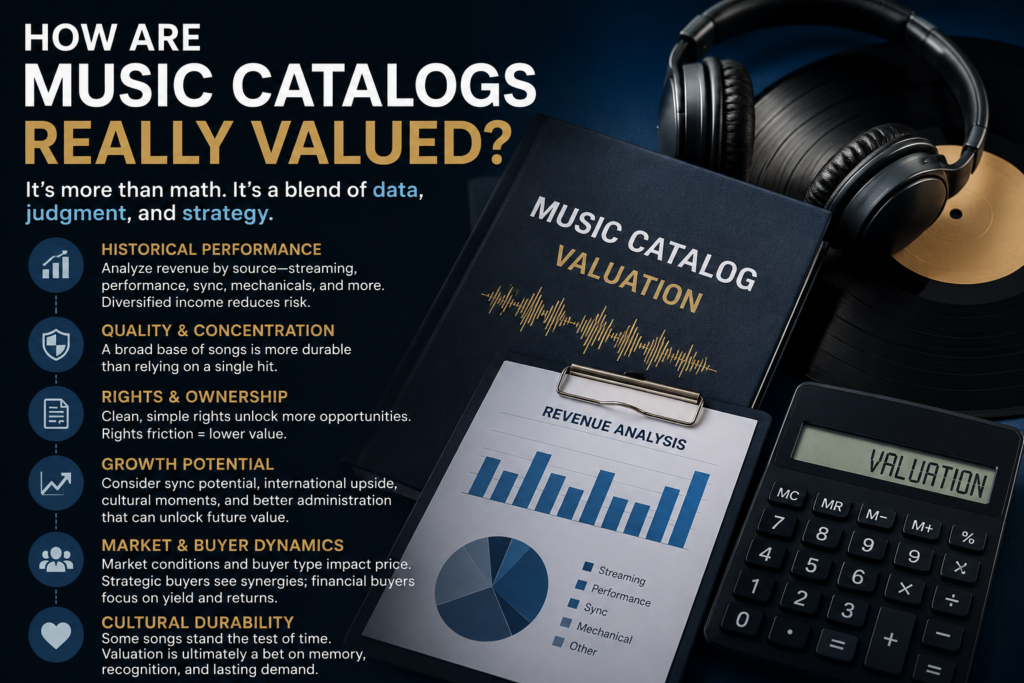
    Music catalog valuation looks simple from the outside. A buyer studies the royalty statements, decides what the songs have earned, puts a multiple on that income, and arrives at a price. In reality, it is far messier. A catalog is not a factory with fixed outputs. It is a living asset shaped by consumer taste, licensing activity, artist reputation, platform shifts, and how actively the rights are managed. That is why the best way to understand valuation is to think of it as a blend of math, judgment, and strategy.

    The first layer is historical performance. Buyers want to know what the catalog has actually done, not what someone hopes it might do. That means looking closely at the last several years of revenue by source. Streaming is usually the headline number because it is visible, recurring, and easy to model. But streaming is only one part of the picture. Performance income, mechanicals, sync licensing, neighboring rights, and other revenue streams can all matter. A catalog with diversified income is often more attractive than one that depends almost entirely on a single source. Diversification lowers risk and gives the buyer more confidence that a sudden change in one channel will not break the investment thesis.

    The second layer is quality of income. Not every dollar is equally valuable. If a catalog’s earnings come from a broad base of songs that continue to show up year after year, that is different from a catalog where one song carries everything. Concentration risk matters. A catalog built on one monster track can still be valuable, but the valuation process has to account for the possibility that interest in that one song fades. A deeper catalog with multiple recognizable works may look less flashy on paper but can be more durable over time.

    Then there is the question of rights. Are you buying publishing, masters, or both? Do the songs have straightforward ownership, or are there samples, multiple writers, conflicting approvals, and legacy complications? Rights friction can reduce value because it slows down monetization. A film and television supervisor wants a clean path. If every placement turns into a multi-party negotiation, some opportunities disappear before they begin. In other words, two songs with similar streaming profiles can have different valuations because one is easier to exploit commercially.

    Another major input is growth potential. Buyers do not pay only for what happened yesterday. They are trying to estimate what the catalog can earn tomorrow. That is where the process gets subjective. Can the catalog benefit from sync licensing? Is there international upside? Does the artist have an anniversary, documentary, biopic, or cultural reappraisal on the horizon? Could better administration or marketing unlock value that the current owner never pursued? Those questions matter because a buyer is not just buying income; they are buying the right to operate the asset better.

    Still, buyers have to be careful not to overpay for upside that may never arrive. A biopic, viral rediscovery, or social media resurgence can meaningfully lift a catalog, but those events are hard to predict with confidence. You cannot build an investment case entirely on wishful thinking. That is why seasoned buyers usually separate the base case from the blue-sky case. The base case depends on what the catalog is already proving in the market. The upside case is where smart operators can outperform, but it should not be the only reason the deal works.

    Music Catalogs Valuations

    Market conditions matter too. In a hot market, buyers may stretch on multiples because they believe music rights are scarce, attractive, and resilient. In a colder market, underwriting gets tougher and assumptions get stricter. Investor sentiment, interest rates, and access to capital all influence what feels like a reasonable price. A catalog is not valued in a vacuum. It is valued in a competitive market where different buyers have different cost-of-capital structures and different exit expectations.

    That brings up another overlooked issue: not every buyer values the same catalog the same way. A strategic music company may pay more than a financial buyer because it can integrate the rights into a broader platform. It may already have sync teams, global infrastructure, label relationships, and marketing channels that create incremental value. A private equity-style buyer, by contrast, may be more disciplined about cash yield and hold period. One sees synergies. The other sees return thresholds. Both are evaluating the same songs, but they are not solving for the same outcome.

    There is also a human element. Cultural relevance is difficult to reduce to a spreadsheet. Some songs have an emotional permanence that numbers only partially capture. They keep resurfacing at weddings, in stadiums, on classic playlists, in movie trailers, and in new generations’ listening habits. Catalog investors are ultimately making a bet on memory, recognition, and recurring demand. They are asking whether people will keep caring.

    So how are music catalogs really valued? By looking backward at revenue, sideways at risk, and forward at possibility. Historical cash flow sets the floor. Rights quality, concentration, licensing potential, and operational strategy shape the premium or discount. Market conditions and buyer type influence the final price. The spreadsheet matters, but so does judgment. That is why catalog valuation is never just arithmetic. It is the art of deciding how much cultural durability is worth in financial terms.