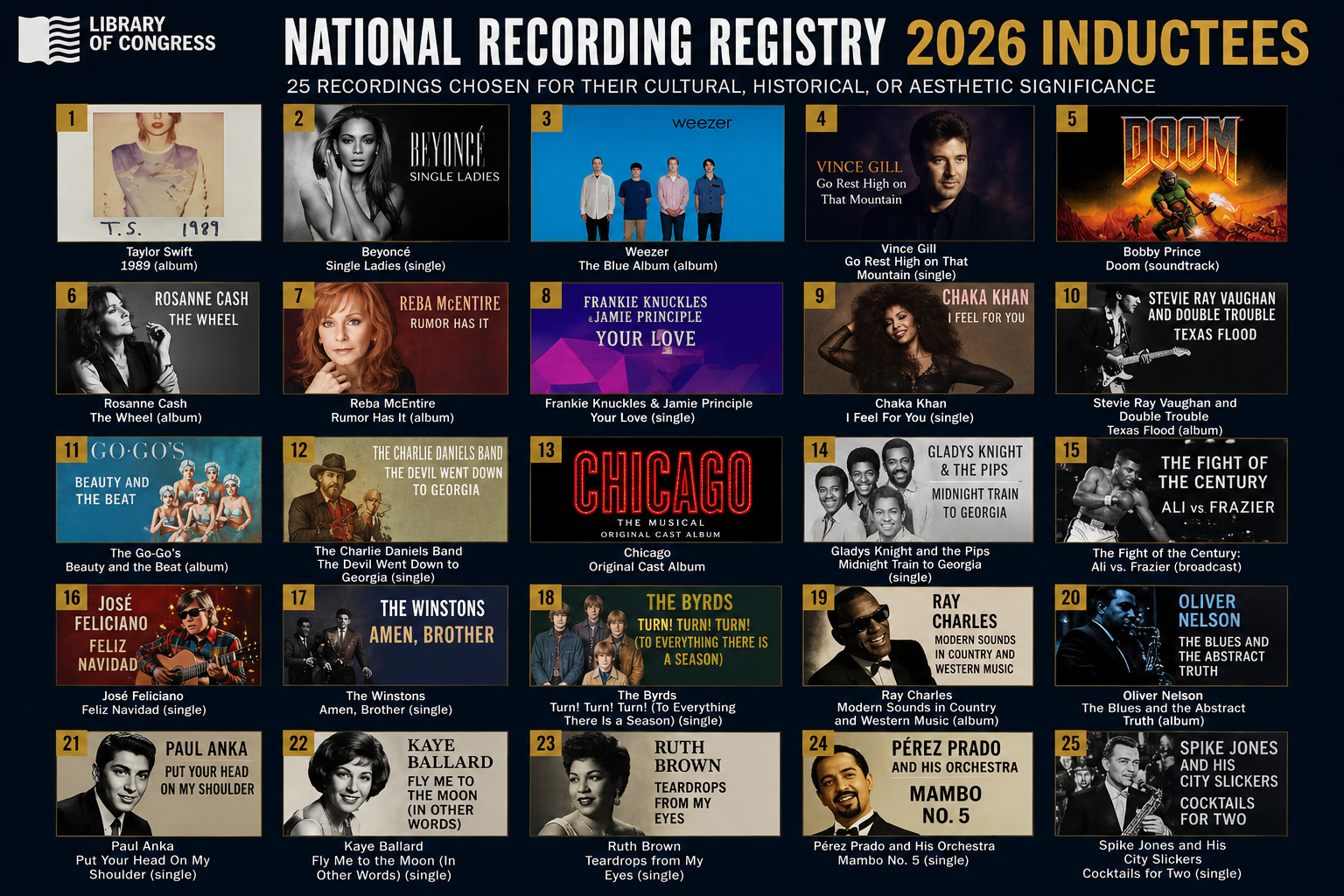
The Library of Congress has announced the newest class of recordings entering the 2026 National Recording Registry — a yearly preservation effort designed to protect audio recordings deemed “culturally, historically, or aesthetically significant.”
This year’s list is a fascinating mix of blockbuster pop, country standards, jazz landmarks, dance music pioneers, video game history, Broadway, classic broadcasts, and deeply influential catalog recordings that continue to shape streaming, licensing, sampling, and music culture decades later.
For artists, estates, labels, publishers, and catalog investors, induction into the Registry can reinforce the long-term cultural durability of a recording. These are the kinds of works that continue generating value through:
Streaming
Sync licensing
Sampling
Reissues
Vinyl demand
Film and television placement
Cultural rediscovery cycles
Social media resurgence
Many of these recordings are already deeply embedded into the American cultural bloodstream. Others may receive a renewed spotlight because of the induction itself.
In an era where catalog value increasingly depends on longevity, discoverability, and cross-generational relevance, the National Recording Registry acts almost like an institutional validation of permanence.
The Biggest Takeaways From 2026 National Recording Registry 2026 Class
1. Catalog Longevity Beats Recency
The inclusion of 1989 stands out because it is one of the newest recordings ever inducted.
That’s significant.
The Registry traditionally leans heavily toward older recordings whose historical importance has already stood the test of time. The rapid inclusion of 1989 signals how quickly modern blockbuster pop albums can become culturally foundational.
It also reinforces the staying power of superstar catalogs in the streaming era.
2. Video Game Music Is Now Officially Canon
The induction of the Doom soundtrack is another major moment.
Video game music is no longer niche nostalgia. It is now formally recognized as part of America’s recorded cultural history.
That matters because gaming soundtracks increasingly function like traditional entertainment IP:
Streaming assets
Live performance material
Vinyl collectibles
Licensing opportunities
Fan-community engagement engines
Gaming catalogs are becoming real catalog businesses.
3. Dance Music’s Architects Are Finally Getting Their Due
Frankie Knuckles and Jamie Principle’s Your Love represents a huge acknowledgment of house music’s foundational influence.
Chicago house music helped shape modern EDM, pop production, remix culture, and club music economics globally.
The Registry recognizing dance music history reflects how electronic genres have moved from underground subculture into institutional legitimacy.
4. Sampling History Continues to Matter
The inclusion of Amen, Brother by The Winstons is especially fascinating.
The track contains the famous “Amen Break” — one of the most sampled drum breaks in music history.
That single recording influenced:
Hip-hop
Jungle
Drum and bass
Electronic music
Modern beat production
One drum pattern became a foundational building block for entire genres.
Few examples better demonstrate how catalog value can compound in unpredictable ways over decades.
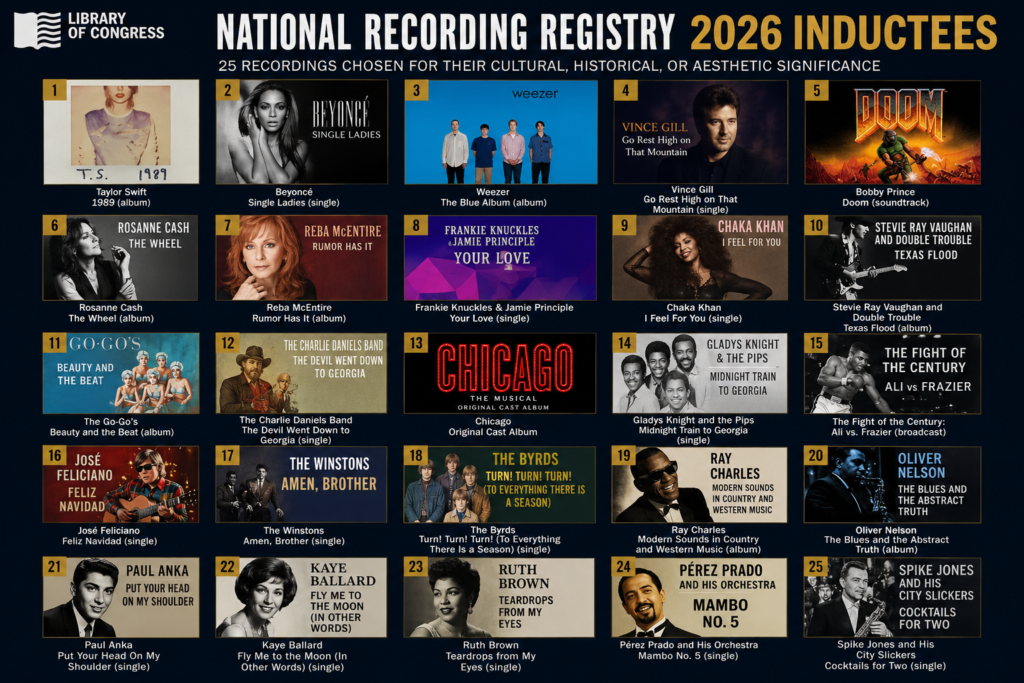
The Full 2026 National Recording Registry Class 1989 — Taylor Swift Single Ladies (Put a Ring on It) — Beyoncé Weezer (The Blue Album) — Weezer Go Rest High on That Mountain — Vince Gill Doom soundtrack — Bobby Prince The Wheel — Rosanne Cash Rumor Has It — Reba McEntire Your Love — Frankie Knuckles & Jamie Principle I Feel for You — Chaka Khan Texas Flood — Stevie Ray Vaughan and Double Trouble Beauty and the Beat — The Go-Go’s The Devil Went Down to Georgia — The Charlie Daniels Band Chicago Original Cast Album Midnight Train to Georgia — Gladys Knight & the Pips The Fight of the Century broadcast Feliz Navidad — José Feliciano Amen, Brother — The Winstons Turn! Turn! Turn! (To Everything There Is a Season) — The Byrds Modern Sounds in Country and Western Music — Ray Charles The Blues and the Abstract Truth — Oliver Nelson Put Your Head on My Shoulder — Paul Anka Fly Me to the Moon — Kaye Ballard Teardrops from My Eyes — Ruth Brown Mambo No. 5 — Pérez Prado and His Orchestra Cocktails for Two — Spike Jones and His City Slickers
Final Thought
The Registry increasingly reflects a broader definition of what matters culturally.
Rock, pop, jazz, country, hip-hop-adjacent sampling culture, dance music, gaming audio, Broadway, holiday music, and sports broadcasting now all sit under the same preservation umbrella.
That evolution mirrors what’s happening in the catalog business itself.
The modern catalog economy is no longer just about classic rock radio. It’s about multi-format intellectual property that can survive format changes, platform shifts, and generational turnover.
And the recordings that survive longest tend to become the most valuable.
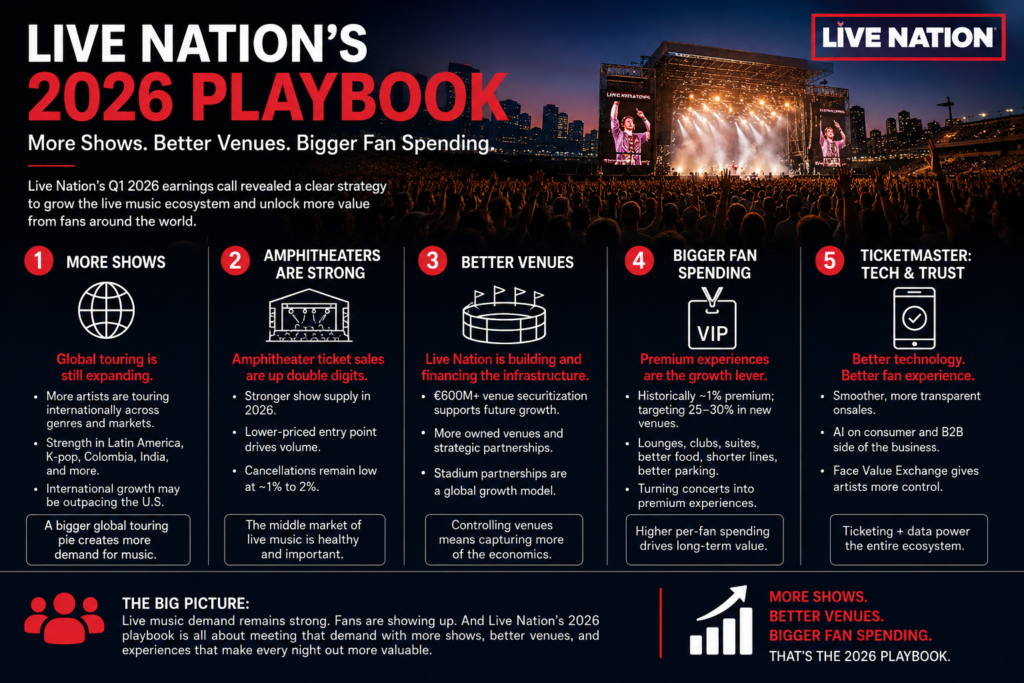
The short version: Live Nation is not just betting on more concerts. It is betting on a bigger live music ecosystem — more global touring, more stadium and amphitheater activity, more owned and partnered venues, better ticketing technology, and higher per-fan spending through premium experiences.
For the music business, that matters. For catalog owners, labels, artists, investors, and anyone watching the economics of music, Live Nation’s call was a reminder that streaming is only one piece of the puzzle. The real money is often built around the fan relationship.
Live music is where that relationship becomes visible.
More Shows: The Global Touring Machine Keeps Expanding
One of the strongest messages from Live Nation management was that global concert supply remains healthy.
CEO Michael Rapino said more artists are touring globally, and that the live music “pie” continues to grow. He pointed to global supply from regions and genres including Latin America, K-pop, Colombia, India, and other international markets. In his view, more artists from more parts of the world are now able to tour across clubs, theaters, arenas, festivals, and stadiums.
That is an important point. Live Nation is not framing growth as dependent on one superstar tour or one geography. The company is talking about a broader, more globalized touring market.
For Catalogs and Cash, this is the key idea: music catalog value becomes more interesting when the audience becomes global.
An artist’s catalog is not just a static bundle of songs collecting streaming royalties. It can become part of a much larger commercial system. Touring can reintroduce fans to older songs. Festivals can expose legacy acts to younger audiences. International markets can create new demand for music that may have already matured in the U.S. or Europe.
The more global the fan base becomes, the more ways there are to monetize the music.
Amphitheaters Are Back in the Story
Live Nation also spent time addressing amphitheaters, which had been a concern in the prior year. Rapino said the company has stronger amphitheater supply in 2026, and that ticket sales are tracking ahead of last year by double digits. He also pushed back on concerns about cancellations, saying the company typically sees a 1% to 2% cancellation rate and that 2026 does not look unusual.
That matters because amphitheaters occupy an important middle lane in the concert business.
Not every artist is a stadium act. Not every catalog is attached to a mega-star. But there is a lot of durable value in artists who can consistently fill amphitheaters, theaters, clubs, and festivals.
Amphitheaters also have a pricing advantage. Rapino described them as a lower-cost entry point compared with arenas and stadiums. That makes them a volume business. For fans who may not want to spend stadium-level money, amphitheaters offer a more accessible live music experience.
This is where the long tail of the music business becomes interesting. Legacy rock acts, country artists, jam bands, alternative bands, nostalgia tours, and multi-act summer packages can all fit into this model.
A catalog does not need to dominate Spotify to have commercial value. Sometimes the better question is: Can this music still move people out of the house?
If the answer is yes, there may be more value there than the streaming chart suggests.
Better Venues: Live Nation Wants More Control of the Infrastructure
The second part of Live Nation’s playbook is venue strategy.
Live Nation is not just promoting shows. It is building, buying, financing, and partnering around venues. CFO Joe Berchtold discussed a venue securitization transaction of just over €600 million, using certain venues as collateral. He described the company’s venue strategy as having something like a property-company/operating-company structure, while still keeping the assets under one roof.
That may sound technical, but the business idea is simple: venues are strategic assets.
If Live Nation controls more of the venue footprint, it can capture more of the economics around the concert. That includes ticketing, sponsorship, food and beverage, premium experiences, parking, hospitality, and long-term fan data.
This is one of the most important ideas in the modern music business: the money is not only in the music itself. It is in the infrastructure around the music.
A song gets the fan interested. The artist gets the fan emotionally committed. The venue turns that attention into a night out. The ticketing platform captures the transaction. The premium experience increases the spend. The sponsor attaches a brand to the moment.
That is the full stack of live music monetization.
Stadium Partnerships Could Become a Global Growth Model
Live Nation also discussed stadium partnerships in Argentina, including arrangements involving Club Atlético and River Plate Stadium. Rapino said the company likes partnering with stadiums globally because many of them are underused compared with NFL-style venues in the U.S.
That is a very interesting model.
Instead of always building from scratch, Live Nation can partner with existing stadiums, bring concerts into the building, add sponsorship expertise, and sometimes provide capital. This can be less capital-intensive than owning or building every venue outright, while still allowing Live Nation to lock up important revenue streams.
For the music industry, this points to a broader trend: live music is becoming more professionalized, more global, and more infrastructure-driven.
For catalog investors, this matters because a stronger live infrastructure can extend the life of music assets. If older artists, reunion tours, tribute events, anniversary shows, and festival appearances become easier to route and monetize globally, then catalogs tied to those artists may have more ways to stay culturally and commercially relevant.
Bigger Fan Spending: Premium Is the Growth Lever
The most interesting part of the call may have been Live Nation’s comments on premium fan experiences.
Rapino said concerts have historically been roughly 99% general admission or standard experience and only 1% premium. But Live Nation sees an opportunity to change that. He said some new arenas could have up to 30% of the house in a premium capacity, while amphitheaters could move from low-single-digit premium levels toward 25% premium.
That is a major shift.
Live Nation wants concerts to look more like sports venues. That means better parking, shorter lines, better food and beverage, hospitality rooms, suites, boxes, lounges, and upgraded experiences.
This makes sense. Fans are not only paying for music. They are paying for the night.
The seat matters. The parking matters. The line matters. The drink matters. The bathroom matters. The ability to avoid chaos matters.
For younger fans, the concert may be a social-media-worthy experience. For older fans, comfort may be the reason they are willing to attend at all. A 50-year-old fan who loves a legacy artist may not want to fight lawn traffic, wait in long lines, or stand all night. But that same fan may pay more for a better experience.
That creates a huge opportunity around legacy catalogs.
Older catalogs often have older fans. Older fans often have more disposable income. If Live Nation can improve the premium experience, it can increase per-fan spending without needing every fan to be a teenager streaming songs all day.
That is a very different way to think about catalog value.
Ticketmaster Is Still Central to the Strategy
Ticketmaster also came up repeatedly on the call.
Rapino said the company is focused on making the onsale process smoother, more transparent, and more confidence-building for fans. He also mentioned using AI on both the consumer side and the B2B side, while building out tools like Face Value Exchange for artists.
Berchtold added that Ticketmaster is using newer approaches, including AI tools, to move faster in markets like Latin America, Asia, and Japan.
The strategic point is clear: ticketing is not just a transaction layer. It is part of the fan relationship.
Who controls the ticketing experience controls a valuable part of the music economy. That company sees demand, pricing, geography, artist strength, fan behavior, and purchase intent.
For artists and catalog owners, this matters because fan data is becoming one of the most important assets in music. A catalog tells you what people listen to. Ticketing tells you what people will leave the house and pay for.
Those are not the same thing.
No Demand Pullback — At Least Not Yet
Live Nation also addressed the big investor question: are consumers pulling back?
Rapino said the company is not seeing a demand slowdown across genres, demographics, geographies, venue types, or price points. He pointed to everything from club shows to amphitheaters to expensive stadium shows and said demand remains strong.
That is a powerful statement, especially in an economy where people keep looking for signs of consumer weakness.
Live music appears to remain a priority. Fans may cut back elsewhere, but the concert is still a major social event. For some fans, it may be one of the few big nights out they plan around all year.
That supports a broader thesis: music remains emotionally durable.
People may change how they consume it. They may shift from CDs to downloads to streaming to short-form video. But the desire to gather around music has not disappeared.
In some ways, it may be stronger because so much of modern life is digital. The live show is physical, social, scarce, and memorable.
That is why it commands pricing power.
The Catalogs and Cash Takeaway
Live Nation’s 2026 playbook is simple:
More shows. Better venues. Bigger fan spending.
But underneath that is a bigger music business lesson.
The value of music is not limited to streaming royalties. Music creates identity, memory, community, and live demand. The companies that can turn that demand into experiences, venues, sponsorships, ticketing, hospitality, and global touring routes are building around the music in ways that can be extremely valuable.
For catalog investors, this should matter.
A catalog is not just a spreadsheet of historical royalties. It is a living asset connected to fan behavior. If the artist can tour, if the music can support a festival slot, if the fan base has spending power, if the songs still create emotional pull, then the catalog may have value beyond passive streaming income.
Live Nation’s call showed that the live music economy still has momentum. The company is investing in venues, expanding globally, improving ticketing, and trying to increase per-fan monetization through premium experiences.
That is not just a concert story.
That is a music asset story.
Bottom Line
Live Nation’s Q1 2026 call was a reminder that the music business is bigger than the stream count.
Streaming tells us what people play. Concerts tell us what people will pay for. Venues show where the money gets captured. Premium experiences show how much more the night can be worth.
And that is the real Catalogs and Cash lesson: the future of music value may belong to the companies that understand not only the song, but the entire economy around the fan.
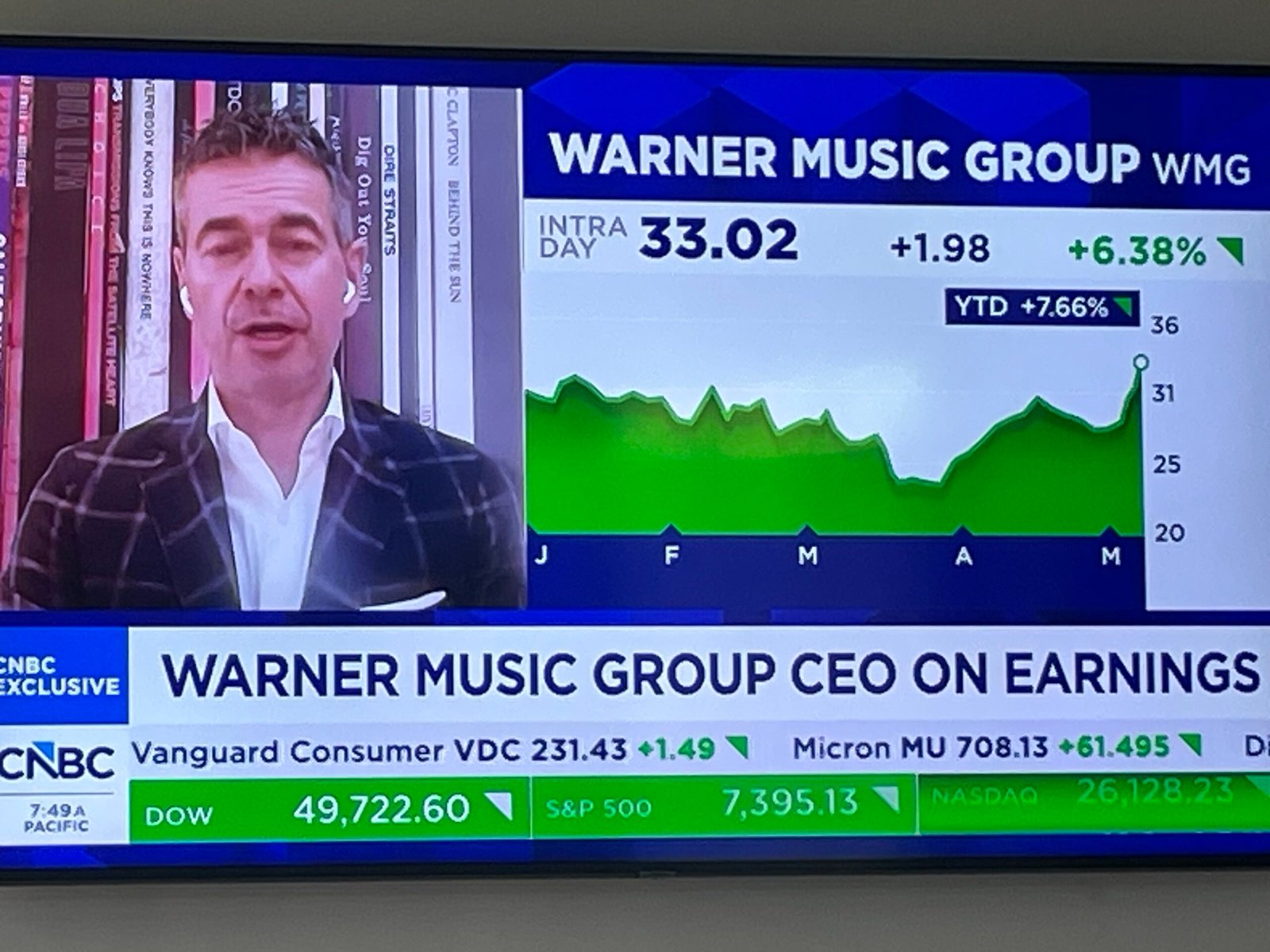
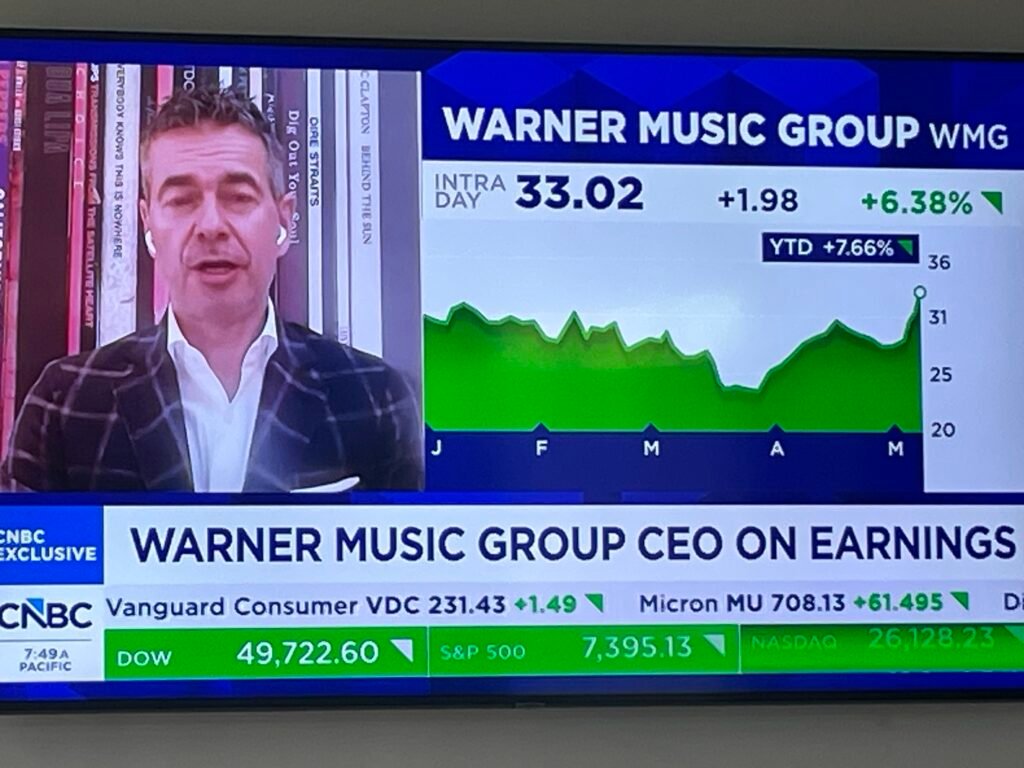
Artificial intelligence was one of the dominant themes during Warner Music Group’s latest earnings call, and CEO Robert Kyncl made it clear the company sees AI as a major growth opportunity — not just a threat.
Rather than framing AI as something the music industry must simply defend against, Kyncl repeatedly described AI as a tool that can expand engagement, improve efficiency, create new revenue streams, and increase the value of music catalogs.
Here are the biggest takeaways from his comments.
Warner Says AI Is Already Improving Catalog Monetization
One of the most revealing parts of the call was Kyncl explaining how Warner is already using AI operationally.
He said Warner has developed AI tools that help the company create:
motion art
visualizers
lyric videos
marketing assets
…quickly and cost-effectively across its enormous music catalog.
That matters because Warner’s catalog includes more than:
1 million tracks
70,000 artists
Historically, labels could only economically market a small percentage of their catalog at scale. AI changes those economics dramatically.
Kyncl explained that Warner is also using proprietary AI models to help determine where marketing resources should be focused, allowing the company to deepen monetization of older music.
In practical terms, AI may allow labels to continuously revive and repackage older songs for new audiences at a much lower cost than before.
Warner Believes AI Can Increase the Value of Music
Kyncl repeatedly emphasized that Warner’s strategy is focused on “increasing the value of music.”
One of the ways the company plans to do that is through:
AI partnerships
premium streaming tiers
interactive fan experiences
Warner specifically discussed working with streaming platforms and emerging AI companies on:
AI-powered subscription tiers
enhanced fan engagement
higher-priced offerings
The broader implication is that streaming could evolve beyond passive listening into something more interactive.
That could eventually include:
remix functionality
fan participation tools
AI-assisted music creation
personalized listening experiences
The company appears to believe consumers will pay more for deeper engagement with music.
Warner’s Partnership With Suno Was A Major Focus
Kyncl highlighted Warner’s licensing relationship with Suno as an example of the company’s AI strategy in action.
Rather than attempting to completely shut down AI music platforms, Warner appears to be pursuing a more pragmatic approach:
licensing
monetization
copyright protection
participation in future growth
Warner said Suno currently has:
roughly 2 million subscribers
an average monthly spend of approximately $12.50
The company also noted that Suno is reportedly generating around $300 million in annualized revenue.
Those figures suggest there is already meaningful consumer demand for AI-powered music experiences.
Warner Says AI Music Has Had “Minimal Dilutive Impact”
One of the more interesting comments from Kyncl involved concerns that AI-generated music could flood streaming services and reduce the value of professionally created music.
According to Warner, major DSPs have reported that most AI-generated uploads are currently seeing:
very limited engagement
minimal impact on overall streaming economics
Kyncl also emphasized that Warner is working closely with DSP partners to ensure contractual protections exist to prevent dilution and protect artists and songwriters.
That signals the major labels are attempting to shape the rules of AI music early rather than reacting later.
AI Is Becoming Part of Warner’s Financial Model
Perhaps the most important takeaway from the earnings call is that Warner no longer talks about AI as an experiment.
Executives explicitly stated they expect AI initiatives to become:
“a material contributor to top and bottom line growth starting in fiscal 2027.”
That is a major shift.
It suggests Warner believes AI will eventually contribute to:
revenue growth
margin expansion
operational efficiency
streaming monetization
catalog engagement
In other words, AI is now entering the company’s long-term business model.
The Bigger Picture
The earnings call revealed something important about the future direction of the music industry.
Warner Music Group increasingly views itself not simply as a traditional record label, but as:
a global intellectual property platform
a data-driven media company
an AI-enabled infrastructure business
Rather than seeing AI solely as a threat, Warner appears determined to:
license it
monetize it
integrate it
control the commercial framework around it
That could fundamentally reshape how music is created, distributed, monetized, and experienced over the next decade.
Warner openly said AI will become a “material contributor” to revenue and profits starting in fiscal 2027. This is no longer theoretical. The company is already using AI for catalog marketing, lyric videos, visualizers, forecasting, reporting, and automation.
2. Catalog Music Is the Economic Engine
Warner said catalog music now represents roughly 65% of recorded music streaming revenue. Older music is becoming more valuable in the streaming era because catalogs can generate recurring revenue for decades.
3. The Labels Want to Monetize AI, Not Just Fight It
Rather than simply resisting AI platforms, Warner is pursuing licensing deals and partnerships. Its relationship with Suno shows the company believes AI music and interactive fan experiences could become major future revenue streams.
4. Modern Record Labels Are Starting to Look Like Tech Companies
The modern label is evolving into an AI-enabled intellectual property platform.
5. Streaming Is Becoming a Higher-Margin Subscription Business
Subscription streaming revenue grew 15%, helped by pricing increases across DSPs. The industry is moving beyond pure user growth and toward higher pricing, premium tiers, and stronger monetization of superfans and interactive experiences.
By 2026, the music catalog business has become something bigger than nostalgia.
It’s infrastructure.
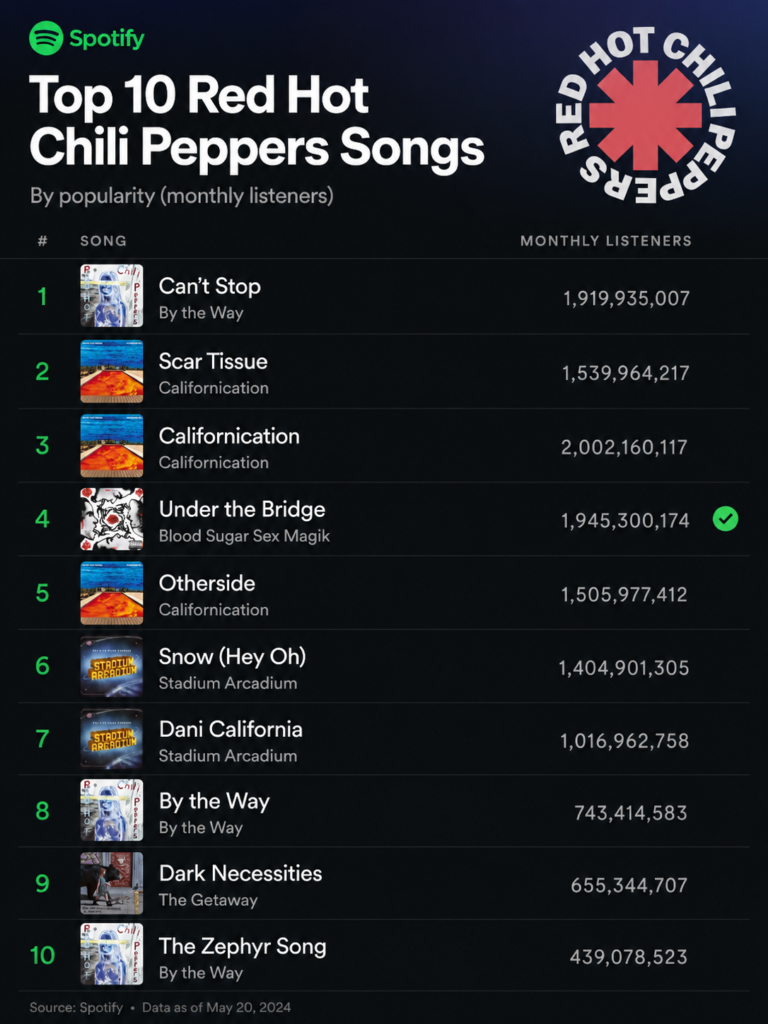
This week, the Red Hot Chili Peppers, with over 46 million monthly listeners on Spotify, reportedly sold their recorded music catalog to Warner Music Group for more than $300 million — one of the largest rock catalog deals in recent memory.
According to Rolling Stone and The Hollywood Reporter, the deal covers the band’s master recordings — the actual sound recordings behind hits like “Californication,” “Under the Bridge,” “Scar Tissue,” “Can’t Stop,” and “Otherside.” They are also the 8th most-played band on SiriusXM Lithium 90’s rock, even though their catalog spans five decades.
And here’s the key detail:
This comes after the band already sold its publishing rights years ago for roughly $140–150 million.
That means the market is now valuing two separate layers of music ownership at enormous scale:
Publishing rights (songwriting/composition)
Master recordings (the recordings themselves)
The Chili Peppers are essentially monetizing decades of cultural relevance twice.
Why Music Catalogs Became Wall Street Assets
Music used to be viewed as entertainment.
Now it’s increasingly viewed as a cash-flowing intellectual property asset class.
Why?
Because streaming transformed old songs into recurring annuities.
A hit song from 1999 no longer disappears after radio rotation ends. It lives forever across:
Spotify
Apple Music
YouTube
TikTok
movies
commercials
sports arenas
playlists
nostalgia-driven algorithms
The Chili Peppers reportedly generate around $26 million annually from their catalog alone.
That’s why firms like:
Sony Music Group
Universal Music Group
Warner Music Group
Bain Capital
are aggressively buying rights portfolios.
This isn’t just about music fandom.
It’s about predictable yield.
The Real Asset Isn’t the Song — It’s the Permanence
What makes a catalog valuable isn’t just popularity.
It’s durability.
The Chili Peppers sit in a rare category of artists whose songs function almost like cultural utility infrastructure:
gym playlists
rock radio staples
sports broadcasts
algorithmic recommendations
movie syncs
guitar-learning staples
generational discovery
Twenty years after Stadium Arcadium, people are still discovering “Snow (Hey Oh)” for the first time.
That matters financially.
This week, SiriusXM launched a major 20th-anniversary retrospective around Stadium Arcadium, complete with track-by-track commentary from the band.
That’s the flywheel:
Legacy catalogs create nostalgia
Nostalgia drives streams
Streams drive revenue
Revenue raises catalog valuations
Valuations attract institutional capital
Music is becoming closer to evergreen software IP than physical media.
Warner Music’s Bigger Bet
One of the most interesting parts of this deal is who bought the catalog.
Warner Music Group has distributed the Chili Peppers since 1991’s Blood Sugar Sex Magik.
So Warner isn’t just acquiring songs.
They’re deepening ownership around an ecosystem they already helped build.
And importantly, Warner reportedly used its joint venture with Bain Capital to fund the purchase.
That tells you something critical about the future:
Private equity increasingly views music catalogs the way previous generations viewed:
commercial real estate
pipelines
telecom infrastructure
utility assets
The difference?
Songs don’t need maintenance crews.
The Streaming Era Changed the Economics Forever
The CD era created spikes.
Streaming created persistence.
A teenager hearing “Californication” on TikTok in 2026 generates revenue from a song released in 1999.
That’s an extraordinary business model.
And unlike television or film libraries, music consumption is deeply habitual:
morning playlists
workouts
driving
studying
restaurants
sports venues
retail stores
Music became embedded into daily software behavior.
That makes elite catalogs incredibly resilient.
Catalogs Are the New Media Moat
The bigger story here isn’t just the Chili Peppers.
It’s that catalogs themselves are becoming strategic weapons.
In a fragmented entertainment landscape, ownership matters more than ever.
Who owns:
the songs,
the masters,
the publishing,
the licensing rights,
the sync rights,
the streaming revenue,
and the cultural memory
will increasingly shape the future economics of media.
The Red Hot Chili Peppers didn’t just sell old songs.
There are moments in the music business where the signal is so obvious, you either see it—or you miss the entire game.
This is one of those moments.
As first reported by Roger Friedman, the “Michael” film is tracking toward $12.5 million in preview revenue—despite functioning less like a traditional biopic and more like a concert experience.
That detail matters.
Because this isn’t a movie story.
It’s a catalog story.
This Isn’t a Film. It’s a Demand Shock.
Audiences aren’t passively watching.
They’re:
Dressing like Michael Jackson
Dancing in theaters
Treating screenings like The Rocky Horror Picture Show-style events
That’s not entertainment.
That’s participation.
And participation is the highest form of catalog engagement.
The Data Just Confirmed It
You don’t have to guess what’s happening.
Amazon’s real-time Top 50 CDs & Vinyl tells the story.
Key Observations from the Current Chart
From your dataset:
Thriller → #2 overall
Off the Wall → Top 15
Bad → Top 20
Number Ones → also charting
At the same time:
Legacy giants dominate:
Abbey Road
The Dark Side of the Moon
Rumours
Legend
And critically:
Greatest hits packages everywhere
The Hidden Pattern: Catalogs Cluster
This is the part most people miss.
When one Michael Jackson album moves…
→ The entire catalog moves.
That’s exactly what we’re seeing:
Thriller pulls attention
Off the Wall captures spillover
Bad benefits downstream
Compilations monetize casual demand
This is not random.
This is catalog clustering behavior.
The Most Important Insight: New Music Is Losing the Battle
Look at the same chart again.
Yes, there are new releases:
Noah Kahan
Olivia Dean
Ringo Starr
But what dominates?
Proven catalogs.
Even more telling:
The “Michael” soundtrack is not leading the charge.
That’s the punchline.
The activation event drives listeners backward, not forward.
Why This Matters for Catalog Investors
If you’re valuing music assets today, this is your model:
1. Activation > Creation
You don’t need new hits.
You need:
Cultural moments
Narrative triggers
Distribution events
2. Emotional Memory Compounds Value
The reason this works:
People don’t consume Michael Jackson as music.
They consume him as:
Memory
Identity
Experience
That’s why accuracy doesn’t matter.
3. Physical Formats Are a Signal, Not a Relic
This Amazon chart is CDs and vinyl.
That matters.
Physical purchases represent:
Intentional demand
Higher-margin fandom
Collector behavior
This is your high-conviction audience.
The Bigger Take: Catalogs Are Experience Engines
The biggest mistake in music investing is thinking you’re buying songs.
You’re not.
You’re buying:
A fan behavior loop
A repeatable activation system
A cultural asset that can be re-triggered
The “Michael” film is just the latest trigger.
Final Take: This Is What $12.5M Really Means
That preview number isn’t about box office.
It’s about elastic demand for elite catalogs.
It proves:
Fans will re-engage regardless of format quality
Legacy hits outperform new releases under pressure
Catalog value is driven by activation—not perfection
And most importantly:
The best catalogs don’t need to evolve. They just need to be turned back on.
The song was not released as a single in the United States, yet still reached:
No. 14 – Billboard Modern Rock Tracks
No. 17 – Mainstream Rock Tracks
Internationally, it performed even better:
No. 10 – Canada
No. 15 – Finland
No. 25 – Netherlands
No. 34 – Australia
No. 44 – New Zealand
Notably, it reached:
No. 1 in Iceland for three consecutive weeks, marking the band’s second straight chart-topper there
👉 Translation: This wasn’t a forgotten song—it was a strong catalog asset waiting for a moment.
Why This Happens (and Why It Matters)
Catalog value isn’t just about streams—it’s about moments of rediscovery.
When a song gets:
Placed in a cultural event
Associated with a mission or narrative
Introduced to a new generation
…it can behave like a new release again.
NASA unintentionally created:
A global listening event
A shared emotional context (space, return, humanity)
A discovery funnel into a 25-year-old catalog
The Bigger Insight for Catalog Owners
This is the playbook:
Moments > Marketing You don’t need a campaign—you need a trigger.
Context Creates Meaning A space mission reframes a song instantly.
Dormant Doesn’t Mean Dead Catalogs are latent assets waiting for activation.
Attention Can Be Re-Routed One decision (a wake-up song) → thousands of interactions
Final Thought
Most songs fade into passive streaming ecosystems.
But every once in a while, something external— a film, a meme, a viral clip, or in this case, a NASA mission— pulls a track back into the center of attention.
Sometimes the story isn’t in the headline numbers. It’s in the small movements that don’t look like much—until you compare them.
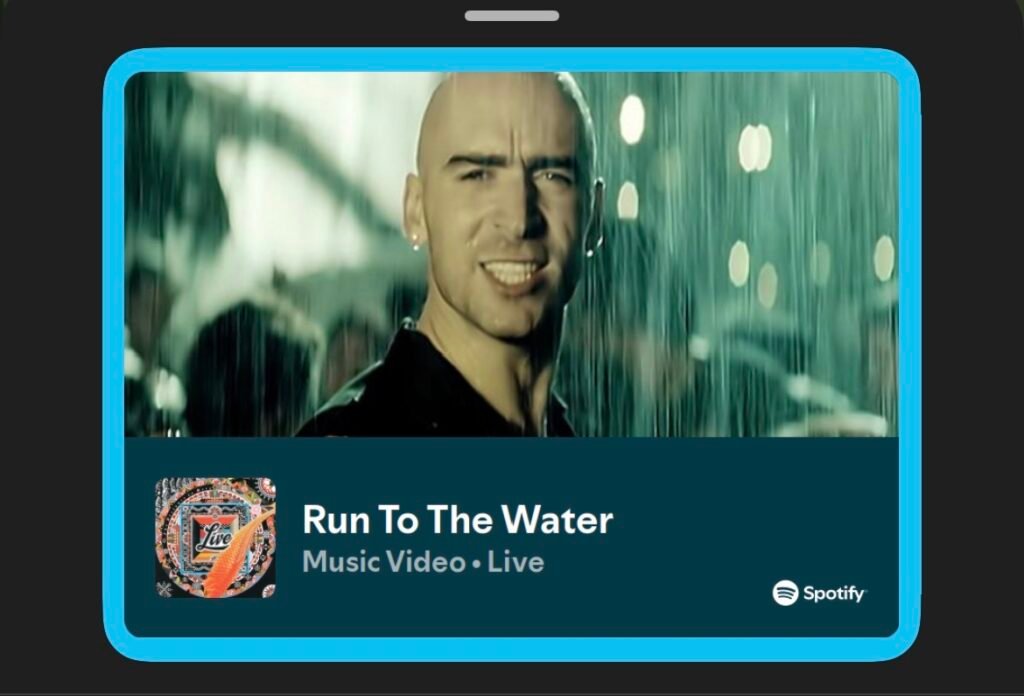
That’s what’s happening right now with “Run to the Water” by Live.
Live currently sits at around 3.7 million monthly listeners on Spotify. That’s a stable, active catalog. Not surging, not declining—just sitting in that middle ground where most legacy bands live.
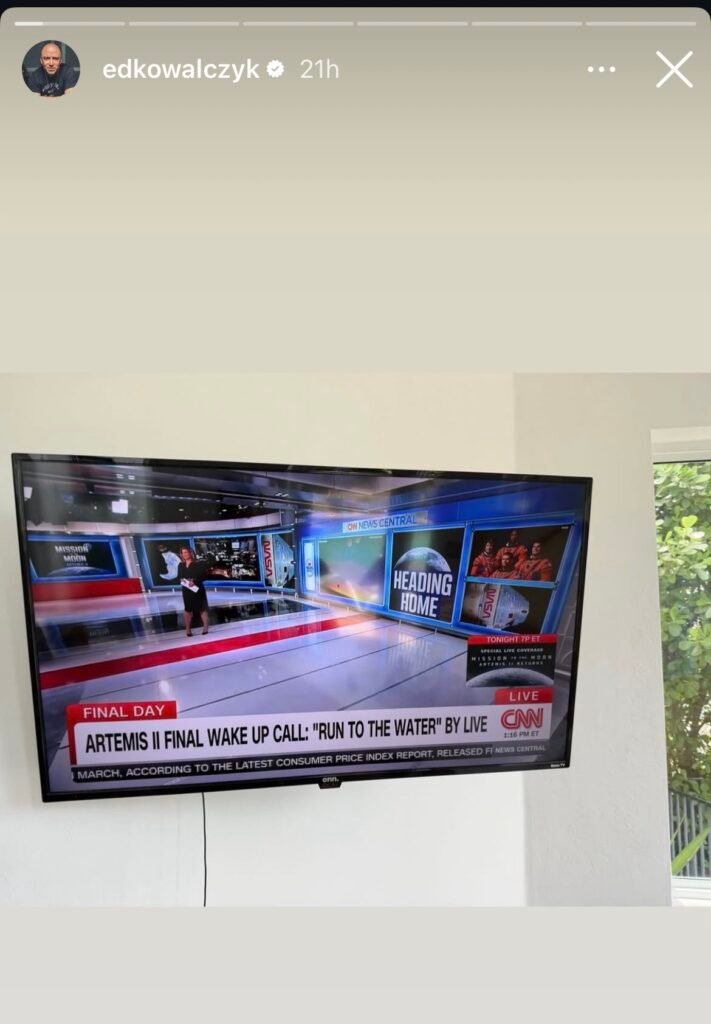
Recently, NASA used “Run to the Water” as part of the wake-up sequence for Artemis II.
On its own, that’s just an interesting cultural note.
But when you look at what happened next, the data tells a more interesting story.
“Run to the Water” didn’t just rise—it outperformed comparable songs in Live’s Spotify Top 10 by roughly 3–4x on a percentage basis over the same period.
Hipgnosis did not invent music catalog investing, but it changed the market in ways that still matter. Before its rise, music royalties were understood by specialists, insiders, and a relatively narrow circle of investors who were comfortable with the complexity of rights. After Hipgnosis, the asset class became much more legible to a broader investing public. That shift in education, visibility, and confidence may be its biggest legacy.
One of the most important things Hipgnosis did was popularize the idea that songs could be discussed like serious financial assets rather than quirky entertainment-side holdings. That sounds obvious now, but it was not always obvious. For years, many mainstream investors were hesitant around music because the business seemed too dependent on taste, too opaque, and too volatile. Hipgnosis helped normalize a different view: that proven catalogs could behave like long-duration cash-flowing assets, supported by recurring consumption and global platforms.
This mattered because education changes capital formation. Once more investors understood the broad case for music royalties, it became easier for the whole sector to raise money, explain the thesis, and defend the economics. Even companies that competed with Hipgnosis benefited from the fact that the market was being taught how to think about rights ownership. In that sense, Hipgnosis expanded the room for everyone.
It also changed expectations around pricing. As more capital entered the market and more investors became comfortable with the category, competition intensified. Multiples rose. Sellers became more aware of what their rights might fetch. Catalogs that may once have traded more quietly began attracting more attention and more aggressive bidding. That was good for owners looking to sell, but it also created concerns about overheating. As in any asset class, more money and more narrative energy can push valuations beyond conservative assumptions.
Hipgnosis also reinforced the importance of story in finance. It was not only selling an asset. It was selling a thesis about why songs matter, why consumption is durable, and why royalties deserve a place in institutional portfolios. The market did not respond just to data. It responded to a compelling narrative: songs are used everywhere, they travel globally, they are embedded in memory, and they can throw off long-term income. That narrative helped bridge the gap between cultural assets and financial analysis.
Another shift was psychological. Hipgnosis gave the market a more public benchmark for what confidence in music rights could look like. Once one prominent player behaves as though catalogs are strategic, scalable, and worth talking about in financial terms, others feel more comfortable entering the space. The result is not just more money. It is less fear. That matters in sectors where novelty and complexity used to deter traditional capital.
Of course, the story is not one-directional. Greater visibility also invited more scrutiny. Once pricing runs up and investor enthusiasm expands, the market starts asking harder questions. Are the assumptions too rosy? Are buyers paying too much for future upside? How should long-term durability be modeled in a fast-changing consumption environment? In that sense, Hipgnosis did not just popularize the market. It forced it to mature by making these debates more visible.
There is a broader lesson here. Markets often need a translator before they can scale. Someone has to take a niche asset and explain it in terms that a larger capital base can understand. Hipgnosis played that role for music rights. Whether one agrees with every valuation approach or strategic decision is almost secondary to that structural impact. It changed who felt invited to participate.
So what did Hipgnosis change in the music catalog market? It mainstreamed the conversation. It helped educate investors. It reduced the sense that music royalties were mysterious. It contributed to price inflation, yes, but it also contributed to legitimacy. And once an asset class becomes legible to mainstream capital, it rarely goes back to being obscure.