Tag: music royalties

  • Red Hot Chili Peppers Just Proved the Music Catalog Gold Rush Isn’t Slowing Down

    By 2026, the music catalog business has become something bigger than nostalgia.

    It’s infrastructure.
    Red Hot Chili Peppers

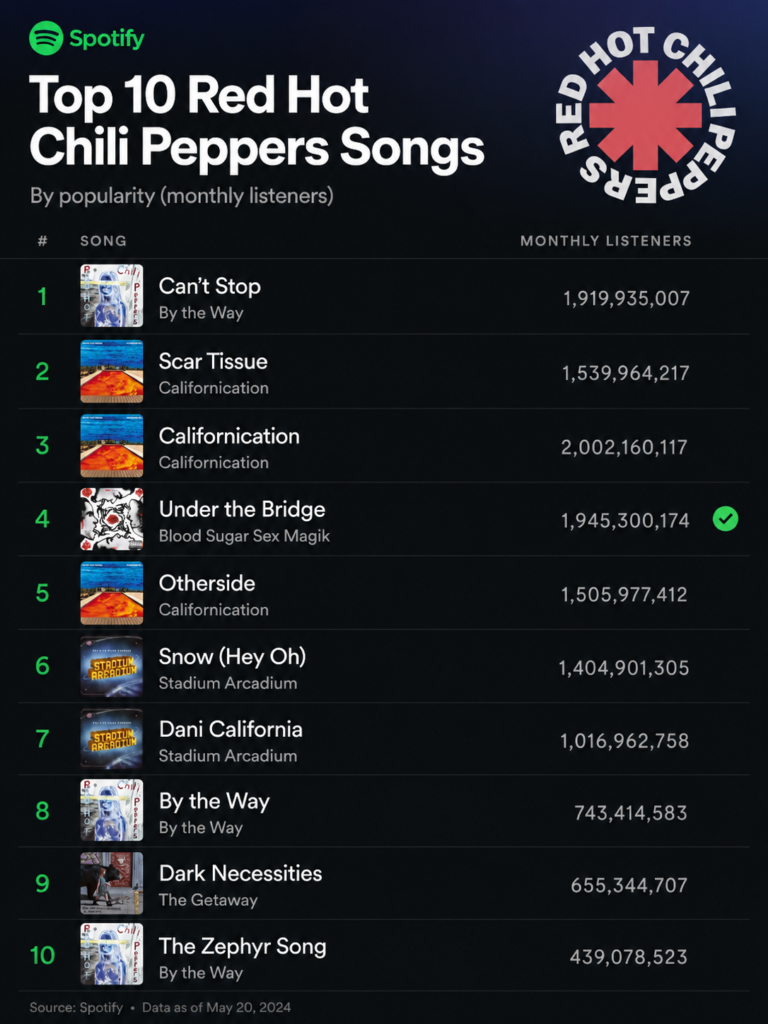
    This week, the Red Hot Chili Peppers, with over 46 million monthly listeners on Spotify, reportedly sold their recorded music catalog to Warner Music Group for more than $300 million — one of the largest rock catalog deals in recent memory.

    According to Rolling Stone and The Hollywood Reporter, the deal covers the band’s master recordings — the actual sound recordings behind hits like “Californication,” “Under the Bridge,” “Scar Tissue,” “Can’t Stop,” and “Otherside.” They are also the 8th most-played band on SiriusXM Lithium 90’s rock, even though their catalog spans five decades.

    And here’s the key detail:

    This comes after the band already sold its publishing rights years ago for roughly $140–150 million.

    That means the market is now valuing two separate layers of music ownership at enormous scale:

    • Publishing rights (songwriting/composition)
    • Master recordings (the recordings themselves)

    The Chili Peppers are essentially monetizing decades of cultural relevance twice.


    Why Music Catalogs Became Wall Street Assets

    Music used to be viewed as entertainment.

    Now it’s increasingly viewed as a cash-flowing intellectual property asset class.

    Why?

    Because streaming transformed old songs into recurring annuities.

    A hit song from 1999 no longer disappears after radio rotation ends. It lives forever across:

    • Spotify
    • Apple Music
    • YouTube
    • TikTok
    • movies
    • commercials
    • sports arenas
    • playlists
    • nostalgia-driven algorithms

    The Chili Peppers reportedly generate around $26 million annually from their catalog alone.

    That’s why firms like:

    • Sony Music Group
    • Universal Music Group
    • Warner Music Group
    • Bain Capital

    are aggressively buying rights portfolios.

    This isn’t just about music fandom.

    It’s about predictable yield.


    The Real Asset Isn’t the Song — It’s the Permanence

    What makes a catalog valuable isn’t just popularity.

    It’s durability.

    The Chili Peppers sit in a rare category of artists whose songs function almost like cultural utility infrastructure:

    • gym playlists
    • rock radio staples
    • sports broadcasts
    • algorithmic recommendations
    • movie syncs
    • guitar-learning staples
    • generational discovery

    Twenty years after Stadium Arcadium, people are still discovering “Snow (Hey Oh)” for the first time.

    That matters financially.

    This week, SiriusXM launched a major 20th-anniversary retrospective around Stadium Arcadium, complete with track-by-track commentary from the band.

    That’s the flywheel:

    1. Legacy catalogs create nostalgia
    2. Nostalgia drives streams
    3. Streams drive revenue
    4. Revenue raises catalog valuations
    5. Valuations attract institutional capital

    Music is becoming closer to evergreen software IP than physical media.


    Warner Music’s Bigger Bet

    One of the most interesting parts of this deal is who bought the catalog.

    Warner Music Group has distributed the Chili Peppers since 1991’s Blood Sugar Sex Magik.

    So Warner isn’t just acquiring songs.

    They’re deepening ownership around an ecosystem they already helped build.

    And importantly, Warner reportedly used its joint venture with Bain Capital to fund the purchase.

    That tells you something critical about the future:

    Private equity increasingly views music catalogs the way previous generations viewed:

    • commercial real estate
    • pipelines
    • telecom infrastructure
    • utility assets

    The difference?

    Songs don’t need maintenance crews.


    The Streaming Era Changed the Economics Forever

    The CD era created spikes.

    Streaming created persistence.

    A teenager hearing “Californication” on TikTok in 2026 generates revenue from a song released in 1999.

    That’s an extraordinary business model.

    And unlike television or film libraries, music consumption is deeply habitual:

    • morning playlists
    • workouts
    • driving
    • studying
    • restaurants
    • sports venues
    • retail stores

    Music became embedded into daily software behavior.

    That makes elite catalogs incredibly resilient.


    Catalogs Are the New Media Moat

    The bigger story here isn’t just the Chili Peppers.

    It’s that catalogs themselves are becoming strategic weapons.

    In a fragmented entertainment landscape, ownership matters more than ever.

    Who owns:

    • the songs,
    • the masters,
    • the publishing,
    • the licensing rights,
    • the sync rights,
    • the streaming revenue,
    • and the cultural memory

    will increasingly shape the future economics of media.

    The Red Hot Chili Peppers didn’t just sell old songs.

    They sold decades of recurring attention.

    And in 2026, attention compounds.

    Sources & Further Reading

  • The “Michael” Movie Isn’t a Film—It’s a Catalog Activation Engine

    There are moments in the music business where the signal is so obvious, you either see it—or you miss the entire game.

    This is one of those moments.

    As first reported by Roger Friedman, the “Michael” film is tracking toward $12.5 million in preview revenue—despite functioning less like a traditional biopic and more like a concert experience.

    That detail matters.

    Because this isn’t a movie story.

    It’s a catalog story.


    This Isn’t a Film. It’s a Demand Shock.

    Audiences aren’t passively watching.

    They’re:

    • Dressing like Michael Jackson
    • Dancing in theaters
    • Treating screenings like The Rocky Horror Picture Show-style events

    That’s not entertainment.

    That’s participation.

    And participation is the highest form of catalog engagement.


    The Data Just Confirmed It

    You don’t have to guess what’s happening.

    Amazon’s real-time Top 50 CDs & Vinyl tells the story.

    Key Observations from the Current Chart

    From your dataset:

    • Thriller#2 overall
    • Off the Wall → Top 15
    • Bad → Top 20
    • Number Ones → also charting

    At the same time:

    • Legacy giants dominate:
      • Abbey Road
      • The Dark Side of the Moon
      • Rumours
      • Legend
    • And critically:
      • Greatest hits packages everywhere

    The Hidden Pattern: Catalogs Cluster

    This is the part most people miss.

    When one Michael Jackson album moves…

    → The entire catalog moves.

    That’s exactly what we’re seeing:

    • Thriller pulls attention
    • Off the Wall captures spillover
    • Bad benefits downstream
    • Compilations monetize casual demand

    This is not random.

    This is catalog clustering behavior.


    The Most Important Insight: New Music Is Losing the Battle

    Look at the same chart again.

    Yes, there are new releases:

    • Noah Kahan
    • Olivia Dean
    • Ringo Starr

    But what dominates?

    Proven catalogs.

    Even more telling:

    The “Michael” soundtrack is not leading the charge.

    That’s the punchline.

    The activation event drives listeners backward, not forward.


    Why This Matters for Catalog Investors

    If you’re valuing music assets today, this is your model:

    1. Activation > Creation

    You don’t need new hits.

    You need:

    • Cultural moments
    • Narrative triggers
    • Distribution events

    2. Emotional Memory Compounds Value

    The reason this works:

    People don’t consume Michael Jackson as music.

    They consume him as:

    • Memory
    • Identity
    • Experience

    That’s why accuracy doesn’t matter.


    3. Physical Formats Are a Signal, Not a Relic

    This Amazon chart is CDs and vinyl.

    That matters.

    Physical purchases represent:

    • Intentional demand
    • Higher-margin fandom
    • Collector behavior

    This is your high-conviction audience.


    The Bigger Take: Catalogs Are Experience Engines

    The biggest mistake in music investing is thinking you’re buying songs.

    You’re not.

    You’re buying:

    • A fan behavior loop
    • A repeatable activation system
    • A cultural asset that can be re-triggered

    The “Michael” film is just the latest trigger.


    Final Take: This Is What $12.5M Really Means

    That preview number isn’t about box office.

    It’s about elastic demand for elite catalogs.

    It proves:

    • Fans will re-engage regardless of format quality
    • Legacy hits outperform new releases under pressure
    • Catalog value is driven by activation—not perfection

    And most importantly:

    The best catalogs don’t need to evolve.
    They just need to be turned back on.

  • Why genre matters (and doesn’t) when selling your music catalog

    Ask most people which genre commands the highest prices in the catalog market and they’ll say classic rock. They’re not wrong — but they’re not exactly right either. Golnar Khosrowshahi, founder and CEO of Reservoir Media, offers a more nuanced take on her appearance on Billboard’s On the Record.


    1. Genre is a proxy for the question buyers actually care about

    Catalog buyers don’t value genre for its own sake. What they’re really evaluating is how widely a song is listened to and how long that appeal is likely to last. Classic rock tends to score well on both dimensions — hence the premium prices — but the underlying logic applies across every genre. A country artist with four decades of proven radio presence is a fundamentally different investment proposition than a dance artist whose biggest hits came out three years ago, regardless of genre.

    “I would break it down as: how widespread is the listenership and how long is that going to last? At what rate is the revenue on this music going to decay?”


    2. Longevity is the real premium, not genre

    There is a finite group of artists and songwriters across every genre who will command truly elite catalog prices. What they share is not a sound or a style — it’s the proven ability to remain culturally relevant long after their peak commercial moment. “Take Me Home, Country Roads” is licensed constantly, covered endlessly, and embedded in American culture in a way that generates consistent revenue decade after decade. That kind of staying power is what justifies a premium multiple, whether the music is country, jazz, pop, or soul.

    “There is a finite group of artists and songwriters across genre who will command that premium — and everything else comes down to what this will be worth in 10, 15, 20 years.”


    3. Hip-hop and dance face real headwinds in sync licensing

    One area where genre genuinely creates friction is sync licensing — the placement of music in films, TV shows, and advertisements. Music with heavy use of expletives or that relies on uncleared samples from other recordings is simply harder to license for these purposes. Advertisers need clean clearances; film and TV supervisors need straightforward rights chains. That doesn’t make hip-hop or dance catalogs worthless — but it does reduce the ceiling on one of the most lucrative revenue streams available to catalog owners.

    “We are going to be more or less optimistic on film and TV sync if we’re looking at music filled with expletives. That’s not going to be easy.”


    4. Geography creates unexpected opportunities

    The catalog market is global, and listener behavior doesn’t always follow obvious patterns. Miles Davis is enormously popular in Japan and France. Country music has a passionate following in France. These cross-cultural affinities can meaningfully expand the revenue base for catalogs that might otherwise seem niche — and they’re easy to overlook if you’re only thinking about domestic streaming numbers when running your valuation.

    “There are pockets of genre-geography marriages that are very, very surprising. Country music is very popular in France.”


    5. The real risk is music that was big in the moment but won’t last

    Every era produces songs that feel culturally definitive at the time but fade quickly from the cultural conversation. Catalog buyers are acutely aware of this risk. A song can be a genuine #1 hit, a genuine cultural moment, and still not be worth much as a catalog asset if there’s no reason to believe people will still be listening to it in 2040. The question isn’t whether a song was important — it’s whether it’s durable.

    “Some hits don’t really stick around. They could be a culturally defining moment — but that doesn’t mean they will sustain that cultural impact two decades from now.”


    Based on Golnar Khosrowshahi’s appearance on On the Record, Billboard’s music industry podcast.

  • What is a music catalog multiple? How catalog valuations actually work

    Every music catalog deal comes with a number attached — sometimes eye-watering ones. But what does that number actually represent? Golnar Khosrowshahi, founder and CEO of Reservoir Media, pulls back the curtain on how catalog valuations really work in her conversation on Billboard’s On the Record.


    1. The multiple is just a way of pricing future cash flow

    A catalog’s value starts with one number: how much cash it generates each year. Buyers then apply a multiple to that figure to determine what they’re willing to pay today in exchange for those future earnings. A catalog generating $1 million annually at a 15x multiple would sell for $15 million. The multiple reflects how confident the buyer is that the cash flow will hold — or grow — over time. Higher confidence in longevity means a higher multiple.

    “The multiple is essentially valuing what the future cash flow is — you are paying two times that gross profit line, or today anywhere from 15 to 20 times.”


    2. Multiples have exploded since the early days

    When Reservoir started acquiring catalogs in 2007, assets were trading at just two to four times annual cash flow. The market was depressed by piracy fears and deep uncertainty about whether streaming would ever work. As streaming matured and proved it could grow music industry revenues sustainably, buyer confidence surged. By the peak of the boom, top-tier catalogs were trading at 15 to 20 times — and marquee assets like Bruce Springsteen’s or Bob Dylan’s catalog commanded even more. That’s a tenfold increase in how much buyers were willing to pay for the same underlying asset.

    “In 15 years, that 2, 3, 4 times multiple you’re paying today is going to translate into a 20 times multiple for that same asset.”


    3. Due diligence goes far beyond the headline number

    Arriving at the right multiple requires deep investigation into a catalog’s history. Buyers examine what percentage of revenue comes from licensing versus streaming, whether sync opportunities have been actively pursued or left on the table, whether any samples are uncleared, and whether the music has simply been neglected. A catalog that has never been properly administered may look undervalued on paper but actually represent a major opportunity — or a major headache, depending on what’s lurking beneath the surface.

    “Has the music been neglected? Maybe it was just collecting dust. Or maybe you’re buying a catalog that has been maximized. We’re certainly not going to say ‘we’ll do 20% better’ — because that’s just not always true.”


    4. Genre, longevity, and sync potential all feed into the number

    Not all cash flows are created equal. Buyers discount future revenue more heavily if they believe a catalog’s appeal will fade. A classic rock catalog from the 1970s carries a very different risk profile than a hip-hop catalog from 2015 — not because one genre is inherently better, but because the older catalog has already proven it can sustain listener interest across decades. Sync potential also factors in: music filled with expletives or uncleared samples simply cannot be licensed to advertisers or film and TV, which reduces the ceiling on future revenue.

    “What is this going to be worth in 10 years, in 15 years, in 20 years? Are we still going to be able to license ‘Take Me Home, Country Roads’ to Google? Yes.”


    5. The unpredictable uplifts are upside, not assumptions

    A well-placed sync in a hit TV show, a biopic, or a viral TikTok moment can dramatically increase a catalog’s streaming numbers overnight. Buyers know this happens — but they cannot reliably model it. Responsible valuation treats these events as potential upside rather than baking them into the base case. The core multiple is built on what a catalog demonstrably earns today; everything else is a bonus that makes the investment more attractive in hindsight.

    “You just wing it — there’s so much that goes into valuing a catalog, but you cannot account for those random blips on the radar that are really positive.”


    Based on Golnar Khosrowshahi’s appearance on On the Record, Billboard’s music industry podcast.

  • Why Sync Licensing Matters So Much in Catalog Value

    Sync licensing can change the trajectory of a music catalog faster than almost any other commercial lever. A song that has been quietly earning for years can suddenly surge because it lands in a hit television show, a movie trailer, a global ad campaign, or a viral scene that brings it to a new audience. That is why sync matters so much in catalog valuation. It is not just another revenue line. It can act as both direct income and an engine for broader catalog reactivation.

    At the most basic level, sync licensing generates money because the rights holder is paid to pair music with visual media. That payment can be meaningful on its own, especially for high-profile placements. But the bigger reason investors care is that sync often creates a second wave of consumer attention. A placement can lead to a spike in streams, Shazam activity, playlist adds, social conversation, and cultural relevance. In some cases, the sync fee is only the beginning. The real value comes from renewed discovery.

    This is especially important for older catalogs. A legacy song may already have proven durability, but a sync placement can introduce it to a generation that did not grow up with it. Suddenly the song is not just “old”; it is current again. That kind of renewal is incredibly valuable because it extends the commercial life of the asset. Catalog buyers love signals that suggest a song can travel through time and still connect.

    Sync also matters because it can diversify income. Streaming is central to modern royalty economics, but it is not the only source of value. When a catalog has credible sync potential, it becomes less dependent on passive consumption patterns alone. The rights holder has a more active way to create moments. That is attractive from an investment standpoint because it means the asset can be managed, not merely observed.

    But not all songs are equally syncable. Some music fits visual storytelling more naturally than others. Lyrics matter. Tone matters. Mood matters. Genre matters. So does simplicity of clearance. If a song has many writers, samples, approval hurdles, or ambiguous ownership, it may be harder to place, even if it is artistically perfect. Supervisors and brands often want the clearest path to execution. A great song with a messy rights chain can lose out to a slightly less perfect song that is easy to license.

    This is where catalog valuation gets more nuanced. Buyers do not simply ask, “Has this catalog earned sync revenue before?” They also ask, “Could it earn more under stronger management?” A catalog that has been underexploited may look more attractive to a buyer with a dedicated sync team, better relationships, or a more aggressive licensing strategy. The same songs can be worth more in the hands of an operator who knows how to package and pitch them.

    There is also a halo effect to consider. A successful placement can elevate not just one song, but the wider artist brand or catalog identity. A film scene, a prestige drama, a documentary, or an ad campaign can trigger press, conversation, and rediscovery. People start listening beyond the placed track. They revisit albums, interviews, images, and adjacent songs. In that sense, sync can function as a cultural marketing event as much as a licensing transaction.

    Still, buyers have to be careful. Sync is important, but it is not guaranteed. Some songs are obvious sync candidates and still never land the big placement everyone imagines. Trends change. Supervisors have taste. Brands get cautious. Competitive dynamics shift. The right scene may never materialize. That is why sync upside should enhance a catalog thesis, not replace it. A strong catalog should work even without a dream placement.

    The best way to think about sync is as optionality. It gives the rights holder more ways to create value from the same underlying songs. It can produce direct fees, increase downstream consumption, refresh relevance, and deepen cross-generational awareness. Those are powerful outcomes, especially in a market where cultural attention is fragmented.

    So why does sync licensing matter so much in catalog value? Because it connects the financial logic of ownership with the emotional logic of discovery. A song placed in the right context becomes newly alive. And when a catalog can reliably generate those moments, the market will usually pay more for the possibility.

  • 1994 was the greatest year in alt-rock history — and SiriusXM Lithium’s data proves it.

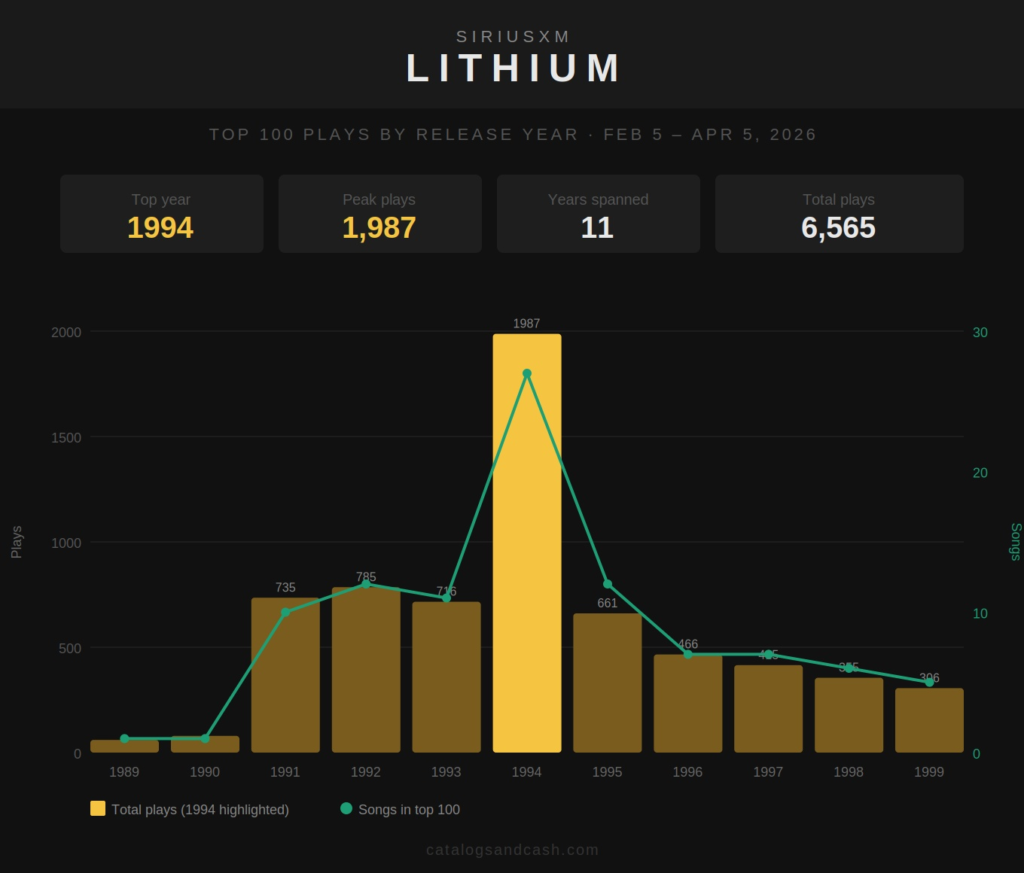
    We pulled the Top 100 most-played songs on Lithium over a 60-day window (Feb 5 – Apr 5, 2026) and ranked them by release year. The result isn’t even close.

    Songs from 1994 accounted for nearly 2,000 plays across 27 tracks — more than double any other year on the chart. That’s not just nostalgia. That’s a catalog that refuses to age.

    1994 Alt Rock

    What made ’94 so dominant? It wasn’t one album. It was everything dropping at once: Green Day’s Dookie, Weezer’s Blue Album, STP’s Purple, Soundgarden’s Superunknown, the Beastie Boys’ Ill Communication — all in the same 12 months. And that’s before you count the posthumous weight of Nirvana’s catalog, which exploded after April of that year.

    The rest of the chart tells its own story. 1991–1993 cluster tightly behind, representing the raw breakout years of grunge. By 1997–1999, the plays drop off — not because the music got worse, but because the era was winding down.

    If you grew up with Lithium on your dial, you already knew 1994 hit different. Now you’ve got the receipts.

    One Take:

    1994-1995 was the peak of the 90’s alternative. There are probably hidden songs that are great, syncable, and have a 90’s vibe, but never made it big because of the crowded radio environment. Might be worth mining those 2nd and 3rd tier bands for songs.

    📊 Data: SiriusXM Lithium Top 100, Feb 5 – Apr 5, 2026 📍 Analysis: catalogsandcash.com


  • Masters vs. publishing rights: what’s the difference and which is more valuable?

    If you’ve ever read a headline about a music catalog sale and wondered exactly what was bought and sold, you’re not alone. Golnar Khosrowshahi, founder and CEO of Reservoir Media, broke down the distinction clearly in her appearance on Billboard’s On the Record — and the difference matters more than most people realize.


    1. Masters and publishing are two completely separate assets

    When an artist records a song, two distinct sets of rights are created. The master recording — the actual audio file you hear on Spotify — is typically owned by the record label that funded the recording. The publishing rights cover the underlying composition: the melody and lyrics written by the songwriter. These can be owned by a publisher, the artist themselves, or split between multiple parties. Every catalog deal involves one, the other, or both — and the price reflects which rights are actually on the table.

    “You can sell your publishing, which is the songwriting rights. Those are two different things — masters versus publishing. A lot of people want one or the other or both.”


    2. Publishing has historically been the safer bet

    In the early days of the catalog market, publishing rights were considered far less risky than masters. Masters required active marketing investment — vinyl releases, promotion, physical product — while publishing generated royalties more passively every time a song was performed, streamed, or licensed. For investors who wanted steady income without operational complexity, publishing was the cleaner bet. Today, Khosrowshahi says the two asset classes trade at roughly equivalent multiples — but the underlying operational demands remain very different.

    “In the early days, the publishing was far less risky. Today I would tell you that these assets are trading at par.”


    3. Owning masters means running an active business

    Buying master recordings isn’t a passive investment. It comes with real operational responsibilities: releasing vinyl, running marketing campaigns, pitching music supervisors, and managing a recorded music roster. Reservoir maintains entirely separate teams for its publishing and recorded music businesses precisely because the work is so different. Anyone looking to acquire masters needs to honestly assess whether they have the infrastructure and expertise to actively manage that catalog — or whether they’re better suited to the publishing side.

    “Publishing is more like ‘I want checks to come in the mail.’ Masters are ‘I’m out there, I want to market, I want to make it more valuable.’”


    4. Who owns the other side of the rights matters too

    If you buy publishing rights to a song, you’re now in a long-term relationship with whoever owns the masters — and vice versa. Khosrowshahi says Reservoir always investigates this before closing a deal. Are the masters owned by a major label with resources to keep marketing the music? Or are they sitting with a smaller label that may not be around in five years? The quality and commitment of the party controlling the other set of rights has a real impact on how much value a catalog can generate over time.

    “We definitely look at who owns the masters — are they going to keep doing any job? Because that’s what you really want to know.”


    5. Taylor Swift’s situation clarified everything for a mainstream audience

    When Big Machine Records sold Taylor Swift’s master recordings to Shamrock Holdings without her consent, millions of people suddenly understood — viscerally — why the masters vs. publishing distinction matters. Swift had signed her deal as a teenager, which was standard practice at the time: the label funded the recordings and retained ownership. Her decision to re-record her entire back catalog as “Taylor’s Version” was an unprecedented response, and it accelerated a broader industry shift toward more artist-friendly deal structures where ownership eventually reverts to the artist or is shared from the outset.

    “That situation really put a spotlight on the fact that Taylor Swift did not own her own masters — and nowadays we’re seeing much more artist-friendly deals at these record labels.”


    Based on Golnar Khosrowshahi’s appearance on On the Record, Billboard’s music industry podcast.

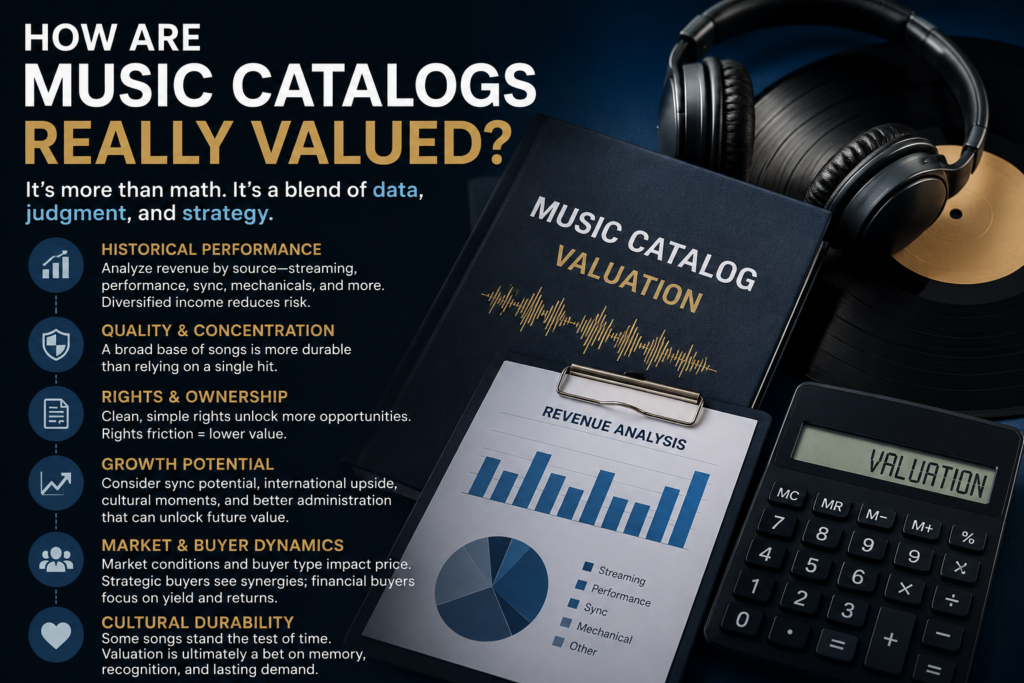
  • How Music Catalogs Are Really Valued

    Music catalog valuation looks simple from the outside. A buyer studies the royalty statements, decides what the songs have earned, puts a multiple on that income, and arrives at a price. In reality, it is far messier. A catalog is not a factory with fixed outputs. It is a living asset shaped by consumer taste, licensing activity, artist reputation, platform shifts, and how actively the rights are managed. That is why the best way to understand valuation is to think of it as a blend of math, judgment, and strategy.

    The first layer is historical performance. Buyers want to know what the catalog has actually done, not what someone hopes it might do. That means looking closely at the last several years of revenue by source. Streaming is usually the headline number because it is visible, recurring, and easy to model. But streaming is only one part of the picture. Performance income, mechanicals, sync licensing, neighboring rights, and other revenue streams can all matter. A catalog with diversified income is often more attractive than one that depends almost entirely on a single source. Diversification lowers risk and gives the buyer more confidence that a sudden change in one channel will not break the investment thesis.

    The second layer is quality of income. Not every dollar is equally valuable. If a catalog’s earnings come from a broad base of songs that continue to show up year after year, that is different from a catalog where one song carries everything. Concentration risk matters. A catalog built on one monster track can still be valuable, but the valuation process has to account for the possibility that interest in that one song fades. A deeper catalog with multiple recognizable works may look less flashy on paper but can be more durable over time.

    Then there is the question of rights. Are you buying publishing, masters, or both? Do the songs have straightforward ownership, or are there samples, multiple writers, conflicting approvals, and legacy complications? Rights friction can reduce value because it slows down monetization. A film and television supervisor wants a clean path. If every placement turns into a multi-party negotiation, some opportunities disappear before they begin. In other words, two songs with similar streaming profiles can have different valuations because one is easier to exploit commercially.

    Another major input is growth potential. Buyers do not pay only for what happened yesterday. They are trying to estimate what the catalog can earn tomorrow. That is where the process gets subjective. Can the catalog benefit from sync licensing? Is there international upside? Does the artist have an anniversary, documentary, biopic, or cultural reappraisal on the horizon? Could better administration or marketing unlock value that the current owner never pursued? Those questions matter because a buyer is not just buying income; they are buying the right to operate the asset better.

    Still, buyers have to be careful not to overpay for upside that may never arrive. A biopic, viral rediscovery, or social media resurgence can meaningfully lift a catalog, but those events are hard to predict with confidence. You cannot build an investment case entirely on wishful thinking. That is why seasoned buyers usually separate the base case from the blue-sky case. The base case depends on what the catalog is already proving in the market. The upside case is where smart operators can outperform, but it should not be the only reason the deal works.

    Music Catalogs Valuations

    Market conditions matter too. In a hot market, buyers may stretch on multiples because they believe music rights are scarce, attractive, and resilient. In a colder market, underwriting gets tougher and assumptions get stricter. Investor sentiment, interest rates, and access to capital all influence what feels like a reasonable price. A catalog is not valued in a vacuum. It is valued in a competitive market where different buyers have different cost-of-capital structures and different exit expectations.

    That brings up another overlooked issue: not every buyer values the same catalog the same way. A strategic music company may pay more than a financial buyer because it can integrate the rights into a broader platform. It may already have sync teams, global infrastructure, label relationships, and marketing channels that create incremental value. A private equity-style buyer, by contrast, may be more disciplined about cash yield and hold period. One sees synergies. The other sees return thresholds. Both are evaluating the same songs, but they are not solving for the same outcome.

    There is also a human element. Cultural relevance is difficult to reduce to a spreadsheet. Some songs have an emotional permanence that numbers only partially capture. They keep resurfacing at weddings, in stadiums, on classic playlists, in movie trailers, and in new generations’ listening habits. Catalog investors are ultimately making a bet on memory, recognition, and recurring demand. They are asking whether people will keep caring.

    So how are music catalogs really valued? By looking backward at revenue, sideways at risk, and forward at possibility. Historical cash flow sets the floor. Rights quality, concentration, licensing potential, and operational strategy shape the premium or discount. Market conditions and buyer type influence the final price. The spreadsheet matters, but so does judgment. That is why catalog valuation is never just arithmetic. It is the art of deciding how much cultural durability is worth in financial terms.