Tag: masters

  • Why Taylor’s Version Worked When Most Re-Recording Projects Don’t

    Plenty of artists have re-recorded songs over the years, but very few projects have reshaped the commercial conversation the way Taylor’s Version did. That is why it matters as more than a pop culture story. It is a case study in how fan relationships, narrative framing, and strategic execution can alter the economics of recorded music. Most re-recording campaigns do not work at that scale because they lack the combination of factors that made this one unusually effective.

    The first factor is fan connection. Taylor Swift did not introduce the re-recordings to a passive audience. She introduced them to a deeply engaged fan base that was already accustomed to following her story closely. That matters because substitution only happens when people care enough to change behavior. In many catalog situations, listeners are not paying attention to ownership details. They stream the version they know. In this case, the audience was motivated to support the artist’s preferred version in a visible, intentional way.

    The second factor is message clarity. The campaign was not framed as a technical rights issue for industry insiders. It was framed as a simple and emotionally legible story about reclaiming work. Fans did not need to understand the full legal architecture of masters to understand the emotional pitch. That made the campaign scalable. It translated business conflict into personal loyalty.

    Third, the songs themselves were already deeply embedded in the fan base’s life. Re-recording works best when the audience feels attachment not just to the hits, but to the era, the mythology, the vault material, and the broader world around the album. The releases became events, not just replacements. They created fresh demand rather than merely rerouting existing streams. In many other artist cases, re-recordings feel redundant because they do not add enough new cultural energy.

    Execution also mattered. These projects were not tossed into the market casually. They were rolled out with sophisticated timing, expanded tracklists, fan engagement, press attention, and a coordinated broader narrative. That level of execution is rare. It requires infrastructure, discipline, and a powerful understanding of audience behavior. Most artists either do not have that machine or do not have an audience large enough to justify building it.

    There is also the matter of era. Taylor’s Version emerged in a moment when artists speaking openly about ownership, agency, and control had strong cultural resonance. The audience was primed to care. Social media amplified the story. Streaming made comparison frictionless. Fans could find the preferred version easily and signal support publicly. The technology and the cultural mood aligned with the campaign.

    Most re-recording projects fail to reach similar heights because one or more of these ingredients are missing. Some artists lack a mobilized fan base. Others do not have a clean story that captures public attention. Some re-recorded songs simply do not improve or expand the listening experience enough to motivate change. In many cases, the original recordings remain so culturally fixed that listeners do not feel any need to switch.

    There is another subtle point: the project worked not just because fans supported the new versions, but because the artist had already changed the nature of fan relationships before the campaign began. The re-recordings were the payoff to years of direct communication, identity building, and community reinforcement. Without that groundwork, the later commercial effect would have been far weaker.

    For catalog investors, the lesson is not that re-recordings always threaten masters. It is that artist power can sometimes override the usual inertia of listener behavior. But this requires unusual scale, unusual discipline, and unusual trust between artist and audience. Those conditions are hard to reproduce.

    Why did Taylor’s Version work when most re-recording projects do not? Because it was never just about making new recordings. It was about giving fans a compelling reason to participate in a moral, emotional, and commercial campaign all at once. That combination is rare. And that rarity is exactly why the case matters so much in the catalog business.
  • Do Re-Recordings Hurt the Value of Masters?

    Re-recordings have always existed in the music business, but they became impossible to ignore after the success of high-profile artist-driven campaigns that reframed old songs for a new audience. That raises a real question for catalog buyers: do re-recordings hurt the value of masters? The answer is yes, they can, but the impact depends heavily on the artist, the fan relationship, and the nature of the original catalog.

    To understand the risk, it helps to remember what a master owner is buying. A master generates value because the original recording continues to be consumed, licensed, and culturally recognized. If an artist creates a new version that listeners adopt as a substitute, some of that value can shift. A catalog buyer may still own the composition-linked economics in some scenarios, but if the transaction centered heavily on the original recordings, substitution risk matters.

    That said, not every re-recording meaningfully damages an original master. In many cases, re-recorded versions feel like alternatives rather than replacements. Listeners often remain attached to the original recording because of familiarity, nostalgia, production choices, or the emotional imprint of the first version. A new take may attract attention for a period of time without permanently erasing the commercial power of the original.

    The biggest exception is when the artist has a uniquely strong and mobilized relationship with fans. In that case, re-recording becomes more than a musical release. It becomes a loyalty event. Fans are invited to participate in a narrative about ownership, justice, authorship, or artist control. That kind of campaign can create real substitution because fans are not simply choosing a song. They are choosing a side. The commercial effect can be more pronounced because the re-recording carries symbolic meaning.

    This is why investors should be careful about overgeneralizing from a few famous examples. A massively engaged global artist with a direct fan-to-artist communication channel is not the norm. Most artists do not have the scale, message discipline, release strategy, and audience behavior required to make re-recordings a dominant substitute for the originals. For many catalogs, the re-recording clause is still a point of risk, but not an existential one.

    Another issue is use case. Even if casual listeners continue consuming the old masters, licensing markets may evolve. Supervisors, advertisers, or filmmakers may choose a newer version for practical or narrative reasons. In some situations, they may prefer the re-recording if it is easier to clear, cheaper to license, or more aligned with the artist’s current preferences. That means re-recordings can change not just listening behavior but also commercial pathways.

    Catalog buyers therefore need to evaluate several factors. How strong is the artist’s current public connection with fans? How likely is the artist to actively promote replacements? How emotionally attached are listeners to the originals? Are the songs important in sync markets where substitutions can happen more deliberately? Is the catalog so iconic that the original recordings remain definitive no matter what?

    There is also a timing element. Sometimes the re-recording risk is highest immediately after release, when press attention and fan mobilization are strongest. Over time, the market may settle into coexistence. Original masters can continue to earn because people return to the familiar recording that first defined the song in culture. In other cases, the new version keeps gaining traction and becomes embedded in playlists and public consciousness.

    The takeaway is that re-recordings do introduce real master-value risk, but the severity is context-dependent. Buyers should not dismiss the possibility, especially when dealing with living artists who have both motive and audience leverage. At the same time, they should avoid assuming that every re-recorded catalog becomes impaired in the same way. Music history is full of original recordings that remain the definitive commercial object even when alternatives exist.

    So do re-recordings hurt the value of masters? Sometimes, yes. But the deeper truth is that they expose a broader question in catalog investing: are you buying ownership of a recording, or are you buying the enduring listener preference for that recording? In the end, that preference is what determines whether the original master remains powerful.

  • How Music Catalogs Are Really Valued

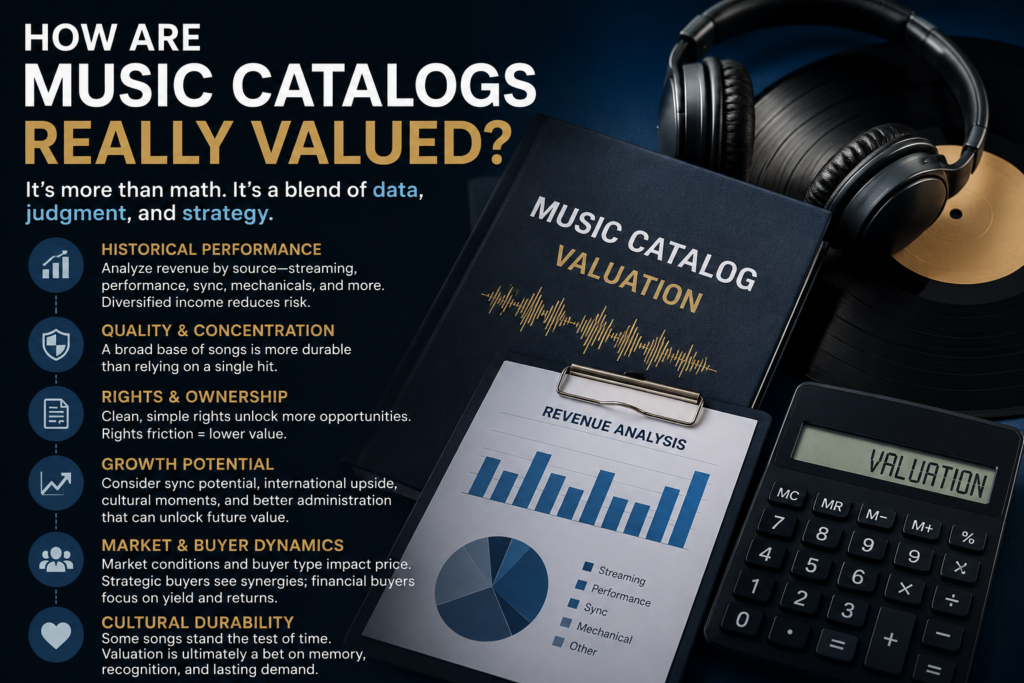
    Music catalog valuation looks simple from the outside. A buyer studies the royalty statements, decides what the songs have earned, puts a multiple on that income, and arrives at a price. In reality, it is far messier. A catalog is not a factory with fixed outputs. It is a living asset shaped by consumer taste, licensing activity, artist reputation, platform shifts, and how actively the rights are managed. That is why the best way to understand valuation is to think of it as a blend of math, judgment, and strategy.

    The first layer is historical performance. Buyers want to know what the catalog has actually done, not what someone hopes it might do. That means looking closely at the last several years of revenue by source. Streaming is usually the headline number because it is visible, recurring, and easy to model. But streaming is only one part of the picture. Performance income, mechanicals, sync licensing, neighboring rights, and other revenue streams can all matter. A catalog with diversified income is often more attractive than one that depends almost entirely on a single source. Diversification lowers risk and gives the buyer more confidence that a sudden change in one channel will not break the investment thesis.

    The second layer is quality of income. Not every dollar is equally valuable. If a catalog’s earnings come from a broad base of songs that continue to show up year after year, that is different from a catalog where one song carries everything. Concentration risk matters. A catalog built on one monster track can still be valuable, but the valuation process has to account for the possibility that interest in that one song fades. A deeper catalog with multiple recognizable works may look less flashy on paper but can be more durable over time.

    Then there is the question of rights. Are you buying publishing, masters, or both? Do the songs have straightforward ownership, or are there samples, multiple writers, conflicting approvals, and legacy complications? Rights friction can reduce value because it slows down monetization. A film and television supervisor wants a clean path. If every placement turns into a multi-party negotiation, some opportunities disappear before they begin. In other words, two songs with similar streaming profiles can have different valuations because one is easier to exploit commercially.

    Another major input is growth potential. Buyers do not pay only for what happened yesterday. They are trying to estimate what the catalog can earn tomorrow. That is where the process gets subjective. Can the catalog benefit from sync licensing? Is there international upside? Does the artist have an anniversary, documentary, biopic, or cultural reappraisal on the horizon? Could better administration or marketing unlock value that the current owner never pursued? Those questions matter because a buyer is not just buying income; they are buying the right to operate the asset better.

    Still, buyers have to be careful not to overpay for upside that may never arrive. A biopic, viral rediscovery, or social media resurgence can meaningfully lift a catalog, but those events are hard to predict with confidence. You cannot build an investment case entirely on wishful thinking. That is why seasoned buyers usually separate the base case from the blue-sky case. The base case depends on what the catalog is already proving in the market. The upside case is where smart operators can outperform, but it should not be the only reason the deal works.

    Music Catalogs Valuations

    Market conditions matter too. In a hot market, buyers may stretch on multiples because they believe music rights are scarce, attractive, and resilient. In a colder market, underwriting gets tougher and assumptions get stricter. Investor sentiment, interest rates, and access to capital all influence what feels like a reasonable price. A catalog is not valued in a vacuum. It is valued in a competitive market where different buyers have different cost-of-capital structures and different exit expectations.

    That brings up another overlooked issue: not every buyer values the same catalog the same way. A strategic music company may pay more than a financial buyer because it can integrate the rights into a broader platform. It may already have sync teams, global infrastructure, label relationships, and marketing channels that create incremental value. A private equity-style buyer, by contrast, may be more disciplined about cash yield and hold period. One sees synergies. The other sees return thresholds. Both are evaluating the same songs, but they are not solving for the same outcome.

    There is also a human element. Cultural relevance is difficult to reduce to a spreadsheet. Some songs have an emotional permanence that numbers only partially capture. They keep resurfacing at weddings, in stadiums, on classic playlists, in movie trailers, and in new generations’ listening habits. Catalog investors are ultimately making a bet on memory, recognition, and recurring demand. They are asking whether people will keep caring.

    So how are music catalogs really valued? By looking backward at revenue, sideways at risk, and forward at possibility. Historical cash flow sets the floor. Rights quality, concentration, licensing potential, and operational strategy shape the premium or discount. Market conditions and buyer type influence the final price. The spreadsheet matters, but so does judgment. That is why catalog valuation is never just arithmetic. It is the art of deciding how much cultural durability is worth in financial terms.