Category: Catalog Valuation

  • Red Hot Chili Peppers Just Proved the Music Catalog Gold Rush Isn’t Slowing Down

    By 2026, the music catalog business has become something bigger than nostalgia.

    It’s infrastructure.
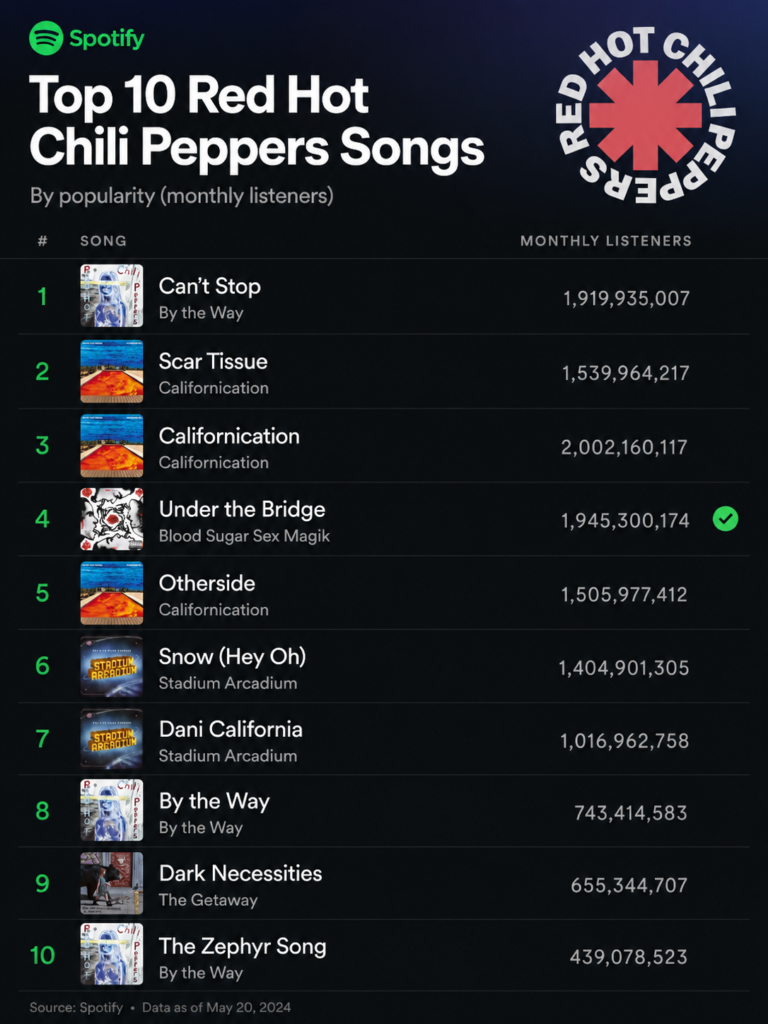
    Red Hot Chili Peppers

    This week, the Red Hot Chili Peppers, with over 46 million monthly listeners on Spotify, reportedly sold their recorded music catalog to Warner Music Group for more than $300 million — one of the largest rock catalog deals in recent memory.

    According to Rolling Stone and The Hollywood Reporter, the deal covers the band’s master recordings — the actual sound recordings behind hits like “Californication,” “Under the Bridge,” “Scar Tissue,” “Can’t Stop,” and “Otherside.” They are also the 8th most-played band on SiriusXM Lithium 90’s rock, even though their catalog spans five decades.

    And here’s the key detail:

    This comes after the band already sold its publishing rights years ago for roughly $140–150 million.

    That means the market is now valuing two separate layers of music ownership at enormous scale:

    • Publishing rights (songwriting/composition)
    • Master recordings (the recordings themselves)

    The Chili Peppers are essentially monetizing decades of cultural relevance twice.


    Why Music Catalogs Became Wall Street Assets

    Music used to be viewed as entertainment.

    Now it’s increasingly viewed as a cash-flowing intellectual property asset class.

    Why?

    Because streaming transformed old songs into recurring annuities.

    A hit song from 1999 no longer disappears after radio rotation ends. It lives forever across:

    • Spotify
    • Apple Music
    • YouTube
    • TikTok
    • movies
    • commercials
    • sports arenas
    • playlists
    • nostalgia-driven algorithms

    The Chili Peppers reportedly generate around $26 million annually from their catalog alone.

    That’s why firms like:

    • Sony Music Group
    • Universal Music Group
    • Warner Music Group
    • Bain Capital

    are aggressively buying rights portfolios.

    This isn’t just about music fandom.

    It’s about predictable yield.


    The Real Asset Isn’t the Song — It’s the Permanence

    What makes a catalog valuable isn’t just popularity.

    It’s durability.

    The Chili Peppers sit in a rare category of artists whose songs function almost like cultural utility infrastructure:

    • gym playlists
    • rock radio staples
    • sports broadcasts
    • algorithmic recommendations
    • movie syncs
    • guitar-learning staples
    • generational discovery

    Twenty years after Stadium Arcadium, people are still discovering “Snow (Hey Oh)” for the first time.

    That matters financially.

    This week, SiriusXM launched a major 20th-anniversary retrospective around Stadium Arcadium, complete with track-by-track commentary from the band.

    That’s the flywheel:

    1. Legacy catalogs create nostalgia
    2. Nostalgia drives streams
    3. Streams drive revenue
    4. Revenue raises catalog valuations
    5. Valuations attract institutional capital

    Music is becoming closer to evergreen software IP than physical media.


    Warner Music’s Bigger Bet

    One of the most interesting parts of this deal is who bought the catalog.

    Warner Music Group has distributed the Chili Peppers since 1991’s Blood Sugar Sex Magik.

    So Warner isn’t just acquiring songs.

    They’re deepening ownership around an ecosystem they already helped build.

    And importantly, Warner reportedly used its joint venture with Bain Capital to fund the purchase.

    That tells you something critical about the future:

    Private equity increasingly views music catalogs the way previous generations viewed:

    • commercial real estate
    • pipelines
    • telecom infrastructure
    • utility assets

    The difference?

    Songs don’t need maintenance crews.


    The Streaming Era Changed the Economics Forever

    The CD era created spikes.

    Streaming created persistence.

    A teenager hearing “Californication” on TikTok in 2026 generates revenue from a song released in 1999.

    That’s an extraordinary business model.

    And unlike television or film libraries, music consumption is deeply habitual:

    • morning playlists
    • workouts
    • driving
    • studying
    • restaurants
    • sports venues
    • retail stores

    Music became embedded into daily software behavior.

    That makes elite catalogs incredibly resilient.


    Catalogs Are the New Media Moat

    The bigger story here isn’t just the Chili Peppers.

    It’s that catalogs themselves are becoming strategic weapons.

    In a fragmented entertainment landscape, ownership matters more than ever.

    Who owns:

    • the songs,
    • the masters,
    • the publishing,
    • the licensing rights,
    • the sync rights,
    • the streaming revenue,
    • and the cultural memory

    will increasingly shape the future economics of media.

    The Red Hot Chili Peppers didn’t just sell old songs.

    They sold decades of recurring attention.

    And in 2026, attention compounds.

    Sources & Further Reading

  • Why Sync Licensing Matters So Much in Catalog Value

    Sync licensing can change the trajectory of a music catalog faster than almost any other commercial lever. A song that has been quietly earning for years can suddenly surge because it lands in a hit television show, a movie trailer, a global ad campaign, or a viral scene that brings it to a new audience. That is why sync matters so much in catalog valuation. It is not just another revenue line. It can act as both direct income and an engine for broader catalog reactivation.

    At the most basic level, sync licensing generates money because the rights holder is paid to pair music with visual media. That payment can be meaningful on its own, especially for high-profile placements. But the bigger reason investors care is that sync often creates a second wave of consumer attention. A placement can lead to a spike in streams, Shazam activity, playlist adds, social conversation, and cultural relevance. In some cases, the sync fee is only the beginning. The real value comes from renewed discovery.

    This is especially important for older catalogs. A legacy song may already have proven durability, but a sync placement can introduce it to a generation that did not grow up with it. Suddenly the song is not just “old”; it is current again. That kind of renewal is incredibly valuable because it extends the commercial life of the asset. Catalog buyers love signals that suggest a song can travel through time and still connect.

    Sync also matters because it can diversify income. Streaming is central to modern royalty economics, but it is not the only source of value. When a catalog has credible sync potential, it becomes less dependent on passive consumption patterns alone. The rights holder has a more active way to create moments. That is attractive from an investment standpoint because it means the asset can be managed, not merely observed.

    But not all songs are equally syncable. Some music fits visual storytelling more naturally than others. Lyrics matter. Tone matters. Mood matters. Genre matters. So does simplicity of clearance. If a song has many writers, samples, approval hurdles, or ambiguous ownership, it may be harder to place, even if it is artistically perfect. Supervisors and brands often want the clearest path to execution. A great song with a messy rights chain can lose out to a slightly less perfect song that is easy to license.

    This is where catalog valuation gets more nuanced. Buyers do not simply ask, “Has this catalog earned sync revenue before?” They also ask, “Could it earn more under stronger management?” A catalog that has been underexploited may look more attractive to a buyer with a dedicated sync team, better relationships, or a more aggressive licensing strategy. The same songs can be worth more in the hands of an operator who knows how to package and pitch them.

    There is also a halo effect to consider. A successful placement can elevate not just one song, but the wider artist brand or catalog identity. A film scene, a prestige drama, a documentary, or an ad campaign can trigger press, conversation, and rediscovery. People start listening beyond the placed track. They revisit albums, interviews, images, and adjacent songs. In that sense, sync can function as a cultural marketing event as much as a licensing transaction.

    Still, buyers have to be careful. Sync is important, but it is not guaranteed. Some songs are obvious sync candidates and still never land the big placement everyone imagines. Trends change. Supervisors have taste. Brands get cautious. Competitive dynamics shift. The right scene may never materialize. That is why sync upside should enhance a catalog thesis, not replace it. A strong catalog should work even without a dream placement.

    The best way to think about sync is as optionality. It gives the rights holder more ways to create value from the same underlying songs. It can produce direct fees, increase downstream consumption, refresh relevance, and deepen cross-generational awareness. Those are powerful outcomes, especially in a market where cultural attention is fragmented.

    So why does sync licensing matter so much in catalog value? Because it connects the financial logic of ownership with the emotional logic of discovery. A song placed in the right context becomes newly alive. And when a catalog can reliably generate those moments, the market will usually pay more for the possibility.

  • The Biggest Risks in Music Catalog Valuation

    When people talk about music catalog investing, they often focus on the appeal. Recurring royalty income, global consumption, streaming growth, and the emotional durability of familiar songs make catalogs sound almost defensive. But every asset class has its risks, and music rights are no exception. In fact, the biggest mistakes in catalog valuation often come from underestimating the ways a catalog can disappoint after the deal closes.

    The first major risk is concentration. A catalog may appear strong because total income looks healthy, but once you open the statements, you may find that one or two songs generate the majority of the revenue. That can be dangerous. If demand for those songs falls, or if usage patterns shift, the valuation can unravel quickly. A broad catalog with many contributors to cash flow is usually safer than a shallow one built on a single classic track.

    The second risk is changing consumer taste. Songs do not exist outside culture. Even great songs move through cycles of discovery, nostalgia, overexposure, and rediscovery. A catalog that feels evergreen today may not command the same attention ten years from now. Buyers who assume stable demand forever can get burned. This is especially true for music that was tied heavily to a specific moment, format, or audience. Enduring catalogs tend to have cross-generational recognition or repeated utility in playlists, sync, and cultural memory. The further a catalog is from that kind of durability, the more cautious the underwriting should be.

    Rights complexity is another big risk. A song may be commercially attractive but difficult to exploit if the ownership chain is tangled. Multiple writers, samples, disputed shares, approval rights, or inconsistent administration can all reduce value. These issues do not always show up in the headline revenue number, but they affect future monetization. If the catalog is hard to clear for sync licensing or other opportunities, some of the potential upside vanishes in practice.

    Platform dependence also matters. If most of a catalog’s earnings are tied to streaming, the buyer is exposed to the economics and algorithms of streaming platforms. That does not automatically make the catalog weak, but it does introduce risk. The business model of music distribution has changed before, and it can change again. A format that feels dominant now may look less central later. The safest catalogs are not necessarily those with the highest streaming numbers, but those with multiple paths to monetization.

    Artist reputation creates another layer of uncertainty. A living artist can help increase the value of a catalog through touring, interviews, anniversaries, or renewed cultural relevance. But a living artist can also damage the asset. Public scandals, erratic behavior, or long periods of negative coverage can reduce licensing interest and hurt brand appeal. This is not always catastrophic, and it can be hard to quantify, but it is real. Investors are not only buying songs. They are buying a relationship to the artist’s public story, whether they admit it or not.

    Overestimating sync upside is one of the most common valuation mistakes. Buyers love the idea that a song could land in a major film, television show, ad campaign, or viral trailer moment. And yes, that can materially lift earnings. But sync is not an automatic faucet. It is selective, competitive, and often unpredictable. Some catalogs are much better suited to licensing than others. Lyrics, mood, genre, clearance simplicity, and market trends all play a role. If the valuation depends too heavily on “what if this explodes in sync,” the buyer may be paying for a fantasy rather than a cash-flowing asset.

    Operational risk matters as well. A catalog is not self-maximizing. Good administration, proactive licensing, metadata accuracy, collection efficiency, and strategic marketing all affect performance. If the buyer lacks the infrastructure to manage the rights well, even a strong catalog can underperform. This is one reason strategic buyers sometimes justify higher prices: they believe they can unlock more value than a pure financial owner can. But that assumption itself is a risk. Synergies sound nice in a deck. Execution is harder.

    Market timing is another factor. In frothy periods, buyers can convince themselves that high multiples are justified because the asset class is fashionable. When rates rise, capital tightens, or enthusiasm cools, those same assumptions can suddenly look aggressive. A catalog bought at the peak of optimism may still be a good asset, but that does not mean it was bought at a good price.

    The core lesson is simple: music catalogs are attractive, but they are not magic. The biggest risks usually come from concentration, rights friction, taste shifts, platform dependence, reputation issues, overhyped upside, weak operations, and bad timing. Valuation works best when it respects both the numbers and the fragility behind the numbers. Great catalog investors are not just optimistic about songs. They are disciplined about what can go wrong.

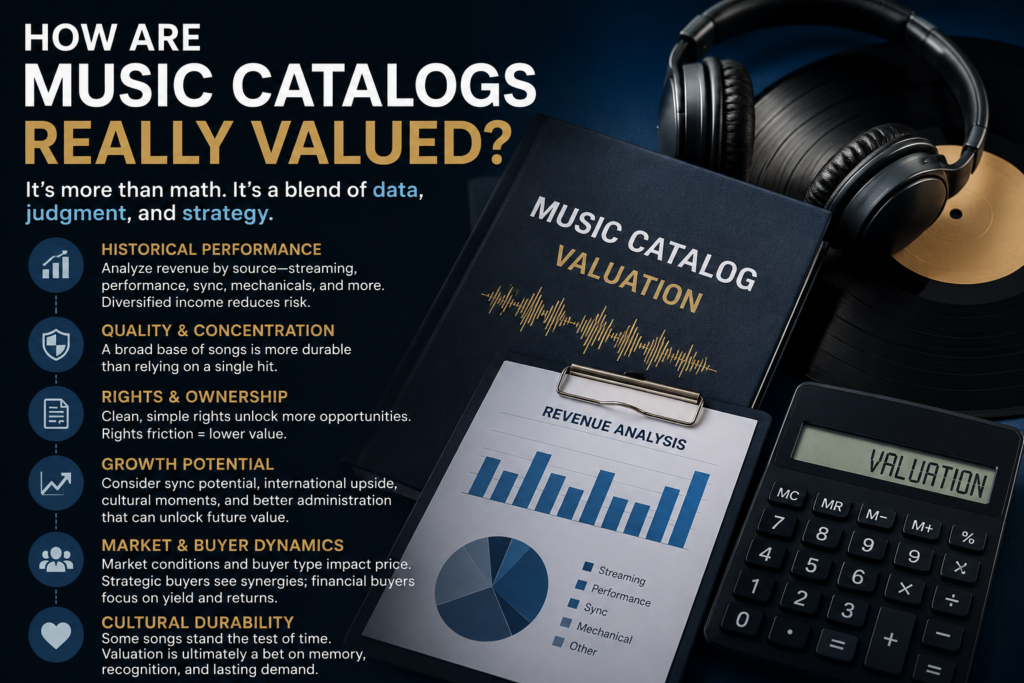
  • How Music Catalogs Are Really Valued

    Music catalog valuation looks simple from the outside. A buyer studies the royalty statements, decides what the songs have earned, puts a multiple on that income, and arrives at a price. In reality, it is far messier. A catalog is not a factory with fixed outputs. It is a living asset shaped by consumer taste, licensing activity, artist reputation, platform shifts, and how actively the rights are managed. That is why the best way to understand valuation is to think of it as a blend of math, judgment, and strategy.

    The first layer is historical performance. Buyers want to know what the catalog has actually done, not what someone hopes it might do. That means looking closely at the last several years of revenue by source. Streaming is usually the headline number because it is visible, recurring, and easy to model. But streaming is only one part of the picture. Performance income, mechanicals, sync licensing, neighboring rights, and other revenue streams can all matter. A catalog with diversified income is often more attractive than one that depends almost entirely on a single source. Diversification lowers risk and gives the buyer more confidence that a sudden change in one channel will not break the investment thesis.

    The second layer is quality of income. Not every dollar is equally valuable. If a catalog’s earnings come from a broad base of songs that continue to show up year after year, that is different from a catalog where one song carries everything. Concentration risk matters. A catalog built on one monster track can still be valuable, but the valuation process has to account for the possibility that interest in that one song fades. A deeper catalog with multiple recognizable works may look less flashy on paper but can be more durable over time.

    Then there is the question of rights. Are you buying publishing, masters, or both? Do the songs have straightforward ownership, or are there samples, multiple writers, conflicting approvals, and legacy complications? Rights friction can reduce value because it slows down monetization. A film and television supervisor wants a clean path. If every placement turns into a multi-party negotiation, some opportunities disappear before they begin. In other words, two songs with similar streaming profiles can have different valuations because one is easier to exploit commercially.

    Another major input is growth potential. Buyers do not pay only for what happened yesterday. They are trying to estimate what the catalog can earn tomorrow. That is where the process gets subjective. Can the catalog benefit from sync licensing? Is there international upside? Does the artist have an anniversary, documentary, biopic, or cultural reappraisal on the horizon? Could better administration or marketing unlock value that the current owner never pursued? Those questions matter because a buyer is not just buying income; they are buying the right to operate the asset better.

    Still, buyers have to be careful not to overpay for upside that may never arrive. A biopic, viral rediscovery, or social media resurgence can meaningfully lift a catalog, but those events are hard to predict with confidence. You cannot build an investment case entirely on wishful thinking. That is why seasoned buyers usually separate the base case from the blue-sky case. The base case depends on what the catalog is already proving in the market. The upside case is where smart operators can outperform, but it should not be the only reason the deal works.

    Music Catalogs Valuations

    Market conditions matter too. In a hot market, buyers may stretch on multiples because they believe music rights are scarce, attractive, and resilient. In a colder market, underwriting gets tougher and assumptions get stricter. Investor sentiment, interest rates, and access to capital all influence what feels like a reasonable price. A catalog is not valued in a vacuum. It is valued in a competitive market where different buyers have different cost-of-capital structures and different exit expectations.

    That brings up another overlooked issue: not every buyer values the same catalog the same way. A strategic music company may pay more than a financial buyer because it can integrate the rights into a broader platform. It may already have sync teams, global infrastructure, label relationships, and marketing channels that create incremental value. A private equity-style buyer, by contrast, may be more disciplined about cash yield and hold period. One sees synergies. The other sees return thresholds. Both are evaluating the same songs, but they are not solving for the same outcome.

    There is also a human element. Cultural relevance is difficult to reduce to a spreadsheet. Some songs have an emotional permanence that numbers only partially capture. They keep resurfacing at weddings, in stadiums, on classic playlists, in movie trailers, and in new generations’ listening habits. Catalog investors are ultimately making a bet on memory, recognition, and recurring demand. They are asking whether people will keep caring.

    So how are music catalogs really valued? By looking backward at revenue, sideways at risk, and forward at possibility. Historical cash flow sets the floor. Rights quality, concentration, licensing potential, and operational strategy shape the premium or discount. Market conditions and buyer type influence the final price. The spreadsheet matters, but so does judgment. That is why catalog valuation is never just arithmetic. It is the art of deciding how much cultural durability is worth in financial terms.

  • 5 Takeaways From Golnar Khosrowshahi’s Billboard’s“On the Record” Interview

    Golnar Khosrowshahi, founder and CEO of Reservoir Media, joined Billboard’s On the Record to discuss where the music catalog market stands in 2026 — and where it’s headed. Here are the five sharpest insights from the conversation.

    Golnar Khosrowshahi
    Golnar Khosrowshahi, CEO of Reservoir Media


    1. Multiples tell the whole story of the boom

    When Reservoir started buying catalogs in 2007, assets traded at just two to four times annual cash flow. Today, the same assets command 15 to 20 times — sometimes more. That shift reflects streaming’s rise from an uncertain experiment to the industry’s dominant revenue engine, turning music IP into a proven, perpetual cash flow asset that institutional investors now eagerly compete for.

    “We certainly saw it as an opportunity — but not through some sort of crystal ball.”


    2. The key valuation question: how long will people care?

    Genre matters in catalog valuation — but not in the way most people assume. The real question buyers ask is how widely a song is listened to, and how long that will last. Classic rock and timeless pop commands premium prices because the music has already proven its staying power across decades. Hip-hop, dance, and even country can fetch strong prices too — but buyers need to believe the music will still resonate in 10, 15, or 20 years.

    “Is it ‘Take Me Home, Country Roads’ — that you will keep listening to forever? Or is it a hit in the moment that won’t sustain that cultural impact two decades from now?”


    3. Relationships — not auctions — drive the best deals

    While the catalog boom brought competitive bidding wars and sky-high auction prices, Reservoir has largely avoided that game. Khosrowshahi says the company executes most of its significant deals off-market, built on long-term relationships with artists, songwriters, lawyers, and managers. That approach — combined with offering ongoing creative services and administration, not just a financial transaction — attracts sellers who care about how their legacy is managed, not just who writes the biggest check.

    “We weren’t really transacting through auction processes. Our business is based on relationships.”


    4. Sync, biopics, and “flipping” songs all move the needle

    A well-placed song in a hit TV show — think Euphoria or Grey’s Anatomy — can reintroduce a catalog to an entirely new generation of listeners. So can a biopic, a fashion collaboration, or a hot new artist sampling an older track. Reservoir knows this firsthand: their ownership of “Ready or Not” (via the Delfonics catalog) has benefited from multiple high-profile interpolations. The challenge, Khosrowshahi notes, is that none of these uplifts can be reliably predicted or baked into a valuation model — they’re upside, not guarantees.

    “There is a group of cornerstone songs that are suitable for this and will continue to have this revival.”


    5. AI is today’s version of the streaming uncertainty — and the principle is the same

    Khosrowshahi draws a direct parallel between the fear around streaming’s rise in the late 2000s and today’s uncertainty around AI-generated music. Her view: the delivery mechanism matters far less than protecting the underlying rights. Whether music is consumed via CD, ringtone, streaming, or some platform that doesn’t yet exist, the business model is fundamentally the same — IP gets licensed and revenue flows from that license. The priority now is ensuring AI-generated music properly compensates the catalogs it trains on.

    “The conduit matters less than the rights protection and the importance of maintaining copyright.”


    Based on Golnar Khosrowshahi’s appearance on On the Record, Billboard’s music industry podcast.