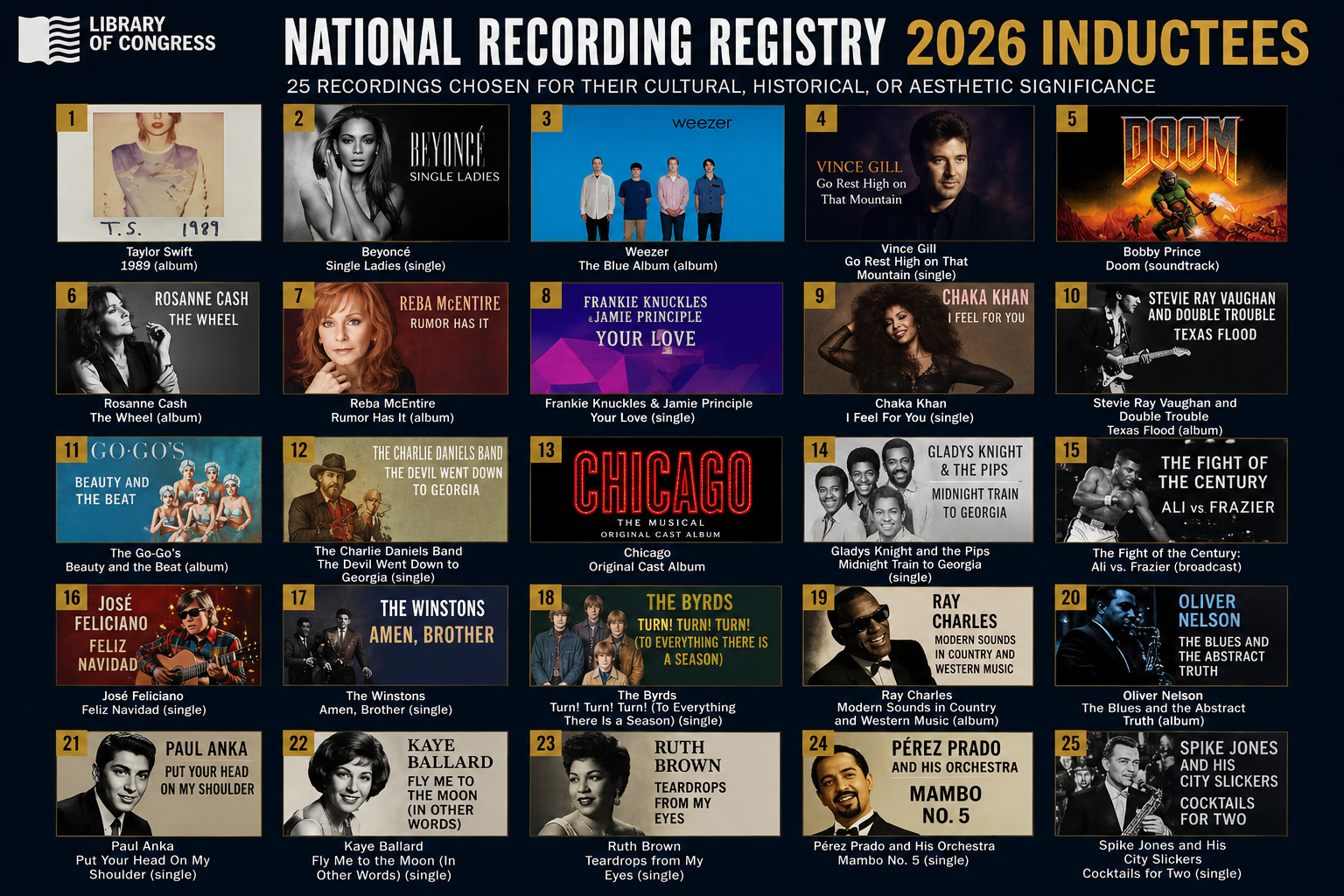
The Library of Congress has announced the newest class of recordings entering the 2026 National Recording Registry — a yearly preservation effort designed to protect audio recordings deemed “culturally, historically, or aesthetically significant.”
This year’s list is a fascinating mix of blockbuster pop, country standards, jazz landmarks, dance music pioneers, video game history, Broadway, classic broadcasts, and deeply influential catalog recordings that continue to shape streaming, licensing, sampling, and music culture decades later.
From Taylor Swift and 1989 to Weezer’s Weezer (The Blue Album) and the groundbreaking Doom soundtrack by Bobby Prince, the 2026 class shows how wide the modern music canon has become.
Why the National Recording Registry Matters
The Registry is more than nostalgia.
For artists, estates, labels, publishers, and catalog investors, induction into the Registry can reinforce the long-term cultural durability of a recording. These are the kinds of works that continue generating value through:
- Streaming
- Sync licensing
- Sampling
- Reissues
- Vinyl demand
- Film and television placement
- Cultural rediscovery cycles
- Social media resurgence
Many of these recordings are already deeply embedded into the American cultural bloodstream. Others may receive a renewed spotlight because of the induction itself.
In an era where catalog value increasingly depends on longevity, discoverability, and cross-generational relevance, the National Recording Registry acts almost like an institutional validation of permanence.
The Biggest Takeaways From 2026 National Recording Registry 2026 Class
1. Catalog Longevity Beats Recency
The inclusion of 1989 stands out because it is one of the newest recordings ever inducted.
That’s significant.
The Registry traditionally leans heavily toward older recordings whose historical importance has already stood the test of time. The rapid inclusion of 1989 signals how quickly modern blockbuster pop albums can become culturally foundational.
It also reinforces the staying power of superstar catalogs in the streaming era.
2. Video Game Music Is Now Officially Canon
The induction of the Doom soundtrack is another major moment.
Video game music is no longer niche nostalgia. It is now formally recognized as part of America’s recorded cultural history.
That matters because gaming soundtracks increasingly function like traditional entertainment IP:
- Streaming assets
- Live performance material
- Vinyl collectibles
- Licensing opportunities
- Fan-community engagement engines
Gaming catalogs are becoming real catalog businesses.
3. Dance Music’s Architects Are Finally Getting Their Due
Frankie Knuckles and Jamie Principle’s Your Love represents a huge acknowledgment of house music’s foundational influence.
Chicago house music helped shape modern EDM, pop production, remix culture, and club music economics globally.
The Registry recognizing dance music history reflects how electronic genres have moved from underground subculture into institutional legitimacy.
4. Sampling History Continues to Matter
The inclusion of Amen, Brother by The Winstons is especially fascinating.
The track contains the famous “Amen Break” — one of the most sampled drum breaks in music history.
That single recording influenced:
- Hip-hop
- Jungle
- Drum and bass
- Electronic music
- Modern beat production
One drum pattern became a foundational building block for entire genres.
Few examples better demonstrate how catalog value can compound in unpredictable ways over decades.
The Full 2026 National Recording Registry Class
1989 — Taylor Swift
Single Ladies (Put a Ring on It) — Beyoncé
Weezer (The Blue Album) — Weezer
Go Rest High on That Mountain — Vince Gill
Doom soundtrack — Bobby Prince
The Wheel — Rosanne Cash
Rumor Has It — Reba McEntire
Your Love — Frankie Knuckles & Jamie Principle
I Feel for You — Chaka Khan
Texas Flood — Stevie Ray Vaughan and Double Trouble
Beauty and the Beat — The Go-Go’s
The Devil Went Down to Georgia — The Charlie Daniels Band
Chicago Original Cast Album
Midnight Train to Georgia — Gladys Knight & the Pips
The Fight of the Century broadcast
Feliz Navidad — José Feliciano
Amen, Brother — The Winstons
Turn! Turn! Turn! (To Everything There Is a Season) — The Byrds
Modern Sounds in Country and Western Music — Ray Charles
The Blues and the Abstract Truth — Oliver Nelson
Put Your Head on My Shoulder — Paul Anka
Fly Me to the Moon — Kaye Ballard
Teardrops from My Eyes — Ruth Brown
Mambo No. 5 — Pérez Prado and His Orchestra
Cocktails for Two — Spike Jones and His City Slickers
Final Thought
The Registry increasingly reflects a broader definition of what matters culturally.
Rock, pop, jazz, country, hip-hop-adjacent sampling culture, dance music, gaming audio, Broadway, holiday music, and sports broadcasting now all sit under the same preservation umbrella.
That evolution mirrors what’s happening in the catalog business itself.
The modern catalog economy is no longer just about classic rock radio. It’s about multi-format intellectual property that can survive format changes, platform shifts, and generational turnover.
And the recordings that survive longest tend to become the most valuable.