Tag: sync licensing

  • The Michael Jackson Estate’s Biggest Opportunity: Repositioning the 1990s Catalog

    Introduction: A Catalog Imbalance Hiding in Plain Sight

    The catalog of Michael Jackson is one of the most valuable in music history. However, it is also uneven.

    On one hand, his 1980s output—Thriller, Bad, Off the Wall—continues to dominate streaming platforms, SiriusXM rotation, and cultural memory. Meanwhile, his 1990s catalog remains underplayed, under-discussed, and under-monetized.

    Importantly, this is not a quality issue. Rather, it is a positioning problem.


    The 1990s Were Bigger Than We Remember

    Dangerous (1991): A Commercial Powerhouse

    The album Dangerous was a commercial powerhouse. It produced major global hits such as “Black or White,” “Remember the Time,” “In the Closet,” and “Jam.”

    At the time, these songs defined pop music on a global scale. Today, however, they are not programmed with the same consistency as his 80s catalog.

    As a result, a generation of listeners associates Michael Jackson primarily with his earlier work, even though the 90s output was substantial.


    HIStory (1995): The Narrative Shift

    HIStory: Past, Present and Future, Book I marked a tonal and thematic pivot.

    Key tracks include:

    • “They Don’t Care About Us”
    • “Scream” (with Janet Jackson)
    • “Stranger in Moscow”
    • “Earth Song”
    • “You Are Not Alone”

    These songs were:

    • More political
    • More introspective
    • More cinematic

    And that shift changed how they age—and how they’re consumed today.


    Why the 90s Catalog Underperforms Today

    1. It Doesn’t Fit Easy Listening Lanes

    The 80s catalog is frictionless:

    • Instant recognition
    • Works in party settings
    • Fits “classic hits” formats

    The 90s catalog is different:

    • Slower
    • Heavier
    • More thematic

    Songs like:

    • “Earth Song”
    • “Stranger in Moscow”

    Don’t slot easily into algorithm-driven playlists or radio formats.


    2. The Narrative Became Complicated

    By the mid-1990s, the story around Michael Jackson changed.

    Music was no longer the only lens:

    • Tabloid coverage intensified
    • Public perception shifted
    • Personal controversy became part of the narrative

    That context affects how songs are remembered and programmed.

    Even a #1 hit like “You Are Not Alone” doesn’t receive consistent rotation today.


    3. There’s a “Story Gap” in the Catalog

    The arc is clear:

    • 70s: emergence
    • 80s: peak dominance
    • 90s: unclear positioning

    Without a defined narrative, the 90s catalog becomes fragmented—and easier to overlook.


    The Reframe: The Cinematic, Global, and Burden of Fame Era

    The 1990s catalog shouldn’t be treated as “post-peak.”

    It should be positioned as:

    Michael Jackson’s cinematic, global era—where the music reflects the weight and consequences of unprecedented fame.

    This reframing connects the work:

    • “Scream” → backlash
    • “They Don’t Care About Us” → defiance
    • “Stranger in Moscow” → isolation
    • “Earth Song” → global consciousness

    Now it’s not a scattered era.

    It’s a cohesive narrative.


    How the Estate Can Unlock Value

    1. Use Film as a Catalyst

    A sequel to Michael presents the strongest opportunity.

    Film doesn’t just revisit music—it reframes it.

    If the 90s are presented as a turning point:

    • Streaming spikes follow
    • Cultural re-evaluation begins
    • Under

    The 1990s Were Bigger Than We Remember

    Dangerous (1991): A Commercial Powerhouse

    The album Dangerous produced major global hits:

    • “Black or White”
    • “Remember the Time”
    • “In the Closet”
    • “Jam”

    These were not minor successes—they were defining records of the era.

    Yet today, they are not programmed or remembered with the same consistency as his 80s work.

    HIStory (1995): The Narrative Shift

    By contrast, HIStory: Past, Present and Future, Book I marked a tonal shift.

    It introduced songs like:

    • “They Don’t Care About Us”
    • “Scream” (with Janet Jackson)
    • “Stranger in Moscow”
    • “Earth Song”

    Notably, these tracks were more political, more introspective, and more cinematic. Because of this, they do not fit neatly into traditional radio formats or algorithm-driven playlists.

    Why the 90s Catalog Underperforms Today

    The 80s catalog is frictionless. For example, it works in party settings, gyms, and “classic hits” formats.

    In contrast, the 90s catalog is slower and more thematic. Therefore, songs like “Earth Song” and “Stranger in Moscow” struggle to find a consistent home in modern programming.

    2. The Narrative Became Complicated

    At the same time, the broader narrative around Michael Jackson changed in the 1990s.

    Music was no longer the only lens. Instead, media coverage and personal controversy began to shape public perception.

    Consequently, even major hits like “You Are Not Alone” do not receive consistent rotation today.

    3. There’s a “Story Gap” in the Catalog

    The arc is clear:

    • 70s: emergence
    • 80s: peak dominance
    • 90s: unclear positioning

    Without a defined narrative, the 90s catalog becomes fragmented—and easier to overlook.

    A Quick Data Check: The Rotation Gap Is Real

    To validate the narrative, it helps to look at real-world airplay.

    Over the last 30 days (April 4 – May 4), the gap is clear.

    On 80s on 8, Michael Jackson has five songs among the most-played tracks. Notably, all five come from Thriller.

    In other words, his 1980s presence is not just strong—it is concentrated around a single, dominant tentpole.

    By contrast, the 1990s tell a very different story.
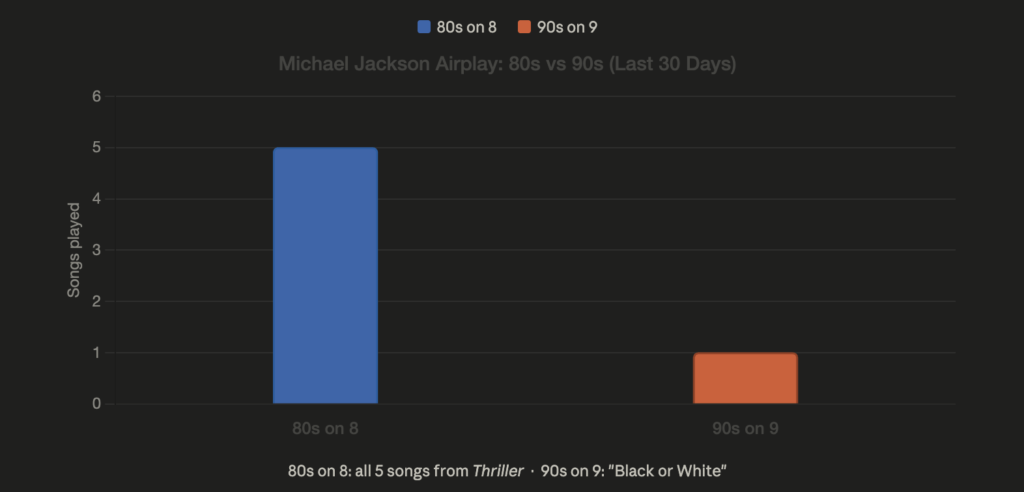
    On 90s on 9, Jackson has just one song in the most-played rotation: “Black or White” from Dangerous.

    Even more interesting, that track ranks #6 overall—and stands as one of the most-played songs from 1991 on the channel.

    However, despite that strong individual performance, the broader 1990s catalog remains largely absent from rotation.

    At the same time, 90s on 9 tends to skew toward the late 1990s, which may further limit exposure for earlier-decade Jackson releases. Still, that alone doesn’t explain the gap.

    Ultimately, the data reinforces the core point:

    The issue isn’t that the 1990s catalog lacks hits—it’s that only one of them consistently breaks through modern programming filters.


    Why This Matters

    Taken together, this creates a clear imbalance:

    • The 1980s catalog is deep, visible, and repeatedly surfaced
    • The 1990s catalog is shallow in rotation, despite proven success

    As a result, listener perception follows exposure—not history.

    And right now, the exposure is telling a very incomplete story.


    The Reframe: The Cinematic, Global, and Burden of Fame Era

    The 1990s catalog shouldn’t be treated as “post-peak.”

    It should be positioned as:

    Michael Jackson’s cinematic, global era—where the music reflects the weight and consequences of unprecedented fame.

    This reframing connects the work:

    • “Scream” → backlash
    • “They Don’t Care About Us” → defiance
    • “Stranger in Moscow” → isolation
    • “Earth Song” → global consciousness

    Now it’s not a scattered era.

    It’s a cohesive narrative.

    How the Estate Can Unlock Value

    1. Use Film as a Catalyst

    A sequel to Michael presents the strongest opportunity.

    Film doesn’t just revisit music—it reframes it.

    If the 90s are presented as a turning point:

    • Streaming spikes follow
    • Cultural re-evaluation begins
    • Underplayed songs gain context

    2. Create New Programming Lanes

    The solution is not forcing 90s songs into old categories.

    It’s building new ones:

    • Cinematic pop
    • Global anthems
    • Fame and pressure narratives

    Right now, these songs are effectively “homeless” in modern programming.

    3. Lean Into Depth, Not Nostalgia

    The 80s catalog thrives on nostalgia.

    The 90s catalog thrives on meaning.

    That distinction matters.

    Songs like:

    • “Earth Song”
    • “Stranger in Moscow”

    Are not background music.

    They are emotional, thematic pieces that require a different listening context.

    The Business Case: A Mispriced Asset

    Catalog value is driven by:

    • Frequency of play
    • Cultural relevance
    • Licensing demand

    Today:

    • 80s MJ = high-frequency assets
    • 90s MJ = low-frequency assets

    That gap is not about quality.

    It’s about positioning.

    The 1990s catalog is a mispriced asset that requires narrative activation to unlock its full value.

    Conclusion

    The music is already there. The hits already exist.

    What’s missing, however, is the story.

    Until the 1990s era is reframed as a distinct and essential chapter—defined by scale, pressure, and global ambition—it will remain underutilized.

    Ultimately, this represents one of the clearest opportunities in modern catalog management.

  • How sync licensing really works — and why a TV placement can change a song’s value overnight

    A single TV placement can send a decades-old song to the top of streaming charts overnight. Golnar Khosrowshahi, founder and CEO of Reservoir Media, explains how sync licensing actually works — and why it’s one of the most powerful and unpredictable forces in the catalog market — in her appearance on Billboard’s On the Record.


    1. Sync is the most powerful discovery engine in the industry

    When a song lands in the right scene of the right show at the right moment, it can introduce that music to an entirely new generation of listeners who had never heard it before. Grey’s Anatomy pioneered this in the mid-2000s, becoming not just a hit drama but a genuine music discovery platform — to the point where landing a placement on the show became an explicit goal for songwriters. Euphoria carried that torch into the streaming era, pairing emotionally charged scenes with carefully curated music that sparked streaming spikes and cultural conversations.

    “Grey’s Anatomy really started this trend of not only being a show everyone was glued to, but being a place where people were discovering music.”


    2. The streaming uplift is real but varies enormously

    Not every placement creates the same effect. A song featured in a pivotal season finale of a culturally dominant show will generate a very different response than background music in a mid-season episode. Khosrowshahi points to Sinead O’Connor’s “Drink Before the War” — a Reservoir catalog asset — which was featured in a key scene of Euphoria Season 2 and drove meaningful renewed interest in O’Connor’s catalog. Shows that have built a reputation for sophisticated musical taste, where audiences actively seek out the soundtrack, consistently deliver stronger and more durable uplifts.

    “Euphoria has captured this persona of having sophisticated musical taste and being very deliberate about the music — and people are still seeking gatekeepers like that.”


    3. Biopics are the ultimate sync play for catalog owners

    A well-made biopic does what no single TV placement can: it immerses an audience in an artist’s entire story and catalog for two hours, then sends them to streaming platforms to explore further. The Johnny Cash biopic was a landmark moment for catalog revival. More recently, the Bob Dylan biopic — with Timothée Chalamet in the lead — represents the same opportunity at enormous scale. Khosrowshahi sees the surge in music biopics as partly driven by catalog owners who now have both the financial resources and the incentive to fund or facilitate these projects.

    “More liquidity and bigger budgets enable either rights holders or filmmakers adjacent to music companies to underwrite these projects — that’s why you’re seeing more of them.”


    4. Some music simply cannot be synced — and that has a cost

    Sync licensing requires clean rights and content that advertisers and studios are willing to associate their brand or project with. Music with heavy use of expletives, uncleared samples with multiple credited writers, or complicated rights chains is effectively locked out of much of the sync market. For catalog buyers evaluating a potential acquisition, the sync ceiling is a material part of the valuation. A catalog that has historically said no to licensing — or that simply can’t be cleared — is worth materially less than one that is open and accessible.

    “You could have music that has historically just said no to licensing — that creates a whole bunch of opportunity. Or music with uncleared samples that can’t easily be licensed at all.”


    5. You can’t engineer a sync moment — but you can position for one

    The most valuable sync placements are the ones that emerge organically from a music supervisor genuinely falling in love with a song for a specific scene. They cannot be bought or manufactured. What catalog owners can control is making sure their music is in front of as many supervisors as possible, that the rights are clean and quick to clear, and that the catalog is actively maintained and promoted. The placement itself is unpredictable; the preparation for it is not.

    “Our sync team is very aware of what the trends are and what the licensing future looks like — is this something we think we can do better marketing to the music supervisors in our database?”


    Based on Golnar Khosrowshahi’s appearance on On the Record, Billboard’s music industry podcast.

  • Why genre matters (and doesn’t) when selling your music catalog

    Ask most people which genre commands the highest prices in the catalog market and they’ll say classic rock. They’re not wrong — but they’re not exactly right either. Golnar Khosrowshahi, founder and CEO of Reservoir Media, offers a more nuanced take on her appearance on Billboard’s On the Record.


    1. Genre is a proxy for the question buyers actually care about

    Catalog buyers don’t value genre for its own sake. What they’re really evaluating is how widely a song is listened to and how long that appeal is likely to last. Classic rock tends to score well on both dimensions — hence the premium prices — but the underlying logic applies across every genre. A country artist with four decades of proven radio presence is a fundamentally different investment proposition than a dance artist whose biggest hits came out three years ago, regardless of genre.

    “I would break it down as: how widespread is the listenership and how long is that going to last? At what rate is the revenue on this music going to decay?”


    2. Longevity is the real premium, not genre

    There is a finite group of artists and songwriters across every genre who will command truly elite catalog prices. What they share is not a sound or a style — it’s the proven ability to remain culturally relevant long after their peak commercial moment. “Take Me Home, Country Roads” is licensed constantly, covered endlessly, and embedded in American culture in a way that generates consistent revenue decade after decade. That kind of staying power is what justifies a premium multiple, whether the music is country, jazz, pop, or soul.

    “There is a finite group of artists and songwriters across genre who will command that premium — and everything else comes down to what this will be worth in 10, 15, 20 years.”


    3. Hip-hop and dance face real headwinds in sync licensing

    One area where genre genuinely creates friction is sync licensing — the placement of music in films, TV shows, and advertisements. Music with heavy use of expletives or that relies on uncleared samples from other recordings is simply harder to license for these purposes. Advertisers need clean clearances; film and TV supervisors need straightforward rights chains. That doesn’t make hip-hop or dance catalogs worthless — but it does reduce the ceiling on one of the most lucrative revenue streams available to catalog owners.

    “We are going to be more or less optimistic on film and TV sync if we’re looking at music filled with expletives. That’s not going to be easy.”


    4. Geography creates unexpected opportunities

    The catalog market is global, and listener behavior doesn’t always follow obvious patterns. Miles Davis is enormously popular in Japan and France. Country music has a passionate following in France. These cross-cultural affinities can meaningfully expand the revenue base for catalogs that might otherwise seem niche — and they’re easy to overlook if you’re only thinking about domestic streaming numbers when running your valuation.

    “There are pockets of genre-geography marriages that are very, very surprising. Country music is very popular in France.”


    5. The real risk is music that was big in the moment but won’t last

    Every era produces songs that feel culturally definitive at the time but fade quickly from the cultural conversation. Catalog buyers are acutely aware of this risk. A song can be a genuine #1 hit, a genuine cultural moment, and still not be worth much as a catalog asset if there’s no reason to believe people will still be listening to it in 2040. The question isn’t whether a song was important — it’s whether it’s durable.

    “Some hits don’t really stick around. They could be a culturally defining moment — but that doesn’t mean they will sustain that cultural impact two decades from now.”


    Based on Golnar Khosrowshahi’s appearance on On the Record, Billboard’s music industry podcast.

  • Why Artists Should Treat Their Music Catalog Like a Family Business

    There’s a quiet shift happening in the music industry — and most artists are missing it.

    For decades, the dream was simple: write great songs, get famous, and eventually cash out. Sell the catalog, take the money, and move on.

    But that model is starting to look short-sighted.

    Because a music catalog isn’t just a collection of songs.

    It’s a cash-flowing asset. A brand. A long-term business.

    And the artists who understand that are starting to think very differently.


    🎸 The Old Model: Build, Peak, Sell

    Historically, artists treated their catalog like a final paycheck.

    You build value over time:

    • Release albums
    • Generate hits
    • Accumulate royalties

    Then one day, you sell:

    • Private equity firm
    • Music publisher
    • Label-backed fund

    We’ve seen this play out again and again:

    • Bob Dylan sells publishing
    • Bruce Springsteen sells masters
    • Stevie Nicks sells catalog stake

    From a financial perspective, it makes sense:

    • Immediate liquidity
    • Risk transfer
    • Estate simplicity

    But here’s the problem:

    You’re selling the one asset that can pay you — and your family — forever.


    💰 The New Reality: Catalogs Are Perpetual Cash Machines

    Streaming changed everything.

    In the past, revenue was front-loaded:

    • Album sales
    • Radio play
    • Touring cycles

    Now, catalogs generate ongoing, compounding income:

    • Spotify / Apple Music streams
    • YouTube monetization
    • Sync licensing (film, TV, ads)
    • Algorithmic discovery

    A song released 30 years ago can still produce meaningful revenue today — sometimes more than when it was released.

    That’s why albums like:

    • Legend
    • Greatest Hits

    continue to generate millions annually.

    These aren’t just albums anymore.

    They’re income-producing portfolios.


    🧠 The Mental Shift: From Artist to Asset Owner

    This is where things get interesting.

    The artists who win long-term don’t just think like creators — they think like owners.

    Instead of asking:

    “How much can I sell this for?”

    They ask:

    “How much can this generate over 30–50 years?”

    That’s a completely different mindset.

    It’s closer to:

    • Real estate investing
    • Dividend stocks
    • Private equity hold strategies

    And it leads to a different conclusion:

    Selling your catalog might be the least optimal move.


    🏛️ The Family Business Model

    Think about a music catalog like a family-owned company.

    You wouldn’t sell a profitable business that:

    • Requires minimal overhead
    • Generates recurring revenue
    • Appreciates over time

    You’d:

    • Protect it
    • Grow it
    • Pass it down

    Music catalogs work the same way.

    A well-managed catalog can:

    • Fund education for future generations
    • Provide consistent income
    • Increase in value as platforms expand

    A hit song isn’t just a moment. It’s an annuity.


    ⚖️ Why Some Artists Still Sell

    To be fair, selling isn’t always wrong.

    There are legitimate reasons:

    • Estate planning complexity
    • Tax optimization
    • Lack of management infrastructure
    • Desire for immediate liquidity

    But increasingly, those decisions are being made under pressure from:

    • Private equity firms
    • Catalog aggregators
    • Institutional buyers

    And those buyers are betting on one thing:

    That the catalog is worth more in the future than what they’re paying today.


    🎯 The Strategic Alternative: Partner, Don’t Sell

    Instead of selling outright, artists have more options than ever:

    • Partial sales (retain control)
    • Joint ventures (share upside)
    • Administration deals (outsource management)
    • Licensing optimization (increase revenue without selling)

    This is where the smartest artists are going.

    They’re treating their catalog like:

    A business to operate — not an asset to exit.


    🔥 The Hidden Opportunity

    Here’s the bigger picture — and it’s where things get really interesting.

    Most artists are:

    • Undermanaging their catalog
    • Undermonetizing their rights
    • Ignoring long-tail value

    Which means there’s a massive opportunity for:

    • Consultants
    • Analysts
    • Operators

    To step in and treat catalogs like:

    • Data assets
    • Financial instruments
    • Strategic businesses

    🟡 Final Thought

    For years, the industry taught artists to chase hits.

    But the real game isn’t hits.

    It’s ownership.

    A catalog isn’t a payday. It’s a dynasty.

    And the artists who understand that will build something far more valuable than a moment of success.

    They’ll build something that lasts.

  • Why Sync Licensing Matters So Much in Catalog Value

    Sync licensing can change the trajectory of a music catalog faster than almost any other commercial lever. A song that has been quietly earning for years can suddenly surge because it lands in a hit television show, a movie trailer, a global ad campaign, or a viral scene that brings it to a new audience. That is why sync matters so much in catalog valuation. It is not just another revenue line. It can act as both direct income and an engine for broader catalog reactivation.

    At the most basic level, sync licensing generates money because the rights holder is paid to pair music with visual media. That payment can be meaningful on its own, especially for high-profile placements. But the bigger reason investors care is that sync often creates a second wave of consumer attention. A placement can lead to a spike in streams, Shazam activity, playlist adds, social conversation, and cultural relevance. In some cases, the sync fee is only the beginning. The real value comes from renewed discovery.

    This is especially important for older catalogs. A legacy song may already have proven durability, but a sync placement can introduce it to a generation that did not grow up with it. Suddenly the song is not just “old”; it is current again. That kind of renewal is incredibly valuable because it extends the commercial life of the asset. Catalog buyers love signals that suggest a song can travel through time and still connect.

    Sync also matters because it can diversify income. Streaming is central to modern royalty economics, but it is not the only source of value. When a catalog has credible sync potential, it becomes less dependent on passive consumption patterns alone. The rights holder has a more active way to create moments. That is attractive from an investment standpoint because it means the asset can be managed, not merely observed.

    But not all songs are equally syncable. Some music fits visual storytelling more naturally than others. Lyrics matter. Tone matters. Mood matters. Genre matters. So does simplicity of clearance. If a song has many writers, samples, approval hurdles, or ambiguous ownership, it may be harder to place, even if it is artistically perfect. Supervisors and brands often want the clearest path to execution. A great song with a messy rights chain can lose out to a slightly less perfect song that is easy to license.

    This is where catalog valuation gets more nuanced. Buyers do not simply ask, “Has this catalog earned sync revenue before?” They also ask, “Could it earn more under stronger management?” A catalog that has been underexploited may look more attractive to a buyer with a dedicated sync team, better relationships, or a more aggressive licensing strategy. The same songs can be worth more in the hands of an operator who knows how to package and pitch them.

    There is also a halo effect to consider. A successful placement can elevate not just one song, but the wider artist brand or catalog identity. A film scene, a prestige drama, a documentary, or an ad campaign can trigger press, conversation, and rediscovery. People start listening beyond the placed track. They revisit albums, interviews, images, and adjacent songs. In that sense, sync can function as a cultural marketing event as much as a licensing transaction.

    Still, buyers have to be careful. Sync is important, but it is not guaranteed. Some songs are obvious sync candidates and still never land the big placement everyone imagines. Trends change. Supervisors have taste. Brands get cautious. Competitive dynamics shift. The right scene may never materialize. That is why sync upside should enhance a catalog thesis, not replace it. A strong catalog should work even without a dream placement.

    The best way to think about sync is as optionality. It gives the rights holder more ways to create value from the same underlying songs. It can produce direct fees, increase downstream consumption, refresh relevance, and deepen cross-generational awareness. Those are powerful outcomes, especially in a market where cultural attention is fragmented.

    So why does sync licensing matter so much in catalog value? Because it connects the financial logic of ownership with the emotional logic of discovery. A song placed in the right context becomes newly alive. And when a catalog can reliably generate those moments, the market will usually pay more for the possibility.