Tag: streaming

  • The Library of Congress Just Added 25 More Recordings to America’s Audio Time Capsule

    The Library of Congress Just Added 25 More Recordings to America’s Audio Time Capsule

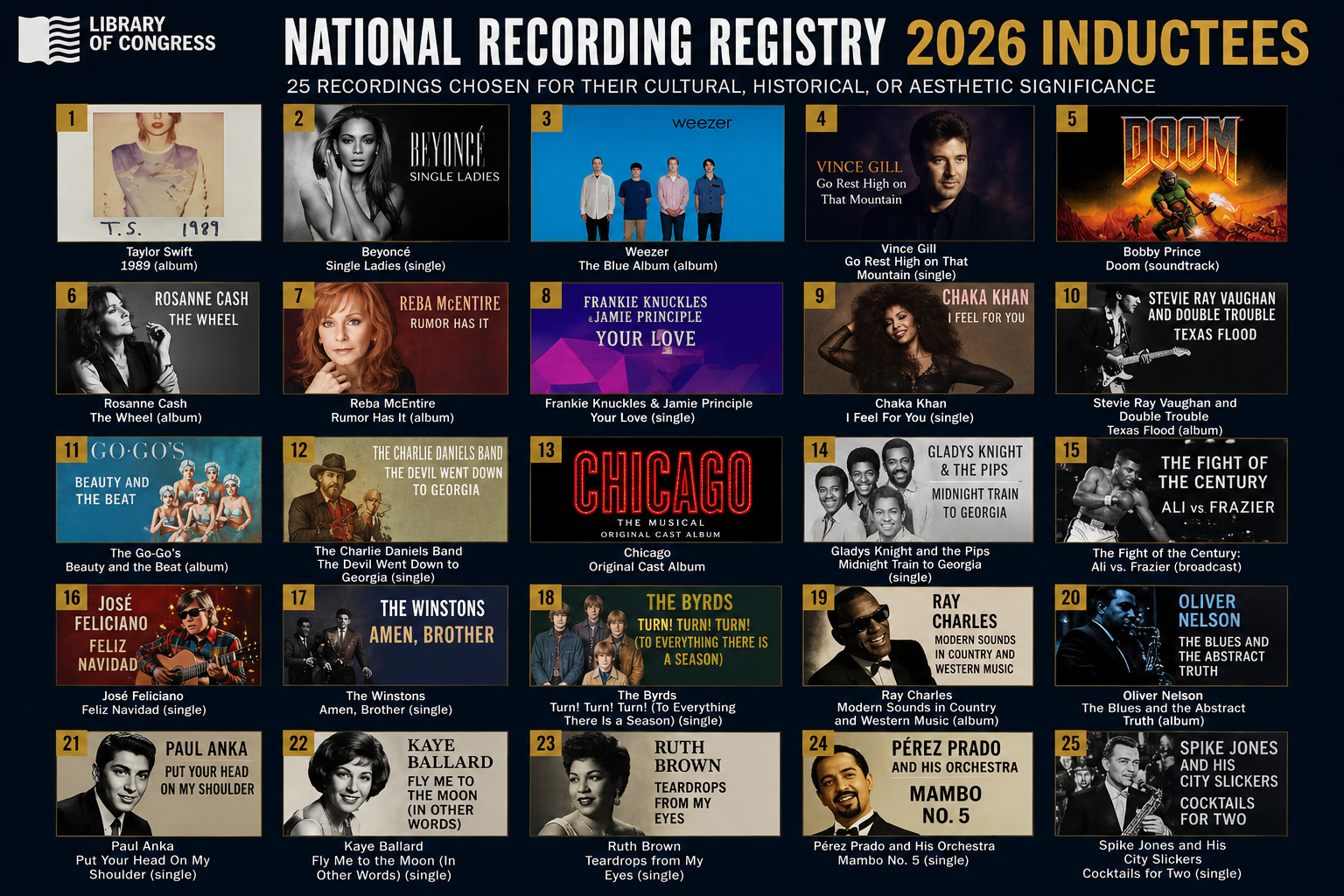
    The Library of Congress has announced the newest class of recordings entering the 2026 National Recording Registry — a yearly preservation effort designed to protect audio recordings deemed “culturally, historically, or aesthetically significant.”

    This year’s list is a fascinating mix of blockbuster pop, country standards, jazz landmarks, dance music pioneers, video game history, Broadway, classic broadcasts, and deeply influential catalog recordings that continue to shape streaming, licensing, sampling, and music culture decades later.

    From Taylor Swift and 1989 to Weezer’s Weezer (The Blue Album) and the groundbreaking Doom soundtrack by Bobby Prince, the 2026 class shows how wide the modern music canon has become.

    Why the National Recording Registry Matters

    The Registry is more than nostalgia.

    For artists, estates, labels, publishers, and catalog investors, induction into the Registry can reinforce the long-term cultural durability of a recording. These are the kinds of works that continue generating value through:

    • Streaming
    • Sync licensing
    • Sampling
    • Reissues
    • Vinyl demand
    • Film and television placement
    • Cultural rediscovery cycles
    • Social media resurgence

    Many of these recordings are already deeply embedded into the American cultural bloodstream. Others may receive a renewed spotlight because of the induction itself.

    In an era where catalog value increasingly depends on longevity, discoverability, and cross-generational relevance, the National Recording Registry acts almost like an institutional validation of permanence.
    2026 National Recording Registry 2026 Inductees

    The Biggest Takeaways From 2026 National Recording Registry 2026 Class

    1. Catalog Longevity Beats Recency

    The inclusion of 1989 stands out because it is one of the newest recordings ever inducted.

    That’s significant.

    The Registry traditionally leans heavily toward older recordings whose historical importance has already stood the test of time. The rapid inclusion of 1989 signals how quickly modern blockbuster pop albums can become culturally foundational.

    It also reinforces the staying power of superstar catalogs in the streaming era.

    2. Video Game Music Is Now Officially Canon

    The induction of the Doom soundtrack is another major moment.

    Video game music is no longer niche nostalgia. It is now formally recognized as part of America’s recorded cultural history.

    That matters because gaming soundtracks increasingly function like traditional entertainment IP:

    • Streaming assets
    • Live performance material
    • Vinyl collectibles
    • Licensing opportunities
    • Fan-community engagement engines

    Gaming catalogs are becoming real catalog businesses.

    3. Dance Music’s Architects Are Finally Getting Their Due

    Frankie Knuckles and Jamie Principle’s Your Love represents a huge acknowledgment of house music’s foundational influence.

    Chicago house music helped shape modern EDM, pop production, remix culture, and club music economics globally.

    The Registry recognizing dance music history reflects how electronic genres have moved from underground subculture into institutional legitimacy.

    4. Sampling History Continues to Matter

    The inclusion of Amen, Brother by The Winstons is especially fascinating.

    The track contains the famous “Amen Break” — one of the most sampled drum breaks in music history.

    That single recording influenced:

    • Hip-hop
    • Jungle
    • Drum and bass
    • Electronic music
    • Modern beat production

    One drum pattern became a foundational building block for entire genres.

    Few examples better demonstrate how catalog value can compound in unpredictable ways over decades.

    The Full 2026 National Recording Registry Class
    1989 — Taylor Swift
    Single Ladies (Put a Ring on It) — Beyoncé
    Weezer (The Blue Album) — Weezer
    Go Rest High on That Mountain — Vince Gill
    Doom soundtrack — Bobby Prince
    The Wheel — Rosanne Cash
    Rumor Has It — Reba McEntire
    Your Love — Frankie Knuckles & Jamie Principle
    I Feel for You — Chaka Khan
    Texas Flood — Stevie Ray Vaughan and Double Trouble
    Beauty and the Beat — The Go-Go’s
    The Devil Went Down to Georgia — The Charlie Daniels Band
    Chicago Original Cast Album
    Midnight Train to Georgia — Gladys Knight & the Pips
    The Fight of the Century broadcast
    Feliz Navidad — José Feliciano
    Amen, Brother — The Winstons
    Turn! Turn! Turn! (To Everything There Is a Season) — The Byrds
    Modern Sounds in Country and Western Music — Ray Charles
    The Blues and the Abstract Truth — Oliver Nelson
    Put Your Head on My Shoulder — Paul Anka
    Fly Me to the Moon — Kaye Ballard
    Teardrops from My Eyes — Ruth Brown
    Mambo No. 5 — Pérez Prado and His Orchestra
    Cocktails for Two — Spike Jones and His City Slickers

    Final Thought

    The Registry increasingly reflects a broader definition of what matters culturally.

    Rock, pop, jazz, country, hip-hop-adjacent sampling culture, dance music, gaming audio, Broadway, holiday music, and sports broadcasting now all sit under the same preservation umbrella.

    That evolution mirrors what’s happening in the catalog business itself.

    The modern catalog economy is no longer just about classic rock radio. It’s about multi-format intellectual property that can survive format changes, platform shifts, and generational turnover.

    And the recordings that survive longest tend to become the most valuable.

  • What the De La Soul catalog story teaches us about uncleared samples and digital distribution

    For years, De La Soul’s pioneering catalog was effectively invisible to an entire generation of listeners — absent from every streaming platform because of uncleared samples buried in the music. Golnar Khosrowshahi, founder and CEO of Reservoir Media, shares what it took to finally bring it online in her appearance on Billboard’s On the Record.


    1. Uncleared samples can lock an entire catalog off streaming platforms

    When Reservoir acquired the Tommy Boy Records catalog in June 2021, one of the most urgent priorities was De La Soul’s music, which had never been available on digital streaming platforms due to uncleared samples embedded throughout their recordings. The group were pioneers of hip-hop’s golden era and among the most critically lauded artists in the genre’s history — yet an entire generation of listeners had no easy way to access their music. Every uncleared sample was a legal liability that had to be resolved before a single track could go live.

    “We purchased Tommy Boy in June of 2021. The first call was to them — and then we spent 18 months clearing the samples.”


    2. Sample clearance is one of the most labor-intensive processes in the business

    The 18-month clearance process for the De La Soul catalog was run on Excel spreadsheets, weekly phone calls, and extensive human coordination — tracking down rights holders, negotiating terms, and documenting every cleared sample one by one. For a catalog as sample-dense as De La Soul’s, this was an enormous undertaking. It required Reservoir to trace the ownership of dozens of interpolated recordings, often across multiple rights holders, label mergers, and estate arrangements. The complexity is a window into why so many catalogs with uncleared samples simply sit in limbo rather than getting resolved.

    “It was run on an Excel spreadsheet with weekly phone calls and a lot of human interaction and recall — an 18-month exercise to get the music ready for the first time on digital platforms.”


    3. Clearing samples can unlock enormous additional value

    Getting De La Soul’s music onto streaming platforms was not just a logistical achievement — it was a commercial one. Once the catalog was live, it was eligible for sync licensing opportunities that had previously been off the table. One of the first to materialize: “3 Is the Magic Number” appearing in the credits of Spider-Man in November, just weeks before Reservoir released the first De La Soul single in January 2023 and the full catalog on March 3rd. A song that had been stuck in legal limbo suddenly had one of the biggest possible promotional platforms in the world.

    “That opened up licensing for ‘3 Is the Magic Number’ in the credits of Spider-Man — which happened the November before we released the music.”


    4. The human cost was devastating — and the timing made it worse

    The clearance work and the eventual streaming release were meant to be a triumphant moment for De La Soul — a long overdue recognition of their legacy and a chance for the three members to finally see their music reach the audience it deserved. Instead, founding member Dave Jolicoeur passed away just weeks before the catalog went live, leaving the group and the Reservoir team to navigate the release in the shadow of grief. For Khosrowshahi, the loss was not primarily a business setback — it was a deeply personal one.

    “What made me the most sad was that they wouldn’t enjoy this moment together, the three of them — with their families. It was going to be such an important moment for them.”


    5. AI could transform sample clearance — and the implications are significant

    Khosrowshahi reflects that the same 18-month clearance process, if undertaken today with AI-assisted tools, could potentially be compressed to a fraction of the time. Sample identification, rights chain research, and clearance tracking are exactly the kinds of repetitive, data-intensive tasks that AI tools are rapidly improving at. For catalog owners sitting on music with uncleared samples, this is potentially transformative: value that has been locked away for legal reasons may become accessible far more quickly and cheaply than it would have been just a few years ago.

    “I wonder if 18 months would be one month — because we would be able to use AI tools to help us clear the samples.”


    Based on Golnar Khosrowshahi’s appearance on On the Record, Billboard’s music industry podcast.

  • Does the Popular Music Canon Still Matter in the Streaming Era?

    The popular music canon used to feel easier to describe. There was a clearer sense of which artists, albums, and songs “everybody knew,” and mass media reinforced that hierarchy. Radio, MTV, major magazines, retail displays, and a smaller field of choices all helped create concentration. In the streaming era, that concentration has weakened. Audiences have more music, more access, more algorithms, and more ways to build highly individualized listening habits. So the question is worth asking: does the popular music canon still matter?

    It does, but not in exactly the same way. The canon may be less centralized than it once was, yet it still shapes behavior, value, and cultural memory. In fact, the catalog market depends on it. When investors pay serious money for older songs, they are making a bet that some works have durable recognition beyond temporary trend cycles. That is another way of saying they believe a canon still exists, even if its borders are blurrier than before.

    One change is that the canon is now more modular. Instead of one universally agreed upon ladder, we have overlapping canons. There is the rock canon, the hip-hop canon, the country canon, the R&B canon, the classic pop canon, and increasingly micro-canons formed by online communities, fan cultures, and generational nostalgia. This fragmentation can make the culture feel less unified, but it does not eliminate the economic importance of recognized works. It simply means recognition may live in clusters rather than in one national monoculture.

    Streaming has changed the mechanics of familiarity. People may hear more total hours of music than earlier generations, but their attention is spread across a vastly larger field. That can weaken the concentration once enjoyed by the most dominant catalog artists. At the same time, streaming also makes rediscovery easier. A song from decades ago can reappear through playlists, social media clips, movie placements, or algorithmic recommendations. That means the canon may be less imposed from above, but it can still regenerate from below.

    Another important shift is that image, context, and narrative now play a larger role in how listeners approach older music. A younger fan may not arrive at a classic artist through linear radio exposure. They may arrive through a fashion story, a documentary, a TikTok trend, a podcast, or a biopic. Canon formation is no longer purely musical. It often depends on adjacent cultural channels that reactivate interest.

    This has consequences for catalog value. The old idea of canon implied permanence. The newer version implies resilience. A canonical work today is not simply a song everyone was once told was great. It is a song that can survive format change, playlist culture, algorithmic competition, and shifting audience attention. That kind of resilience is precisely what makes older catalogs investable.

    Still, there is a real challenge. If attention continues fragmenting, it becomes harder for any one body of work to dominate the way previous generations’ giants did. Future canon formation may be weaker, slower, or more contested. That matters because today’s catalog valuations often rely on assumptions about long-term cultural durability. If the culture becomes too diffuse, the economic premium attached to canonical status may become harder to sustain.

    Yet there is a counterpoint. In times of abundance, trusted reference points can become more valuable, not less. When listeners face overwhelming choice, they often return to the familiar, the validated, and the emotionally legible. Canonical songs retain an advantage because people already know what they are. They carry memory, social proof, and repeat utility. Weddings, parties, movies, playlists, sports events, and background listening all reward songs that are already embedded in shared life.

    So does the popular music canon still matter in the streaming era? Yes, but it behaves differently. It is less singular, less top-down, and more dependent on ongoing cultural reinforcement. It is not obsolete. It is evolving. For artists, estates, and investors, the lesson is that catalog value now depends not just on historical greatness, but on the ongoing ability of that greatness to stay visible in a crowded world. The canon still matters because familiarity still matters. And in music, familiarity remains one of the strongest economic assets there is.

  • How sync licensing really works — and why a TV placement can change a song’s value overnight

    A single TV placement can send a decades-old song to the top of streaming charts overnight. Golnar Khosrowshahi, founder and CEO of Reservoir Media, explains how sync licensing actually works — and why it’s one of the most powerful and unpredictable forces in the catalog market — in her appearance on Billboard’s On the Record.


    1. Sync is the most powerful discovery engine in the industry

    When a song lands in the right scene of the right show at the right moment, it can introduce that music to an entirely new generation of listeners who had never heard it before. Grey’s Anatomy pioneered this in the mid-2000s, becoming not just a hit drama but a genuine music discovery platform — to the point where landing a placement on the show became an explicit goal for songwriters. Euphoria carried that torch into the streaming era, pairing emotionally charged scenes with carefully curated music that sparked streaming spikes and cultural conversations.

    “Grey’s Anatomy really started this trend of not only being a show everyone was glued to, but being a place where people were discovering music.”


    2. The streaming uplift is real but varies enormously

    Not every placement creates the same effect. A song featured in a pivotal season finale of a culturally dominant show will generate a very different response than background music in a mid-season episode. Khosrowshahi points to Sinead O’Connor’s “Drink Before the War” — a Reservoir catalog asset — which was featured in a key scene of Euphoria Season 2 and drove meaningful renewed interest in O’Connor’s catalog. Shows that have built a reputation for sophisticated musical taste, where audiences actively seek out the soundtrack, consistently deliver stronger and more durable uplifts.

    “Euphoria has captured this persona of having sophisticated musical taste and being very deliberate about the music — and people are still seeking gatekeepers like that.”


    3. Biopics are the ultimate sync play for catalog owners

    A well-made biopic does what no single TV placement can: it immerses an audience in an artist’s entire story and catalog for two hours, then sends them to streaming platforms to explore further. The Johnny Cash biopic was a landmark moment for catalog revival. More recently, the Bob Dylan biopic — with Timothée Chalamet in the lead — represents the same opportunity at enormous scale. Khosrowshahi sees the surge in music biopics as partly driven by catalog owners who now have both the financial resources and the incentive to fund or facilitate these projects.

    “More liquidity and bigger budgets enable either rights holders or filmmakers adjacent to music companies to underwrite these projects — that’s why you’re seeing more of them.”


    4. Some music simply cannot be synced — and that has a cost

    Sync licensing requires clean rights and content that advertisers and studios are willing to associate their brand or project with. Music with heavy use of expletives, uncleared samples with multiple credited writers, or complicated rights chains is effectively locked out of much of the sync market. For catalog buyers evaluating a potential acquisition, the sync ceiling is a material part of the valuation. A catalog that has historically said no to licensing — or that simply can’t be cleared — is worth materially less than one that is open and accessible.

    “You could have music that has historically just said no to licensing — that creates a whole bunch of opportunity. Or music with uncleared samples that can’t easily be licensed at all.”


    5. You can’t engineer a sync moment — but you can position for one

    The most valuable sync placements are the ones that emerge organically from a music supervisor genuinely falling in love with a song for a specific scene. They cannot be bought or manufactured. What catalog owners can control is making sure their music is in front of as many supervisors as possible, that the rights are clean and quick to clear, and that the catalog is actively maintained and promoted. The placement itself is unpredictable; the preparation for it is not.

    “Our sync team is very aware of what the trends are and what the licensing future looks like — is this something we think we can do better marketing to the music supervisors in our database?”


    Based on Golnar Khosrowshahi’s appearance on On the Record, Billboard’s music industry podcast.

  • What is a music catalog multiple? How catalog valuations actually work

    Every music catalog deal comes with a number attached — sometimes eye-watering ones. But what does that number actually represent? Golnar Khosrowshahi, founder and CEO of Reservoir Media, pulls back the curtain on how catalog valuations really work in her conversation on Billboard’s On the Record.


    1. The multiple is just a way of pricing future cash flow

    A catalog’s value starts with one number: how much cash it generates each year. Buyers then apply a multiple to that figure to determine what they’re willing to pay today in exchange for those future earnings. A catalog generating $1 million annually at a 15x multiple would sell for $15 million. The multiple reflects how confident the buyer is that the cash flow will hold — or grow — over time. Higher confidence in longevity means a higher multiple.

    “The multiple is essentially valuing what the future cash flow is — you are paying two times that gross profit line, or today anywhere from 15 to 20 times.”


    2. Multiples have exploded since the early days

    When Reservoir started acquiring catalogs in 2007, assets were trading at just two to four times annual cash flow. The market was depressed by piracy fears and deep uncertainty about whether streaming would ever work. As streaming matured and proved it could grow music industry revenues sustainably, buyer confidence surged. By the peak of the boom, top-tier catalogs were trading at 15 to 20 times — and marquee assets like Bruce Springsteen’s or Bob Dylan’s catalog commanded even more. That’s a tenfold increase in how much buyers were willing to pay for the same underlying asset.

    “In 15 years, that 2, 3, 4 times multiple you’re paying today is going to translate into a 20 times multiple for that same asset.”


    3. Due diligence goes far beyond the headline number

    Arriving at the right multiple requires deep investigation into a catalog’s history. Buyers examine what percentage of revenue comes from licensing versus streaming, whether sync opportunities have been actively pursued or left on the table, whether any samples are uncleared, and whether the music has simply been neglected. A catalog that has never been properly administered may look undervalued on paper but actually represent a major opportunity — or a major headache, depending on what’s lurking beneath the surface.

    “Has the music been neglected? Maybe it was just collecting dust. Or maybe you’re buying a catalog that has been maximized. We’re certainly not going to say ‘we’ll do 20% better’ — because that’s just not always true.”


    4. Genre, longevity, and sync potential all feed into the number

    Not all cash flows are created equal. Buyers discount future revenue more heavily if they believe a catalog’s appeal will fade. A classic rock catalog from the 1970s carries a very different risk profile than a hip-hop catalog from 2015 — not because one genre is inherently better, but because the older catalog has already proven it can sustain listener interest across decades. Sync potential also factors in: music filled with expletives or uncleared samples simply cannot be licensed to advertisers or film and TV, which reduces the ceiling on future revenue.

    “What is this going to be worth in 10 years, in 15 years, in 20 years? Are we still going to be able to license ‘Take Me Home, Country Roads’ to Google? Yes.”


    5. The unpredictable uplifts are upside, not assumptions

    A well-placed sync in a hit TV show, a biopic, or a viral TikTok moment can dramatically increase a catalog’s streaming numbers overnight. Buyers know this happens — but they cannot reliably model it. Responsible valuation treats these events as potential upside rather than baking them into the base case. The core multiple is built on what a catalog demonstrably earns today; everything else is a bonus that makes the investment more attractive in hindsight.

    “You just wing it — there’s so much that goes into valuing a catalog, but you cannot account for those random blips on the radar that are really positive.”


    Based on Golnar Khosrowshahi’s appearance on On the Record, Billboard’s music industry podcast.