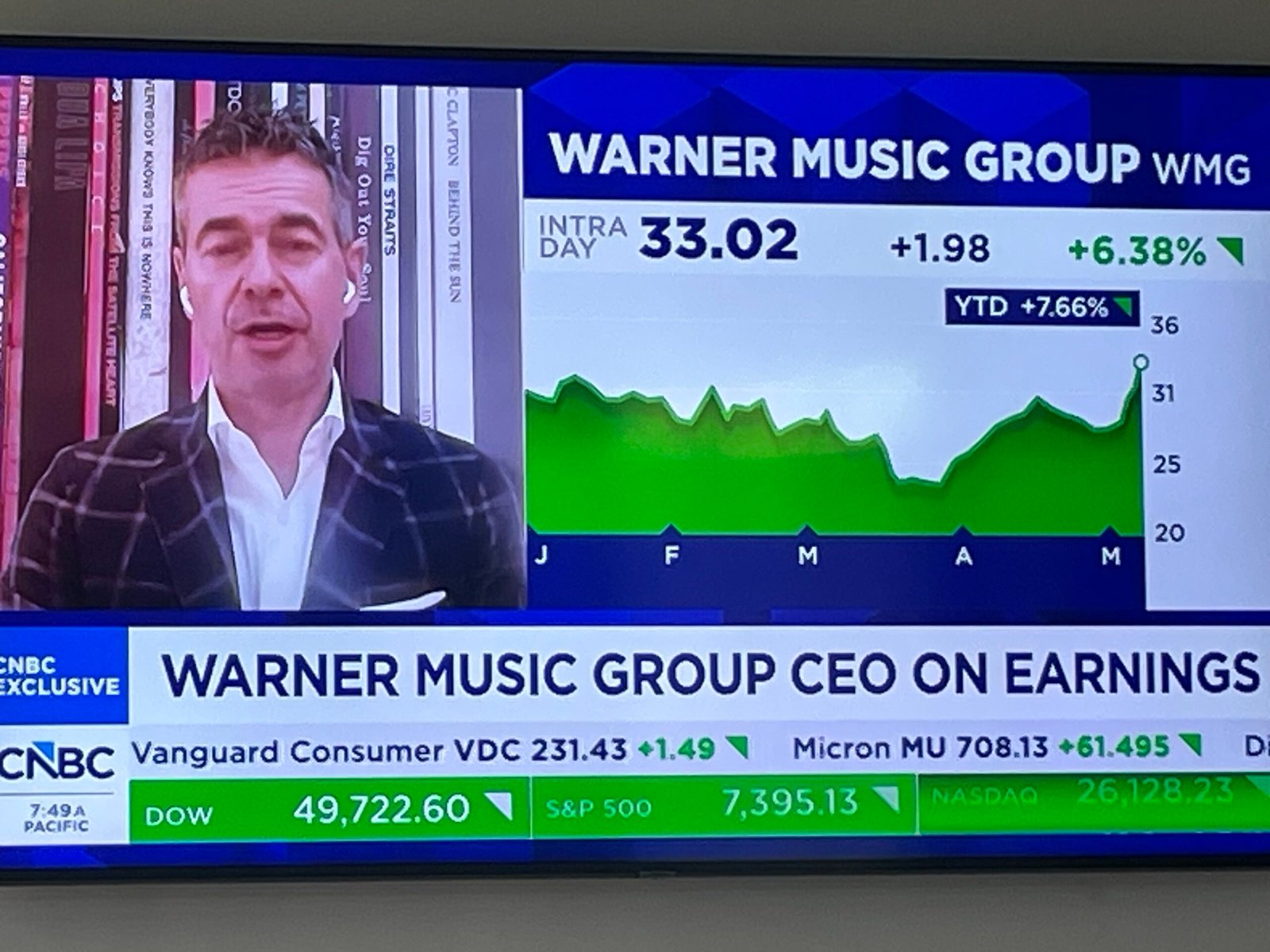
Artificial intelligence was one of the dominant themes during Warner Music Group’s latest earnings call, and CEO Robert Kyncl made it clear the company sees AI as a major growth opportunity — not just a threat.
Rather than framing AI as something the music industry must simply defend against, Kyncl repeatedly described AI as a tool that can expand engagement, improve efficiency, create new revenue streams, and increase the value of music catalogs.
Here are the biggest takeaways from his comments.
Warner Says AI Is Already Improving Catalog Monetization
One of the most revealing parts of the call was Kyncl explaining how Warner is already using AI operationally.
He said Warner has developed AI tools that help the company create:
- motion art
- visualizers
- lyric videos
- marketing assets
…quickly and cost-effectively across its enormous music catalog.
That matters because Warner’s catalog includes more than:
- 1 million tracks
- 70,000 artists
Historically, labels could only economically market a small percentage of their catalog at scale. AI changes those economics dramatically.
Kyncl explained that Warner is also using proprietary AI models to help determine where marketing resources should be focused, allowing the company to deepen monetization of older music.
In practical terms, AI may allow labels to continuously revive and repackage older songs for new audiences at a much lower cost than before.
Warner Believes AI Can Increase the Value of Music
Kyncl repeatedly emphasized that Warner’s strategy is focused on “increasing the value of music.”
One of the ways the company plans to do that is through:
- AI partnerships
- premium streaming tiers
- interactive fan experiences
Warner specifically discussed working with streaming platforms and emerging AI companies on:
- AI-powered subscription tiers
- enhanced fan engagement
- higher-priced offerings
The broader implication is that streaming could evolve beyond passive listening into something more interactive.
That could eventually include:
- remix functionality
- fan participation tools
- AI-assisted music creation
- personalized listening experiences
The company appears to believe consumers will pay more for deeper engagement with music.
Warner’s Partnership With Suno Was A Major Focus
Kyncl highlighted Warner’s licensing relationship with Suno as an example of the company’s AI strategy in action.
Rather than attempting to completely shut down AI music platforms, Warner appears to be pursuing a more pragmatic approach:
- licensing
- monetization
- copyright protection
- participation in future growth
Warner said Suno currently has:
- roughly 2 million subscribers
- an average monthly spend of approximately $12.50
The company also noted that Suno is reportedly generating around $300 million in annualized revenue.
Those figures suggest there is already meaningful consumer demand for AI-powered music experiences.
Warner Says AI Music Has Had “Minimal Dilutive Impact”
One of the more interesting comments from Kyncl involved concerns that AI-generated music could flood streaming services and reduce the value of professionally created music.
According to Warner, major DSPs have reported that most AI-generated uploads are currently seeing:
- very limited engagement
- minimal impact on overall streaming economics
Kyncl also emphasized that Warner is working closely with DSP partners to ensure contractual protections exist to prevent dilution and protect artists and songwriters.
That signals the major labels are attempting to shape the rules of AI music early rather than reacting later.
AI Is Becoming Part of Warner’s Financial Model
Perhaps the most important takeaway from the earnings call is that Warner no longer talks about AI as an experiment.
Executives explicitly stated they expect AI initiatives to become:
“a material contributor to top and bottom line growth starting in fiscal 2027.”
That is a major shift.
It suggests Warner believes AI will eventually contribute to:
- revenue growth
- margin expansion
- operational efficiency
- streaming monetization
- catalog engagement
In other words, AI is now entering the company’s long-term business model.
The Bigger Picture
The earnings call revealed something important about the future direction of the music industry.
Warner Music Group increasingly views itself not simply as a traditional record label, but as:
- a global intellectual property platform
- a data-driven media company
- an AI-enabled infrastructure business
Rather than seeing AI solely as a threat, Warner appears determined to:
- license it
- monetize it
- integrate it
- control the commercial framework around it
That could fundamentally reshape how music is created, distributed, monetized, and experienced over the next decade.