Tag: music valuation

  • Red Hot Chili Peppers Just Proved the Music Catalog Gold Rush Isn’t Slowing Down

    By 2026, the music catalog business has become something bigger than nostalgia.

    It’s infrastructure.
    Red Hot Chili Peppers

    This week, the Red Hot Chili Peppers, with over 46 million monthly listeners on Spotify, reportedly sold their recorded music catalog to Warner Music Group for more than $300 million — one of the largest rock catalog deals in recent memory.

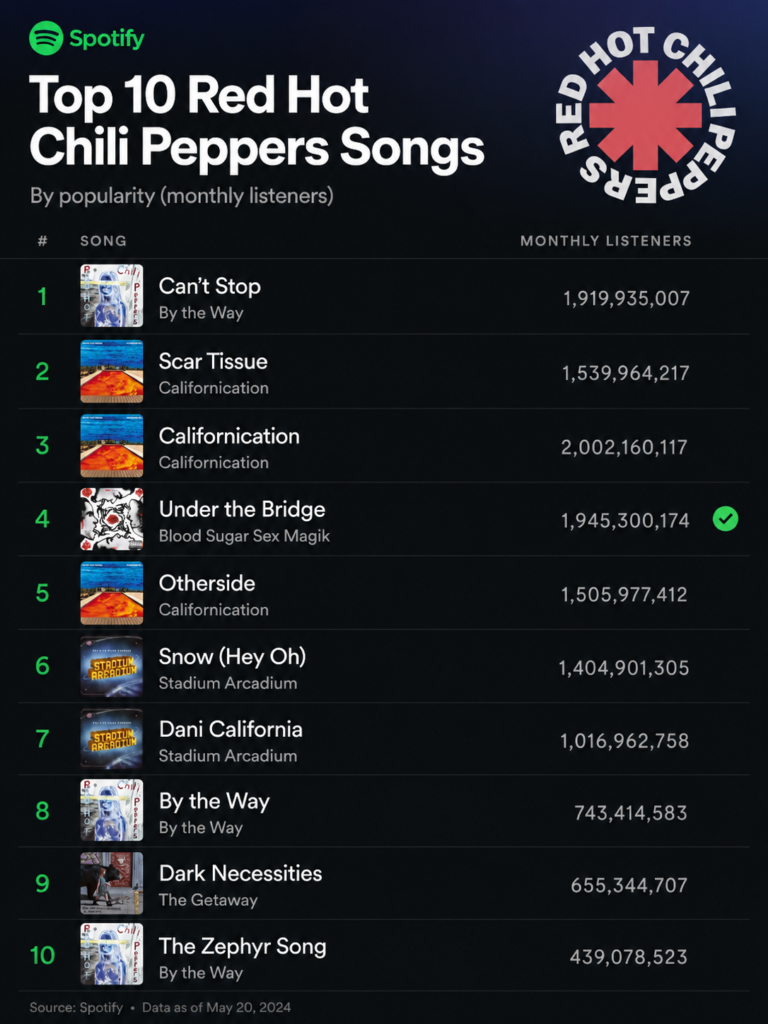
    According to Rolling Stone and The Hollywood Reporter, the deal covers the band’s master recordings — the actual sound recordings behind hits like “Californication,” “Under the Bridge,” “Scar Tissue,” “Can’t Stop,” and “Otherside.” They are also the 8th most-played band on SiriusXM Lithium 90’s rock, even though their catalog spans five decades.

    And here’s the key detail:

    This comes after the band already sold its publishing rights years ago for roughly $140–150 million.

    That means the market is now valuing two separate layers of music ownership at enormous scale:

    • Publishing rights (songwriting/composition)
    • Master recordings (the recordings themselves)

    The Chili Peppers are essentially monetizing decades of cultural relevance twice.


    Why Music Catalogs Became Wall Street Assets

    Music used to be viewed as entertainment.

    Now it’s increasingly viewed as a cash-flowing intellectual property asset class.

    Why?

    Because streaming transformed old songs into recurring annuities.

    A hit song from 1999 no longer disappears after radio rotation ends. It lives forever across:

    • Spotify
    • Apple Music
    • YouTube
    • TikTok
    • movies
    • commercials
    • sports arenas
    • playlists
    • nostalgia-driven algorithms

    The Chili Peppers reportedly generate around $26 million annually from their catalog alone.

    That’s why firms like:

    • Sony Music Group
    • Universal Music Group
    • Warner Music Group
    • Bain Capital

    are aggressively buying rights portfolios.

    This isn’t just about music fandom.

    It’s about predictable yield.


    The Real Asset Isn’t the Song — It’s the Permanence

    What makes a catalog valuable isn’t just popularity.

    It’s durability.

    The Chili Peppers sit in a rare category of artists whose songs function almost like cultural utility infrastructure:

    • gym playlists
    • rock radio staples
    • sports broadcasts
    • algorithmic recommendations
    • movie syncs
    • guitar-learning staples
    • generational discovery

    Twenty years after Stadium Arcadium, people are still discovering “Snow (Hey Oh)” for the first time.

    That matters financially.

    This week, SiriusXM launched a major 20th-anniversary retrospective around Stadium Arcadium, complete with track-by-track commentary from the band.

    That’s the flywheel:

    1. Legacy catalogs create nostalgia
    2. Nostalgia drives streams
    3. Streams drive revenue
    4. Revenue raises catalog valuations
    5. Valuations attract institutional capital

    Music is becoming closer to evergreen software IP than physical media.


    Warner Music’s Bigger Bet

    One of the most interesting parts of this deal is who bought the catalog.

    Warner Music Group has distributed the Chili Peppers since 1991’s Blood Sugar Sex Magik.

    So Warner isn’t just acquiring songs.

    They’re deepening ownership around an ecosystem they already helped build.

    And importantly, Warner reportedly used its joint venture with Bain Capital to fund the purchase.

    That tells you something critical about the future:

    Private equity increasingly views music catalogs the way previous generations viewed:

    • commercial real estate
    • pipelines
    • telecom infrastructure
    • utility assets

    The difference?

    Songs don’t need maintenance crews.


    The Streaming Era Changed the Economics Forever

    The CD era created spikes.

    Streaming created persistence.

    A teenager hearing “Californication” on TikTok in 2026 generates revenue from a song released in 1999.

    That’s an extraordinary business model.

    And unlike television or film libraries, music consumption is deeply habitual:

    • morning playlists
    • workouts
    • driving
    • studying
    • restaurants
    • sports venues
    • retail stores

    Music became embedded into daily software behavior.

    That makes elite catalogs incredibly resilient.


    Catalogs Are the New Media Moat

    The bigger story here isn’t just the Chili Peppers.

    It’s that catalogs themselves are becoming strategic weapons.

    In a fragmented entertainment landscape, ownership matters more than ever.

    Who owns:

    • the songs,
    • the masters,
    • the publishing,
    • the licensing rights,
    • the sync rights,
    • the streaming revenue,
    • and the cultural memory

    will increasingly shape the future economics of media.

    The Red Hot Chili Peppers didn’t just sell old songs.

    They sold decades of recurring attention.

    And in 2026, attention compounds.


    Sources & Further Reading

  • The Biggest Risks in Music Catalog Valuation

    When people talk about music catalog investing, they often focus on the appeal. Recurring royalty income, global consumption, streaming growth, and the emotional durability of familiar songs make catalogs sound almost defensive. But every asset class has its risks, and music rights are no exception. In fact, the biggest mistakes in catalog valuation often come from underestimating the ways a catalog can disappoint after the deal closes.

    The first major risk is concentration. A catalog may appear strong because total income looks healthy, but once you open the statements, you may find that one or two songs generate the majority of the revenue. That can be dangerous. If demand for those songs falls, or if usage patterns shift, the valuation can unravel quickly. A broad catalog with many contributors to cash flow is usually safer than a shallow one built on a single classic track.

    The second risk is changing consumer taste. Songs do not exist outside culture. Even great songs move through cycles of discovery, nostalgia, overexposure, and rediscovery. A catalog that feels evergreen today may not command the same attention ten years from now. Buyers who assume stable demand forever can get burned. This is especially true for music that was tied heavily to a specific moment, format, or audience. Enduring catalogs tend to have cross-generational recognition or repeated utility in playlists, sync, and cultural memory. The further a catalog is from that kind of durability, the more cautious the underwriting should be.

    Rights complexity is another big risk. A song may be commercially attractive but difficult to exploit if the ownership chain is tangled. Multiple writers, samples, disputed shares, approval rights, or inconsistent administration can all reduce value. These issues do not always show up in the headline revenue number, but they affect future monetization. If the catalog is hard to clear for sync licensing or other opportunities, some of the potential upside vanishes in practice.

    Platform dependence also matters. If most of a catalog’s earnings are tied to streaming, the buyer is exposed to the economics and algorithms of streaming platforms. That does not automatically make the catalog weak, but it does introduce risk. The business model of music distribution has changed before, and it can change again. A format that feels dominant now may look less central later. The safest catalogs are not necessarily those with the highest streaming numbers, but those with multiple paths to monetization.

    Artist reputation creates another layer of uncertainty. A living artist can help increase the value of a catalog through touring, interviews, anniversaries, or renewed cultural relevance. But a living artist can also damage the asset. Public scandals, erratic behavior, or long periods of negative coverage can reduce licensing interest and hurt brand appeal. This is not always catastrophic, and it can be hard to quantify, but it is real. Investors are not only buying songs. They are buying a relationship to the artist’s public story, whether they admit it or not.

    Overestimating sync upside is one of the most common valuation mistakes. Buyers love the idea that a song could land in a major film, television show, ad campaign, or viral trailer moment. And yes, that can materially lift earnings. But sync is not an automatic faucet. It is selective, competitive, and often unpredictable. Some catalogs are much better suited to licensing than others. Lyrics, mood, genre, clearance simplicity, and market trends all play a role. If the valuation depends too heavily on “what if this explodes in sync,” the buyer may be paying for a fantasy rather than a cash-flowing asset.

    Operational risk matters as well. A catalog is not self-maximizing. Good administration, proactive licensing, metadata accuracy, collection efficiency, and strategic marketing all affect performance. If the buyer lacks the infrastructure to manage the rights well, even a strong catalog can underperform. This is one reason strategic buyers sometimes justify higher prices: they believe they can unlock more value than a pure financial owner can. But that assumption itself is a risk. Synergies sound nice in a deck. Execution is harder.

    Market timing is another factor. In frothy periods, buyers can convince themselves that high multiples are justified because the asset class is fashionable. When rates rise, capital tightens, or enthusiasm cools, those same assumptions can suddenly look aggressive. A catalog bought at the peak of optimism may still be a good asset, but that does not mean it was bought at a good price.

    The core lesson is simple: music catalogs are attractive, but they are not magic. The biggest risks usually come from concentration, rights friction, taste shifts, platform dependence, reputation issues, overhyped upside, weak operations, and bad timing. Valuation works best when it respects both the numbers and the fragility behind the numbers. Great catalog investors are not just optimistic about songs. They are disciplined about what can go wrong.