Tag: music publishing

  • The Library of Congress Just Added 25 More Recordings to America’s Audio Time Capsule

    The Library of Congress Just Added 25 More Recordings to America’s Audio Time Capsule

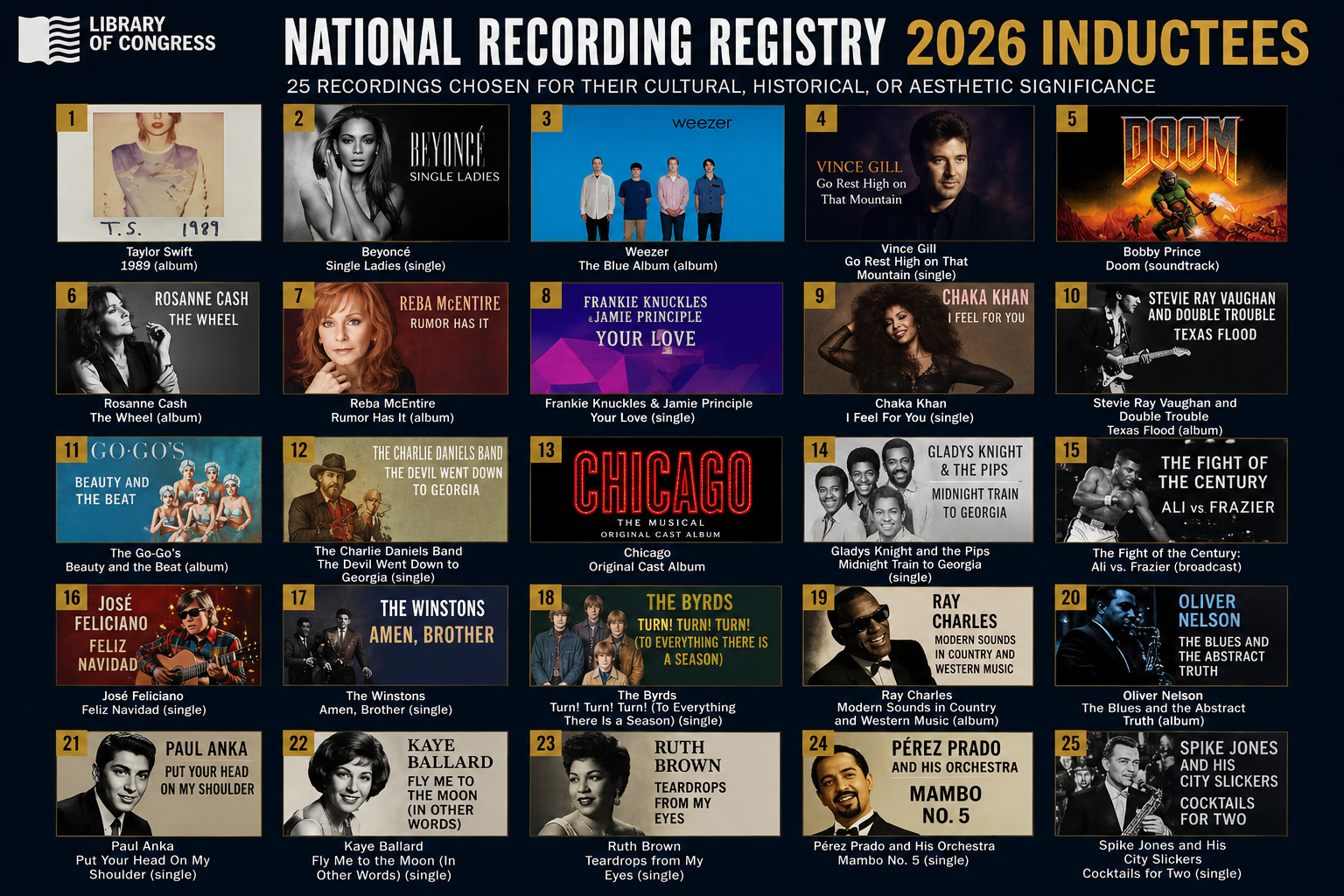
    The Library of Congress has announced the newest class of recordings entering the 2026 National Recording Registry — a yearly preservation effort designed to protect audio recordings deemed “culturally, historically, or aesthetically significant.”

    This year’s list is a fascinating mix of blockbuster pop, country standards, jazz landmarks, dance music pioneers, video game history, Broadway, classic broadcasts, and deeply influential catalog recordings that continue to shape streaming, licensing, sampling, and music culture decades later.

    From Taylor Swift and 1989 to Weezer’s Weezer (The Blue Album) and the groundbreaking Doom soundtrack by Bobby Prince, the 2026 class shows how wide the modern music canon has become.

    Why the National Recording Registry Matters

    The Registry is more than nostalgia.

    For artists, estates, labels, publishers, and catalog investors, induction into the Registry can reinforce the long-term cultural durability of a recording. These are the kinds of works that continue generating value through:

    • Streaming
    • Sync licensing
    • Sampling
    • Reissues
    • Vinyl demand
    • Film and television placement
    • Cultural rediscovery cycles
    • Social media resurgence

    Many of these recordings are already deeply embedded into the American cultural bloodstream. Others may receive a renewed spotlight because of the induction itself.

    In an era where catalog value increasingly depends on longevity, discoverability, and cross-generational relevance, the National Recording Registry acts almost like an institutional validation of permanence.
    2026 National Recording Registry 2026 Inductees

    The Biggest Takeaways From 2026 National Recording Registry 2026 Class

    1. Catalog Longevity Beats Recency

    The inclusion of 1989 stands out because it is one of the newest recordings ever inducted.

    That’s significant.

    The Registry traditionally leans heavily toward older recordings whose historical importance has already stood the test of time. The rapid inclusion of 1989 signals how quickly modern blockbuster pop albums can become culturally foundational.

    It also reinforces the staying power of superstar catalogs in the streaming era.

    2. Video Game Music Is Now Officially Canon

    The induction of the Doom soundtrack is another major moment.

    Video game music is no longer niche nostalgia. It is now formally recognized as part of America’s recorded cultural history.

    That matters because gaming soundtracks increasingly function like traditional entertainment IP:

    • Streaming assets
    • Live performance material
    • Vinyl collectibles
    • Licensing opportunities
    • Fan-community engagement engines

    Gaming catalogs are becoming real catalog businesses.

    3. Dance Music’s Architects Are Finally Getting Their Due

    Frankie Knuckles and Jamie Principle’s Your Love represents a huge acknowledgment of house music’s foundational influence.

    Chicago house music helped shape modern EDM, pop production, remix culture, and club music economics globally.

    The Registry recognizing dance music history reflects how electronic genres have moved from underground subculture into institutional legitimacy.

    4. Sampling History Continues to Matter

    The inclusion of Amen, Brother by The Winstons is especially fascinating.

    The track contains the famous “Amen Break” — one of the most sampled drum breaks in music history.

    That single recording influenced:

    • Hip-hop
    • Jungle
    • Drum and bass
    • Electronic music
    • Modern beat production

    One drum pattern became a foundational building block for entire genres.

    Few examples better demonstrate how catalog value can compound in unpredictable ways over decades.

    The Full 2026 National Recording Registry Class
    1989 — Taylor Swift
    Single Ladies (Put a Ring on It) — Beyoncé
    Weezer (The Blue Album) — Weezer
    Go Rest High on That Mountain — Vince Gill
    Doom soundtrack — Bobby Prince
    The Wheel — Rosanne Cash
    Rumor Has It — Reba McEntire
    Your Love — Frankie Knuckles & Jamie Principle
    I Feel for You — Chaka Khan
    Texas Flood — Stevie Ray Vaughan and Double Trouble
    Beauty and the Beat — The Go-Go’s
    The Devil Went Down to Georgia — The Charlie Daniels Band
    Chicago Original Cast Album
    Midnight Train to Georgia — Gladys Knight & the Pips
    The Fight of the Century broadcast
    Feliz Navidad — José Feliciano
    Amen, Brother — The Winstons
    Turn! Turn! Turn! (To Everything There Is a Season) — The Byrds
    Modern Sounds in Country and Western Music — Ray Charles
    The Blues and the Abstract Truth — Oliver Nelson
    Put Your Head on My Shoulder — Paul Anka
    Fly Me to the Moon — Kaye Ballard
    Teardrops from My Eyes — Ruth Brown
    Mambo No. 5 — Pérez Prado and His Orchestra
    Cocktails for Two — Spike Jones and His City Slickers

    Final Thought

    The Registry increasingly reflects a broader definition of what matters culturally.

    Rock, pop, jazz, country, hip-hop-adjacent sampling culture, dance music, gaming audio, Broadway, holiday music, and sports broadcasting now all sit under the same preservation umbrella.

    That evolution mirrors what’s happening in the catalog business itself.

    The modern catalog economy is no longer just about classic rock radio. It’s about multi-format intellectual property that can survive format changes, platform shifts, and generational turnover.

    And the recordings that survive longest tend to become the most valuable.
  • What Robert Kyncl Said About AI During Warner Music Group’s Earnings Call

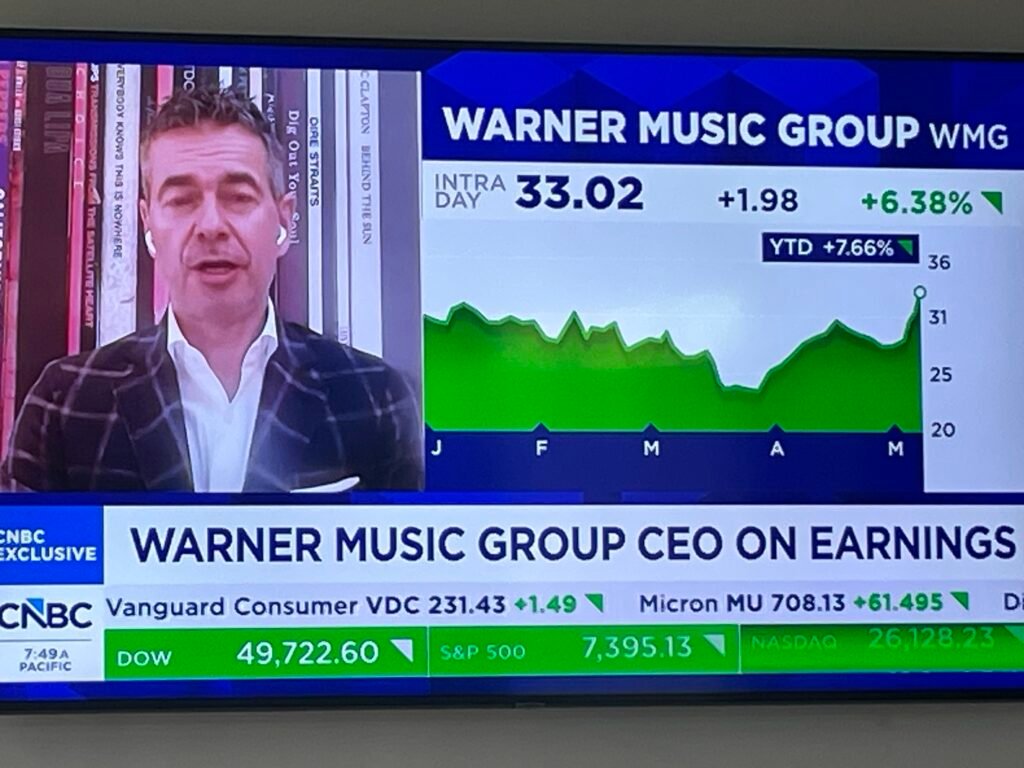
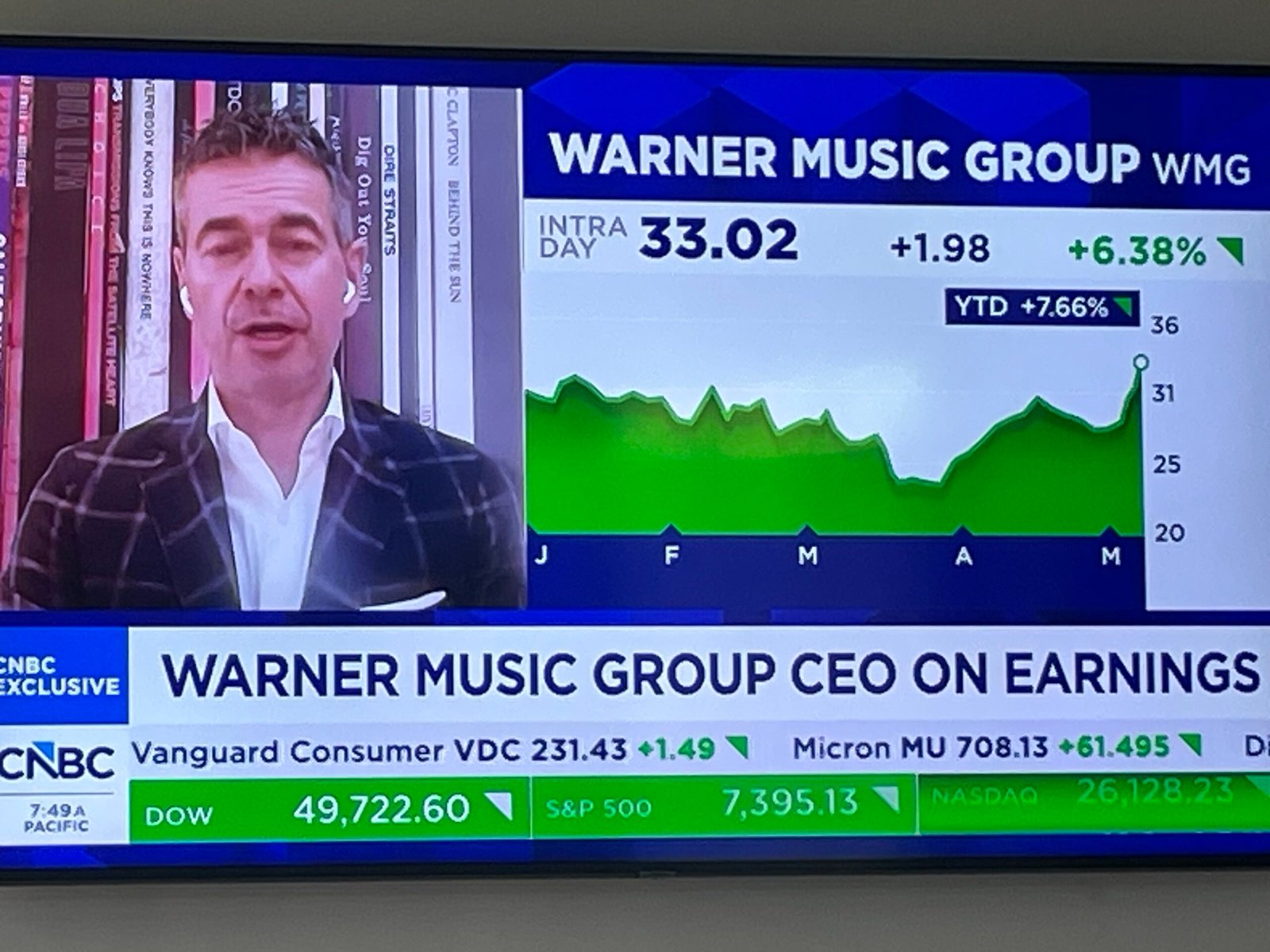
    What Robert Kyncl Said About AI During Warner Music Group’s Earnings Call

    Artificial intelligence was one of the dominant themes during Warner Music Group’s latest earnings call, and CEO Robert Kyncl made it clear the company sees AI as a major growth opportunity — not just a threat.

    Rather than framing AI as something the music industry must simply defend against, Kyncl repeatedly described AI as a tool that can expand engagement, improve efficiency, create new revenue streams, and increase the value of music catalogs.

    Here are the biggest takeaways from his comments.

    Robert Kyncl

    Warner Says AI Is Already Improving Catalog Monetization

    One of the most revealing parts of the call was Kyncl explaining how Warner is already using AI operationally.

    He said Warner has developed AI tools that help the company create:

    • motion art
    • visualizers
    • lyric videos
    • marketing assets

    …quickly and cost-effectively across its enormous music catalog.

    That matters because Warner’s catalog includes more than:

    • 1 million tracks
    • 70,000 artists

    Historically, labels could only economically market a small percentage of their catalog at scale. AI changes those economics dramatically.

    Kyncl explained that Warner is also using proprietary AI models to help determine where marketing resources should be focused, allowing the company to deepen monetization of older music.

    In practical terms, AI may allow labels to continuously revive and repackage older songs for new audiences at a much lower cost than before.


    Warner Believes AI Can Increase the Value of Music

    Kyncl repeatedly emphasized that Warner’s strategy is focused on “increasing the value of music.”

    One of the ways the company plans to do that is through:

    • AI partnerships
    • premium streaming tiers
    • interactive fan experiences

    Warner specifically discussed working with streaming platforms and emerging AI companies on:

    • AI-powered subscription tiers
    • enhanced fan engagement
    • higher-priced offerings

    The broader implication is that streaming could evolve beyond passive listening into something more interactive.

    That could eventually include:

    • remix functionality
    • fan participation tools
    • AI-assisted music creation
    • personalized listening experiences

    The company appears to believe consumers will pay more for deeper engagement with music.


    Warner’s Partnership With Suno Was A Major Focus

    Kyncl highlighted Warner’s licensing relationship with Suno as an example of the company’s AI strategy in action.

    Rather than attempting to completely shut down AI music platforms, Warner appears to be pursuing a more pragmatic approach:

    • licensing
    • monetization
    • copyright protection
    • participation in future growth

    Warner said Suno currently has:

    • roughly 2 million subscribers
    • an average monthly spend of approximately $12.50

    The company also noted that Suno is reportedly generating around $300 million in annualized revenue.

    Those figures suggest there is already meaningful consumer demand for AI-powered music experiences.


    Warner Says AI Music Has Had “Minimal Dilutive Impact”

    One of the more interesting comments from Kyncl involved concerns that AI-generated music could flood streaming services and reduce the value of professionally created music.

    According to Warner, major DSPs have reported that most AI-generated uploads are currently seeing:

    • very limited engagement
    • minimal impact on overall streaming economics

    Kyncl also emphasized that Warner is working closely with DSP partners to ensure contractual protections exist to prevent dilution and protect artists and songwriters.

    That signals the major labels are attempting to shape the rules of AI music early rather than reacting later.


    AI Is Becoming Part of Warner’s Financial Model

    Perhaps the most important takeaway from the earnings call is that Warner no longer talks about AI as an experiment.

    Executives explicitly stated they expect AI initiatives to become:

    “a material contributor to top and bottom line growth starting in fiscal 2027.”

    That is a major shift.

    It suggests Warner believes AI will eventually contribute to:

    • revenue growth
    • margin expansion
    • operational efficiency
    • streaming monetization
    • catalog engagement

    In other words, AI is now entering the company’s long-term business model.


    The Bigger Picture

    The earnings call revealed something important about the future direction of the music industry.

    Warner Music Group increasingly views itself not simply as a traditional record label, but as:

    • a global intellectual property platform
    • a data-driven media company
    • an AI-enabled infrastructure business

    Rather than seeing AI solely as a threat, Warner appears determined to:

    • license it
    • monetize it
    • integrate it
    • control the commercial framework around it

    That could fundamentally reshape how music is created, distributed, monetized, and experienced over the next decade.

  • 5 Takeaways From Warner Music’s May 2026 Earnings Call

    1. AI Is Already Changing the Music Business

    Warner openly said AI will become a “material contributor” to revenue and profits starting in fiscal 2027. This is no longer theoretical. The company is already using AI for catalog marketing, lyric videos, visualizers, forecasting, reporting, and automation.

    2. Catalog Music Is the Economic Engine

    Warner said catalog music now represents roughly 65% of recorded music streaming revenue. Older music is becoming more valuable in the streaming era because catalogs can generate recurring revenue for decades.

    3. The Labels Want to Monetize AI, Not Just Fight It

    Rather than simply resisting AI platforms, Warner is pursuing licensing deals and partnerships. Its relationship with Suno shows the company believes AI music and interactive fan experiences could become major future revenue streams.

    4. Modern Record Labels Are Starting to Look Like Tech Companies

    The earnings call sounded more like a technology company presentation than a traditional music business update. Warner repeatedly discussed:

    • automation
    • standardized data systems
    • operating leverage
    • AI-driven forecasting
    • centralized intelligence

    The modern label is evolving into an AI-enabled intellectual property platform.

    5. Streaming Is Becoming a Higher-Margin Subscription Business

    Subscription streaming revenue grew 15%, helped by pricing increases across DSPs. The industry is moving beyond pure user growth and toward higher pricing, premium tiers, and stronger monetization of superfans and interactive experiences.

  • How sync licensing really works — and why a TV placement can change a song’s value overnight

    A single TV placement can send a decades-old song to the top of streaming charts overnight. Golnar Khosrowshahi, founder and CEO of Reservoir Media, explains how sync licensing actually works — and why it’s one of the most powerful and unpredictable forces in the catalog market — in her appearance on Billboard’s On the Record.


    1. Sync is the most powerful discovery engine in the industry

    When a song lands in the right scene of the right show at the right moment, it can introduce that music to an entirely new generation of listeners who had never heard it before. Grey’s Anatomy pioneered this in the mid-2000s, becoming not just a hit drama but a genuine music discovery platform — to the point where landing a placement on the show became an explicit goal for songwriters. Euphoria carried that torch into the streaming era, pairing emotionally charged scenes with carefully curated music that sparked streaming spikes and cultural conversations.

    “Grey’s Anatomy really started this trend of not only being a show everyone was glued to, but being a place where people were discovering music.”


    2. The streaming uplift is real but varies enormously

    Not every placement creates the same effect. A song featured in a pivotal season finale of a culturally dominant show will generate a very different response than background music in a mid-season episode. Khosrowshahi points to Sinead O’Connor’s “Drink Before the War” — a Reservoir catalog asset — which was featured in a key scene of Euphoria Season 2 and drove meaningful renewed interest in O’Connor’s catalog. Shows that have built a reputation for sophisticated musical taste, where audiences actively seek out the soundtrack, consistently deliver stronger and more durable uplifts.

    “Euphoria has captured this persona of having sophisticated musical taste and being very deliberate about the music — and people are still seeking gatekeepers like that.”


    3. Biopics are the ultimate sync play for catalog owners

    A well-made biopic does what no single TV placement can: it immerses an audience in an artist’s entire story and catalog for two hours, then sends them to streaming platforms to explore further. The Johnny Cash biopic was a landmark moment for catalog revival. More recently, the Bob Dylan biopic — with Timothée Chalamet in the lead — represents the same opportunity at enormous scale. Khosrowshahi sees the surge in music biopics as partly driven by catalog owners who now have both the financial resources and the incentive to fund or facilitate these projects.

    “More liquidity and bigger budgets enable either rights holders or filmmakers adjacent to music companies to underwrite these projects — that’s why you’re seeing more of them.”


    4. Some music simply cannot be synced — and that has a cost

    Sync licensing requires clean rights and content that advertisers and studios are willing to associate their brand or project with. Music with heavy use of expletives, uncleared samples with multiple credited writers, or complicated rights chains is effectively locked out of much of the sync market. For catalog buyers evaluating a potential acquisition, the sync ceiling is a material part of the valuation. A catalog that has historically said no to licensing — or that simply can’t be cleared — is worth materially less than one that is open and accessible.

    “You could have music that has historically just said no to licensing — that creates a whole bunch of opportunity. Or music with uncleared samples that can’t easily be licensed at all.”


    5. You can’t engineer a sync moment — but you can position for one

    The most valuable sync placements are the ones that emerge organically from a music supervisor genuinely falling in love with a song for a specific scene. They cannot be bought or manufactured. What catalog owners can control is making sure their music is in front of as many supervisors as possible, that the rights are clean and quick to clear, and that the catalog is actively maintained and promoted. The placement itself is unpredictable; the preparation for it is not.

    “Our sync team is very aware of what the trends are and what the licensing future looks like — is this something we think we can do better marketing to the music supervisors in our database?”


    Based on Golnar Khosrowshahi’s appearance on On the Record, Billboard’s music industry podcast.

  • Masters vs. publishing rights: what’s the difference and which is more valuable?

    If you’ve ever read a headline about a music catalog sale and wondered exactly what was bought and sold, you’re not alone. Golnar Khosrowshahi, founder and CEO of Reservoir Media, broke down the distinction clearly in her appearance on Billboard’s On the Record — and the difference matters more than most people realize.


    1. Masters and publishing are two completely separate assets

    When an artist records a song, two distinct sets of rights are created. The master recording — the actual audio file you hear on Spotify — is typically owned by the record label that funded the recording. The publishing rights cover the underlying composition: the melody and lyrics written by the songwriter. These can be owned by a publisher, the artist themselves, or split between multiple parties. Every catalog deal involves one, the other, or both — and the price reflects which rights are actually on the table.

    “You can sell your publishing, which is the songwriting rights. Those are two different things — masters versus publishing. A lot of people want one or the other or both.”


    2. Publishing has historically been the safer bet

    In the early days of the catalog market, publishing rights were considered far less risky than masters. Masters required active marketing investment — vinyl releases, promotion, physical product — while publishing generated royalties more passively every time a song was performed, streamed, or licensed. For investors who wanted steady income without operational complexity, publishing was the cleaner bet. Today, Khosrowshahi says the two asset classes trade at roughly equivalent multiples — but the underlying operational demands remain very different.

    “In the early days, the publishing was far less risky. Today I would tell you that these assets are trading at par.”


    3. Owning masters means running an active business

    Buying master recordings isn’t a passive investment. It comes with real operational responsibilities: releasing vinyl, running marketing campaigns, pitching music supervisors, and managing a recorded music roster. Reservoir maintains entirely separate teams for its publishing and recorded music businesses precisely because the work is so different. Anyone looking to acquire masters needs to honestly assess whether they have the infrastructure and expertise to actively manage that catalog — or whether they’re better suited to the publishing side.

    “Publishing is more like ‘I want checks to come in the mail.’ Masters are ‘I’m out there, I want to market, I want to make it more valuable.’”


    4. Who owns the other side of the rights matters too

    If you buy publishing rights to a song, you’re now in a long-term relationship with whoever owns the masters — and vice versa. Khosrowshahi says Reservoir always investigates this before closing a deal. Are the masters owned by a major label with resources to keep marketing the music? Or are they sitting with a smaller label that may not be around in five years? The quality and commitment of the party controlling the other set of rights has a real impact on how much value a catalog can generate over time.

    “We definitely look at who owns the masters — are they going to keep doing any job? Because that’s what you really want to know.”


    5. Taylor Swift’s situation clarified everything for a mainstream audience

    When Big Machine Records sold Taylor Swift’s master recordings to Shamrock Holdings without her consent, millions of people suddenly understood — viscerally — why the masters vs. publishing distinction matters. Swift had signed her deal as a teenager, which was standard practice at the time: the label funded the recordings and retained ownership. Her decision to re-record her entire back catalog as “Taylor’s Version” was an unprecedented response, and it accelerated a broader industry shift toward more artist-friendly deal structures where ownership eventually reverts to the artist or is shared from the outset.

    “That situation really put a spotlight on the fact that Taylor Swift did not own her own masters — and nowadays we’re seeing much more artist-friendly deals at these record labels.”


    Based on Golnar Khosrowshahi’s appearance on On the Record, Billboard’s music industry podcast.