Tag: music finance

  • What Robert Kyncl Said About AI During Warner Music Group’s Earnings Call

    What Robert Kyncl Said About AI During Warner Music Group’s Earnings Call

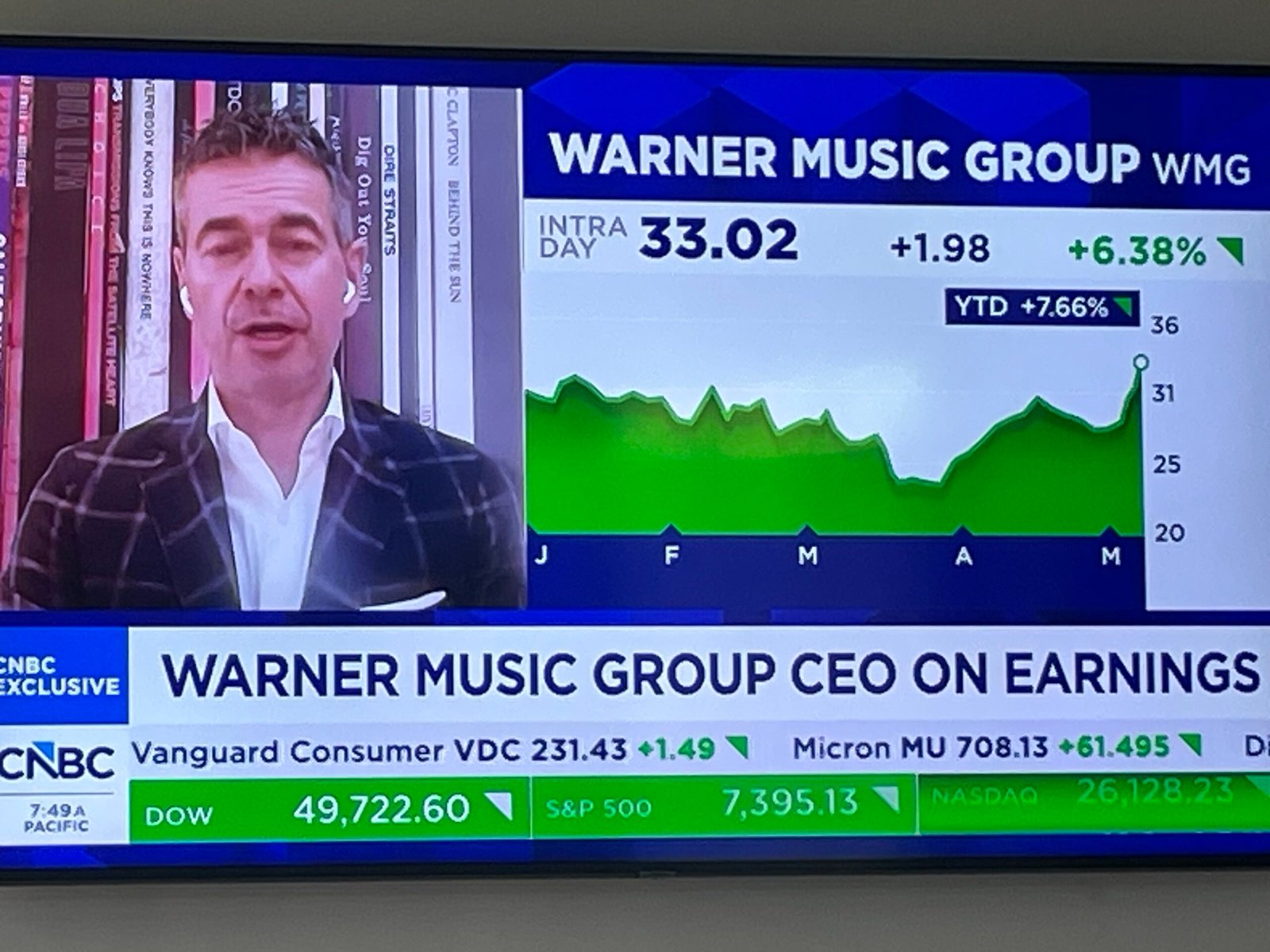
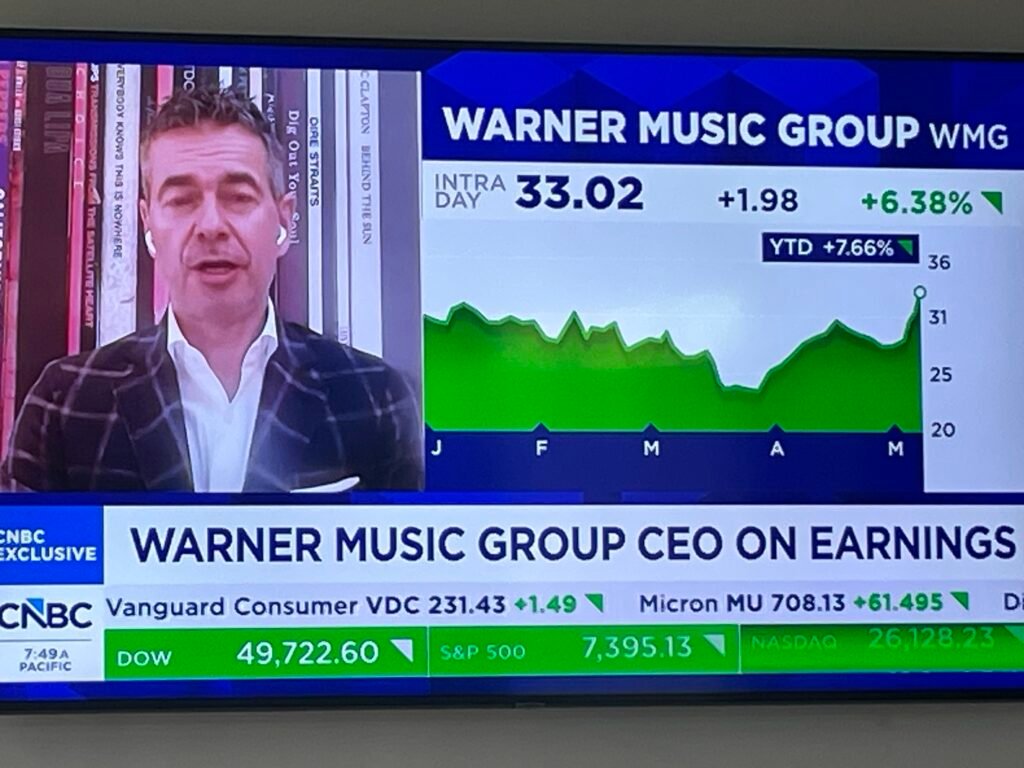
    Artificial intelligence was one of the dominant themes during Warner Music Group’s latest earnings call, and CEO Robert Kyncl made it clear the company sees AI as a major growth opportunity — not just a threat.

    Rather than framing AI as something the music industry must simply defend against, Kyncl repeatedly described AI as a tool that can expand engagement, improve efficiency, create new revenue streams, and increase the value of music catalogs.

    Here are the biggest takeaways from his comments.
    Robert Kyncl

    Warner Says AI Is Already Improving Catalog Monetization

    One of the most revealing parts of the call was Kyncl explaining how Warner is already using AI operationally.

    He said Warner has developed AI tools that help the company create:

    • motion art
    • visualizers
    • lyric videos
    • marketing assets

    …quickly and cost-effectively across its enormous music catalog.

    That matters because Warner’s catalog includes more than:

    • 1 million tracks
    • 70,000 artists

    Historically, labels could only economically market a small percentage of their catalog at scale. AI changes those economics dramatically.

    Kyncl explained that Warner is also using proprietary AI models to help determine where marketing resources should be focused, allowing the company to deepen monetization of older music.

    In practical terms, AI may allow labels to continuously revive and repackage older songs for new audiences at a much lower cost than before.


    Warner Believes AI Can Increase the Value of Music

    Kyncl repeatedly emphasized that Warner’s strategy is focused on “increasing the value of music.”

    One of the ways the company plans to do that is through:

    • AI partnerships
    • premium streaming tiers
    • interactive fan experiences

    Warner specifically discussed working with streaming platforms and emerging AI companies on:

    • AI-powered subscription tiers
    • enhanced fan engagement
    • higher-priced offerings

    The broader implication is that streaming could evolve beyond passive listening into something more interactive.

    That could eventually include:

    • remix functionality
    • fan participation tools
    • AI-assisted music creation
    • personalized listening experiences

    The company appears to believe consumers will pay more for deeper engagement with music.


    Warner’s Partnership With Suno Was A Major Focus

    Kyncl highlighted Warner’s licensing relationship with Suno as an example of the company’s AI strategy in action.

    Rather than attempting to completely shut down AI music platforms, Warner appears to be pursuing a more pragmatic approach:

    • licensing
    • monetization
    • copyright protection
    • participation in future growth

    Warner said Suno currently has:

    • roughly 2 million subscribers
    • an average monthly spend of approximately $12.50

    The company also noted that Suno is reportedly generating around $300 million in annualized revenue.

    Those figures suggest there is already meaningful consumer demand for AI-powered music experiences.


    Warner Says AI Music Has Had “Minimal Dilutive Impact”

    One of the more interesting comments from Kyncl involved concerns that AI-generated music could flood streaming services and reduce the value of professionally created music.

    According to Warner, major DSPs have reported that most AI-generated uploads are currently seeing:

    • very limited engagement
    • minimal impact on overall streaming economics

    Kyncl also emphasized that Warner is working closely with DSP partners to ensure contractual protections exist to prevent dilution and protect artists and songwriters.

    That signals the major labels are attempting to shape the rules of AI music early rather than reacting later.


    AI Is Becoming Part of Warner’s Financial Model

    Perhaps the most important takeaway from the earnings call is that Warner no longer talks about AI as an experiment.

    Executives explicitly stated they expect AI initiatives to become:

    “a material contributor to top and bottom line growth starting in fiscal 2027.”

    That is a major shift.

    It suggests Warner believes AI will eventually contribute to:

    • revenue growth
    • margin expansion
    • operational efficiency
    • streaming monetization
    • catalog engagement

    In other words, AI is now entering the company’s long-term business model.


    The Bigger Picture

    The earnings call revealed something important about the future direction of the music industry.

    Warner Music Group increasingly views itself not simply as a traditional record label, but as:

    • a global intellectual property platform
    • a data-driven media company
    • an AI-enabled infrastructure business

    Rather than seeing AI solely as a threat, Warner appears determined to:

    • license it
    • monetize it
    • integrate it
    • control the commercial framework around it

    That could fundamentally reshape how music is created, distributed, monetized, and experienced over the next decade.

  • Red Hot Chili Peppers Just Proved the Music Catalog Gold Rush Isn’t Slowing Down

    By 2026, the music catalog business has become something bigger than nostalgia.

    It’s infrastructure.

    Red Hot Chili Peppers

    This week, the Red Hot Chili Peppers, with over 46 million monthly listeners on Spotify, reportedly sold their recorded music catalog to Warner Music Group for more than $300 million — one of the largest rock catalog deals in recent memory.

    According to Rolling Stone and The Hollywood Reporter, the deal covers the band’s master recordings — the actual sound recordings behind hits like “Californication,” “Under the Bridge,” “Scar Tissue,” “Can’t Stop,” and “Otherside.” They are also the 8th most-played band on SiriusXM Lithium 90’s rock, even though their catalog spans five decades.

    And here’s the key detail:

    This comes after the band already sold its publishing rights years ago for roughly $140–150 million.

    That means the market is now valuing two separate layers of music ownership at enormous scale:

    • Publishing rights (songwriting/composition)
    • Master recordings (the recordings themselves)

    The Chili Peppers are essentially monetizing decades of cultural relevance twice.


    Why Music Catalogs Became Wall Street Assets

    Music used to be viewed as entertainment.

    Now it’s increasingly viewed as a cash-flowing intellectual property asset class.

    Why?

    Because streaming transformed old songs into recurring annuities.

    A hit song from 1999 no longer disappears after radio rotation ends. It lives forever across:

    • Spotify
    • Apple Music
    • YouTube
    • TikTok
    • movies
    • commercials
    • sports arenas
    • playlists
    • nostalgia-driven algorithms

    The Chili Peppers reportedly generate around $26 million annually from their catalog alone.

    That’s why firms like:

    • Sony Music Group
    • Universal Music Group
    • Warner Music Group
    • Bain Capital

    are aggressively buying rights portfolios.

    This isn’t just about music fandom.

    It’s about predictable yield.


    The Real Asset Isn’t the Song — It’s the Permanence

    What makes a catalog valuable isn’t just popularity.

    It’s durability.

    The Chili Peppers sit in a rare category of artists whose songs function almost like cultural utility infrastructure:

    • gym playlists
    • rock radio staples
    • sports broadcasts
    • algorithmic recommendations
    • movie syncs
    • guitar-learning staples
    • generational discovery

    Twenty years after Stadium Arcadium, people are still discovering “Snow (Hey Oh)” for the first time.

    That matters financially.

    This week, SiriusXM launched a major 20th-anniversary retrospective around Stadium Arcadium, complete with track-by-track commentary from the band.

    That’s the flywheel:

    1. Legacy catalogs create nostalgia
    2. Nostalgia drives streams
    3. Streams drive revenue
    4. Revenue raises catalog valuations
    5. Valuations attract institutional capital

    Music is becoming closer to evergreen software IP than physical media.


    Warner Music’s Bigger Bet

    One of the most interesting parts of this deal is who bought the catalog.

    Warner Music Group has distributed the Chili Peppers since 1991’s Blood Sugar Sex Magik.

    So Warner isn’t just acquiring songs.

    They’re deepening ownership around an ecosystem they already helped build.

    And importantly, Warner reportedly used its joint venture with Bain Capital to fund the purchase.

    That tells you something critical about the future:

    Private equity increasingly views music catalogs the way previous generations viewed:

    • commercial real estate
    • pipelines
    • telecom infrastructure
    • utility assets

    The difference?

    Songs don’t need maintenance crews.


    The Streaming Era Changed the Economics Forever

    The CD era created spikes.

    Streaming created persistence.

    A teenager hearing “Californication” on TikTok in 2026 generates revenue from a song released in 1999.

    That’s an extraordinary business model.

    And unlike television or film libraries, music consumption is deeply habitual:

    • morning playlists
    • workouts
    • driving
    • studying
    • restaurants
    • sports venues
    • retail stores

    Music became embedded into daily software behavior.

    That makes elite catalogs incredibly resilient.


    Catalogs Are the New Media Moat

    The bigger story here isn’t just the Chili Peppers.

    It’s that catalogs themselves are becoming strategic weapons.

    In a fragmented entertainment landscape, ownership matters more than ever.

    Who owns:

    • the songs,
    • the masters,
    • the publishing,
    • the licensing rights,
    • the sync rights,
    • the streaming revenue,
    • and the cultural memory

    will increasingly shape the future economics of media.

    The Red Hot Chili Peppers didn’t just sell old songs.

    They sold decades of recurring attention.

    And in 2026, attention compounds.


    Sources & Further Reading

  • What Hipgnosis Changed in the Music Catalog Market

    Hipgnosis did not invent music catalog investing, but it changed the market in ways that still matter. Before its rise, music royalties were understood by specialists, insiders, and a relatively narrow circle of investors who were comfortable with the complexity of rights. After Hipgnosis, the asset class became much more legible to a broader investing public. That shift in education, visibility, and confidence may be its biggest legacy.

    One of the most important things Hipgnosis did was popularize the idea that songs could be discussed like serious financial assets rather than quirky entertainment-side holdings. That sounds obvious now, but it was not always obvious. For years, many mainstream investors were hesitant around music because the business seemed too dependent on taste, too opaque, and too volatile. Hipgnosis helped normalize a different view: that proven catalogs could behave like long-duration cash-flowing assets, supported by recurring consumption and global platforms.

    This mattered because education changes capital formation. Once more investors understood the broad case for music royalties, it became easier for the whole sector to raise money, explain the thesis, and defend the economics. Even companies that competed with Hipgnosis benefited from the fact that the market was being taught how to think about rights ownership. In that sense, Hipgnosis expanded the room for everyone.

    It also changed expectations around pricing. As more capital entered the market and more investors became comfortable with the category, competition intensified. Multiples rose. Sellers became more aware of what their rights might fetch. Catalogs that may once have traded more quietly began attracting more attention and more aggressive bidding. That was good for owners looking to sell, but it also created concerns about overheating. As in any asset class, more money and more narrative energy can push valuations beyond conservative assumptions.

    Hipgnosis also reinforced the importance of story in finance. It was not only selling an asset. It was selling a thesis about why songs matter, why consumption is durable, and why royalties deserve a place in institutional portfolios. The market did not respond just to data. It responded to a compelling narrative: songs are used everywhere, they travel globally, they are embedded in memory, and they can throw off long-term income. That narrative helped bridge the gap between cultural assets and financial analysis.

    Another shift was psychological. Hipgnosis gave the market a more public benchmark for what confidence in music rights could look like. Once one prominent player behaves as though catalogs are strategic, scalable, and worth talking about in financial terms, others feel more comfortable entering the space. The result is not just more money. It is less fear. That matters in sectors where novelty and complexity used to deter traditional capital.

    Of course, the story is not one-directional. Greater visibility also invited more scrutiny. Once pricing runs up and investor enthusiasm expands, the market starts asking harder questions. Are the assumptions too rosy? Are buyers paying too much for future upside? How should long-term durability be modeled in a fast-changing consumption environment? In that sense, Hipgnosis did not just popularize the market. It forced it to mature by making these debates more visible.

    There is a broader lesson here. Markets often need a translator before they can scale. Someone has to take a niche asset and explain it in terms that a larger capital base can understand. Hipgnosis played that role for music rights. Whether one agrees with every valuation approach or strategic decision is almost secondary to that structural impact. It changed who felt invited to participate.

    So what did Hipgnosis change in the music catalog market? It mainstreamed the conversation. It helped educate investors. It reduced the sense that music royalties were mysterious. It contributed to price inflation, yes, but it also contributed to legitimacy. And once an asset class becomes legible to mainstream capital, it rarely goes back to being obscure.