Introduction: A Catalog Imbalance Hiding in Plain Sight
The catalog of Michael Jackson is one of the most valuable in music history. However, it is also uneven.
On one hand, his 1980s output—Thriller, Bad, Off the Wall—continues to dominate streaming platforms, SiriusXM rotation, and cultural memory. Meanwhile, his 1990s catalog remains underplayed, under-discussed, and under-monetized.
Importantly, this is not a quality issue. Rather, it is a positioning problem.
The 1990s Were Bigger Than We Remember
Dangerous (1991): A Commercial Powerhouse
The album Dangerous was a commercial powerhouse. It produced major global hits such as “Black or White,” “Remember the Time,” “In the Closet,” and “Jam.”
At the time, these songs defined pop music on a global scale. Today, however, they are not programmed with the same consistency as his 80s catalog.
As a result, a generation of listeners associates Michael Jackson primarily with his earlier work, even though the 90s output was substantial.
HIStory (1995): The Narrative Shift
HIStory: Past, Present and Future, Book I marked a tonal and thematic pivot.
Key tracks include:
- “They Don’t Care About Us”
- “Scream” (with Janet Jackson)
- “Stranger in Moscow”
- “Earth Song”
- “You Are Not Alone”
These songs were:
- More political
- More introspective
- More cinematic
And that shift changed how they age—and how they’re consumed today.
Why the 90s Catalog Underperforms Today
1. It Doesn’t Fit Easy Listening Lanes
The 80s catalog is frictionless:
- Instant recognition
- Works in party settings
- Fits “classic hits” formats
The 90s catalog is different:
- Slower
- Heavier
- More thematic
Songs like:
- “Earth Song”
- “Stranger in Moscow”
Don’t slot easily into algorithm-driven playlists or radio formats.
2. The Narrative Became Complicated
By the mid-1990s, the story around Michael Jackson changed.
Music was no longer the only lens:
- Tabloid coverage intensified
- Public perception shifted
- Personal controversy became part of the narrative
That context affects how songs are remembered and programmed.
Even a #1 hit like “You Are Not Alone” doesn’t receive consistent rotation today.
3. There’s a “Story Gap” in the Catalog
The arc is clear:
- 70s: emergence
- 80s: peak dominance
- 90s: unclear positioning
Without a defined narrative, the 90s catalog becomes fragmented—and easier to overlook.
The Reframe: The Cinematic, Global, and Burden of Fame Era
The 1990s catalog shouldn’t be treated as “post-peak.”
It should be positioned as:
Michael Jackson’s cinematic, global era—where the music reflects the weight and consequences of unprecedented fame.
This reframing connects the work:
- “Scream” → backlash
- “They Don’t Care About Us” → defiance
- “Stranger in Moscow” → isolation
- “Earth Song” → global consciousness
Now it’s not a scattered era.
It’s a cohesive narrative.
How the Estate Can Unlock Value
1. Use Film as a Catalyst
A sequel to Michael presents the strongest opportunity.
Film doesn’t just revisit music—it reframes it.
If the 90s are presented as a turning point:
- Streaming spikes follow
- Cultural re-evaluation begins
- Under
The 1990s Were Bigger Than We Remember
Dangerous (1991): A Commercial Powerhouse
The album Dangerous produced major global hits:
- “Black or White”
- “Remember the Time”
- “In the Closet”
- “Jam”
These were not minor successes—they were defining records of the era.
Yet today, they are not programmed or remembered with the same consistency as his 80s work.
HIStory (1995): The Narrative Shift
By contrast, HIStory: Past, Present and Future, Book I marked a tonal shift.
It introduced songs like:
- “They Don’t Care About Us”
- “Scream” (with Janet Jackson)
- “Stranger in Moscow”
- “Earth Song”
Notably, these tracks were more political, more introspective, and more cinematic. Because of this, they do not fit neatly into traditional radio formats or algorithm-driven playlists.
Why the 90s Catalog Underperforms Today
The 80s catalog is frictionless. For example, it works in party settings, gyms, and “classic hits” formats.
In contrast, the 90s catalog is slower and more thematic. Therefore, songs like “Earth Song” and “Stranger in Moscow” struggle to find a consistent home in modern programming.
2. The Narrative Became Complicated
At the same time, the broader narrative around Michael Jackson changed in the 1990s.
Music was no longer the only lens. Instead, media coverage and personal controversy began to shape public perception.
Consequently, even major hits like “You Are Not Alone” do not receive consistent rotation today.
3. There’s a “Story Gap” in the Catalog
The arc is clear:
- 70s: emergence
- 80s: peak dominance
- 90s: unclear positioning
Without a defined narrative, the 90s catalog becomes fragmented—and easier to overlook.
A Quick Data Check: The Rotation Gap Is Real
To validate the narrative, it helps to look at real-world airplay.
Over the last 30 days (April 4 – May 4), the gap is clear.
In other words, his 1980s presence is not just strong—it is concentrated around a single, dominant tentpole.
By contrast, the 1990s tell a very different story.
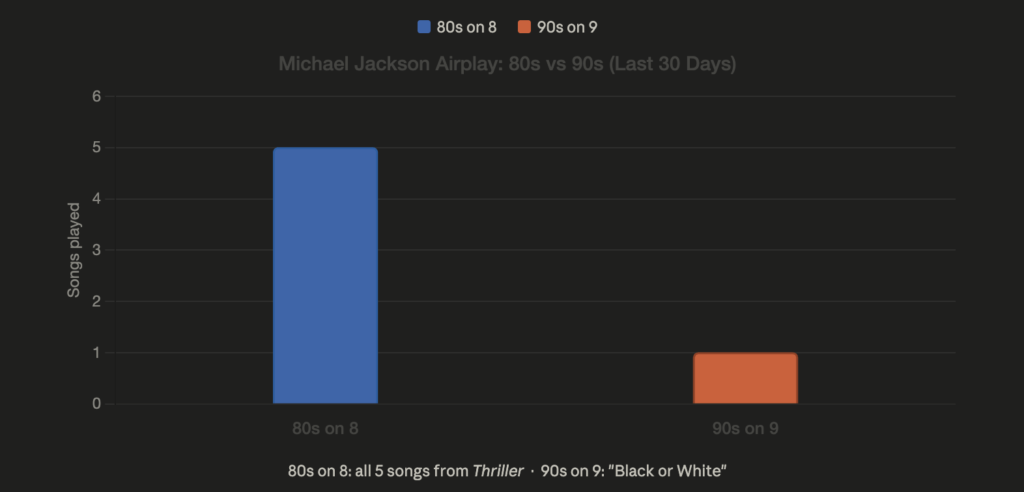
On 90s on 9, Jackson has just one song in the most-played rotation: “Black or White” from Dangerous.
Even more interesting, that track ranks #6 overall—and stands as one of the most-played songs from 1991 on the channel.
However, despite that strong individual performance, the broader 1990s catalog remains largely absent from rotation.
At the same time, 90s on 9 tends to skew toward the late 1990s, which may further limit exposure for earlier-decade Jackson releases. Still, that alone doesn’t explain the gap.
Ultimately, the data reinforces the core point:
The issue isn’t that the 1990s catalog lacks hits—it’s that only one of them consistently breaks through modern programming filters.
Why This Matters
Taken together, this creates a clear imbalance:
- The 1980s catalog is deep, visible, and repeatedly surfaced
- The 1990s catalog is shallow in rotation, despite proven success
As a result, listener perception follows exposure—not history.
And right now, the exposure is telling a very incomplete story.
The Reframe: The Cinematic, Global, and Burden of Fame Era
The 1990s catalog shouldn’t be treated as “post-peak.”
It should be positioned as:
Michael Jackson’s cinematic, global era—where the music reflects the weight and consequences of unprecedented fame.
This reframing connects the work:
- “Scream” → backlash
- “They Don’t Care About Us” → defiance
- “Stranger in Moscow” → isolation
- “Earth Song” → global consciousness
Now it’s not a scattered era.
It’s a cohesive narrative.
How the Estate Can Unlock Value
1. Use Film as a Catalyst
A sequel to Michael presents the strongest opportunity.
Film doesn’t just revisit music—it reframes it.
If the 90s are presented as a turning point:
- Streaming spikes follow
- Cultural re-evaluation begins
- Underplayed songs gain context
2. Create New Programming Lanes
The solution is not forcing 90s songs into old categories.
It’s building new ones:
- Cinematic pop
- Global anthems
- Fame and pressure narratives
Right now, these songs are effectively “homeless” in modern programming.
3. Lean Into Depth, Not Nostalgia
The 80s catalog thrives on nostalgia.
The 90s catalog thrives on meaning.
That distinction matters.
Songs like:
- “Earth Song”
- “Stranger in Moscow”
Are not background music.
They are emotional, thematic pieces that require a different listening context.
The Business Case: A Mispriced Asset
Catalog value is driven by:
- Frequency of play
- Cultural relevance
- Licensing demand
Today:
- 80s MJ = high-frequency assets
- 90s MJ = low-frequency assets
That gap is not about quality.
It’s about positioning.
The 1990s catalog is a mispriced asset that requires narrative activation to unlock its full value.
Conclusion
The music is already there. The hits already exist.
What’s missing, however, is the story.
Until the 1990s era is reframed as a distinct and essential chapter—defined by scale, pressure, and global ambition—it will remain underutilized.
Ultimately, this represents one of the clearest opportunities in modern catalog management.