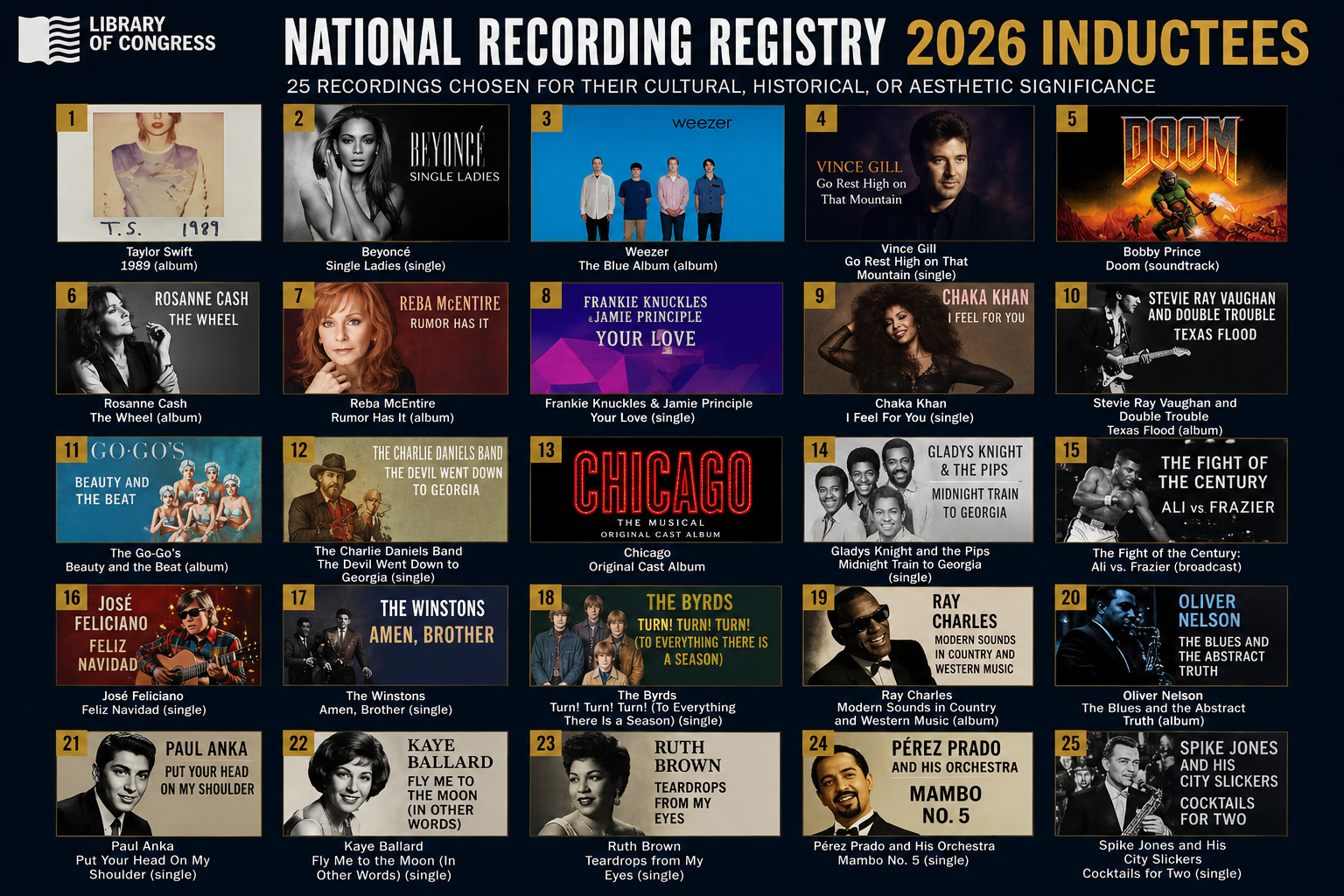
Tag: catalog value

  • The Library of Congress Just Added 25 More Recordings to America’s Audio Time Capsule

    The Library of Congress Just Added 25 More Recordings to America’s Audio Time Capsule

    The Library of Congress has announced the newest class of recordings entering the 2026 National Recording Registry — a yearly preservation effort designed to protect audio recordings deemed “culturally, historically, or aesthetically significant.”

    This year’s list is a fascinating mix of blockbuster pop, country standards, jazz landmarks, dance music pioneers, video game history, Broadway, classic broadcasts, and deeply influential catalog recordings that continue to shape streaming, licensing, sampling, and music culture decades later.

    From Taylor Swift and 1989 to Weezer’s Weezer (The Blue Album) and the groundbreaking Doom soundtrack by Bobby Prince, the 2026 class shows how wide the modern music canon has become.

    Why the National Recording Registry Matters

    The Registry is more than nostalgia.

    For artists, estates, labels, publishers, and catalog investors, induction into the Registry can reinforce the long-term cultural durability of a recording. These are the kinds of works that continue generating value through:

    • Streaming
    • Sync licensing
    • Sampling
    • Reissues
    • Vinyl demand
    • Film and television placement
    • Cultural rediscovery cycles
    • Social media resurgence

    Many of these recordings are already deeply embedded into the American cultural bloodstream. Others may receive a renewed spotlight because of the induction itself.

    In an era where catalog value increasingly depends on longevity, discoverability, and cross-generational relevance, the National Recording Registry acts almost like an institutional validation of permanence.
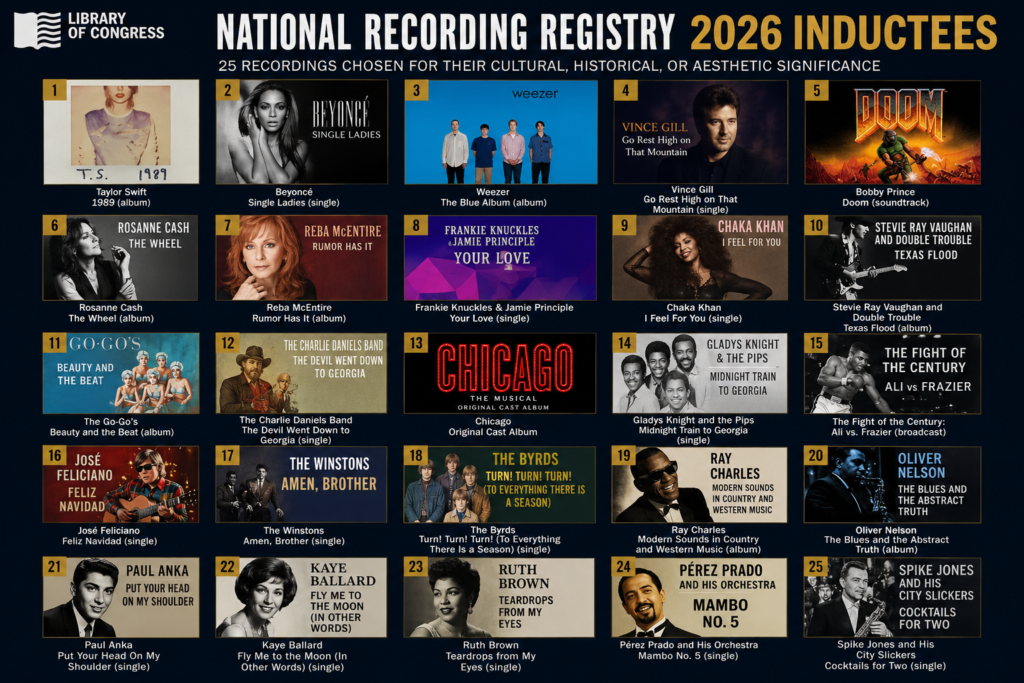
    2026 National Recording Registry 2026 Inductees

    The Biggest Takeaways From 2026 National Recording Registry 2026 Class

    1. Catalog Longevity Beats Recency

    The inclusion of 1989 stands out because it is one of the newest recordings ever inducted.

    That’s significant.

    The Registry traditionally leans heavily toward older recordings whose historical importance has already stood the test of time. The rapid inclusion of 1989 signals how quickly modern blockbuster pop albums can become culturally foundational.

    It also reinforces the staying power of superstar catalogs in the streaming era.

    2. Video Game Music Is Now Officially Canon

    The induction of the Doom soundtrack is another major moment.

    Video game music is no longer niche nostalgia. It is now formally recognized as part of America’s recorded cultural history.

    That matters because gaming soundtracks increasingly function like traditional entertainment IP:

    • Streaming assets
    • Live performance material
    • Vinyl collectibles
    • Licensing opportunities
    • Fan-community engagement engines

    Gaming catalogs are becoming real catalog businesses.

    3. Dance Music’s Architects Are Finally Getting Their Due

    Frankie Knuckles and Jamie Principle’s Your Love represents a huge acknowledgment of house music’s foundational influence.

    Chicago house music helped shape modern EDM, pop production, remix culture, and club music economics globally.

    The Registry recognizing dance music history reflects how electronic genres have moved from underground subculture into institutional legitimacy.

    4. Sampling History Continues to Matter

    The inclusion of Amen, Brother by The Winstons is especially fascinating.

    The track contains the famous “Amen Break” — one of the most sampled drum breaks in music history.

    That single recording influenced:

    • Hip-hop
    • Jungle
    • Drum and bass
    • Electronic music
    • Modern beat production

    One drum pattern became a foundational building block for entire genres.

    Few examples better demonstrate how catalog value can compound in unpredictable ways over decades.

    The Full 2026 National Recording Registry Class
    1989 — Taylor Swift
    Single Ladies (Put a Ring on It) — Beyoncé
    Weezer (The Blue Album) — Weezer
    Go Rest High on That Mountain — Vince Gill
    Doom soundtrack — Bobby Prince
    The Wheel — Rosanne Cash
    Rumor Has It — Reba McEntire
    Your Love — Frankie Knuckles & Jamie Principle
    I Feel for You — Chaka Khan
    Texas Flood — Stevie Ray Vaughan and Double Trouble
    Beauty and the Beat — The Go-Go’s
    The Devil Went Down to Georgia — The Charlie Daniels Band
    Chicago Original Cast Album
    Midnight Train to Georgia — Gladys Knight & the Pips
    The Fight of the Century broadcast
    Feliz Navidad — José Feliciano
    Amen, Brother — The Winstons
    Turn! Turn! Turn! (To Everything There Is a Season) — The Byrds
    Modern Sounds in Country and Western Music — Ray Charles
    The Blues and the Abstract Truth — Oliver Nelson
    Put Your Head on My Shoulder — Paul Anka
    Fly Me to the Moon — Kaye Ballard
    Teardrops from My Eyes — Ruth Brown
    Mambo No. 5 — Pérez Prado and His Orchestra
    Cocktails for Two — Spike Jones and His City Slickers

    Final Thought

    The Registry increasingly reflects a broader definition of what matters culturally.

    Rock, pop, jazz, country, hip-hop-adjacent sampling culture, dance music, gaming audio, Broadway, holiday music, and sports broadcasting now all sit under the same preservation umbrella.

    That evolution mirrors what’s happening in the catalog business itself.

    The modern catalog economy is no longer just about classic rock radio. It’s about multi-format intellectual property that can survive format changes, platform shifts, and generational turnover.

    And the recordings that survive longest tend to become the most valuable.

  • Does the Popular Music Canon Still Matter in the Streaming Era?

    The popular music canon used to feel easier to describe. There was a clearer sense of which artists, albums, and songs “everybody knew,” and mass media reinforced that hierarchy. Radio, MTV, major magazines, retail displays, and a smaller field of choices all helped create concentration. In the streaming era, that concentration has weakened. Audiences have more music, more access, more algorithms, and more ways to build highly individualized listening habits. So the question is worth asking: does the popular music canon still matter?

    It does, but not in exactly the same way. The canon may be less centralized than it once was, yet it still shapes behavior, value, and cultural memory. In fact, the catalog market depends on it. When investors pay serious money for older songs, they are making a bet that some works have durable recognition beyond temporary trend cycles. That is another way of saying they believe a canon still exists, even if its borders are blurrier than before.

    One change is that the canon is now more modular. Instead of one universally agreed upon ladder, we have overlapping canons. There is the rock canon, the hip-hop canon, the country canon, the R&B canon, the classic pop canon, and increasingly micro-canons formed by online communities, fan cultures, and generational nostalgia. This fragmentation can make the culture feel less unified, but it does not eliminate the economic importance of recognized works. It simply means recognition may live in clusters rather than in one national monoculture.

    Streaming has changed the mechanics of familiarity. People may hear more total hours of music than earlier generations, but their attention is spread across a vastly larger field. That can weaken the concentration once enjoyed by the most dominant catalog artists. At the same time, streaming also makes rediscovery easier. A song from decades ago can reappear through playlists, social media clips, movie placements, or algorithmic recommendations. That means the canon may be less imposed from above, but it can still regenerate from below.

    Another important shift is that image, context, and narrative now play a larger role in how listeners approach older music. A younger fan may not arrive at a classic artist through linear radio exposure. They may arrive through a fashion story, a documentary, a TikTok trend, a podcast, or a biopic. Canon formation is no longer purely musical. It often depends on adjacent cultural channels that reactivate interest.

    This has consequences for catalog value. The old idea of canon implied permanence. The newer version implies resilience. A canonical work today is not simply a song everyone was once told was great. It is a song that can survive format change, playlist culture, algorithmic competition, and shifting audience attention. That kind of resilience is precisely what makes older catalogs investable.

    Still, there is a real challenge. If attention continues fragmenting, it becomes harder for any one body of work to dominate the way previous generations’ giants did. Future canon formation may be weaker, slower, or more contested. That matters because today’s catalog valuations often rely on assumptions about long-term cultural durability. If the culture becomes too diffuse, the economic premium attached to canonical status may become harder to sustain.

    Yet there is a counterpoint. In times of abundance, trusted reference points can become more valuable, not less. When listeners face overwhelming choice, they often return to the familiar, the validated, and the emotionally legible. Canonical songs retain an advantage because people already know what they are. They carry memory, social proof, and repeat utility. Weddings, parties, movies, playlists, sports events, and background listening all reward songs that are already embedded in shared life.

    So does the popular music canon still matter in the streaming era? Yes, but it behaves differently. It is less singular, less top-down, and more dependent on ongoing cultural reinforcement. It is not obsolete. It is evolving. For artists, estates, and investors, the lesson is that catalog value now depends not just on historical greatness, but on the ongoing ability of that greatness to stay visible in a crowded world. The canon still matters because familiarity still matters. And in music, familiarity remains one of the strongest economic assets there is.

  • Why Sync Licensing Matters So Much in Catalog Value

    Sync licensing can change the trajectory of a music catalog faster than almost any other commercial lever. A song that has been quietly earning for years can suddenly surge because it lands in a hit television show, a movie trailer, a global ad campaign, or a viral scene that brings it to a new audience. That is why sync matters so much in catalog valuation. It is not just another revenue line. It can act as both direct income and an engine for broader catalog reactivation.

    At the most basic level, sync licensing generates money because the rights holder is paid to pair music with visual media. That payment can be meaningful on its own, especially for high-profile placements. But the bigger reason investors care is that sync often creates a second wave of consumer attention. A placement can lead to a spike in streams, Shazam activity, playlist adds, social conversation, and cultural relevance. In some cases, the sync fee is only the beginning. The real value comes from renewed discovery.

    This is especially important for older catalogs. A legacy song may already have proven durability, but a sync placement can introduce it to a generation that did not grow up with it. Suddenly the song is not just “old”; it is current again. That kind of renewal is incredibly valuable because it extends the commercial life of the asset. Catalog buyers love signals that suggest a song can travel through time and still connect.

    Sync also matters because it can diversify income. Streaming is central to modern royalty economics, but it is not the only source of value. When a catalog has credible sync potential, it becomes less dependent on passive consumption patterns alone. The rights holder has a more active way to create moments. That is attractive from an investment standpoint because it means the asset can be managed, not merely observed.

    But not all songs are equally syncable. Some music fits visual storytelling more naturally than others. Lyrics matter. Tone matters. Mood matters. Genre matters. So does simplicity of clearance. If a song has many writers, samples, approval hurdles, or ambiguous ownership, it may be harder to place, even if it is artistically perfect. Supervisors and brands often want the clearest path to execution. A great song with a messy rights chain can lose out to a slightly less perfect song that is easy to license.

    This is where catalog valuation gets more nuanced. Buyers do not simply ask, “Has this catalog earned sync revenue before?” They also ask, “Could it earn more under stronger management?” A catalog that has been underexploited may look more attractive to a buyer with a dedicated sync team, better relationships, or a more aggressive licensing strategy. The same songs can be worth more in the hands of an operator who knows how to package and pitch them.

    There is also a halo effect to consider. A successful placement can elevate not just one song, but the wider artist brand or catalog identity. A film scene, a prestige drama, a documentary, or an ad campaign can trigger press, conversation, and rediscovery. People start listening beyond the placed track. They revisit albums, interviews, images, and adjacent songs. In that sense, sync can function as a cultural marketing event as much as a licensing transaction.

    Still, buyers have to be careful. Sync is important, but it is not guaranteed. Some songs are obvious sync candidates and still never land the big placement everyone imagines. Trends change. Supervisors have taste. Brands get cautious. Competitive dynamics shift. The right scene may never materialize. That is why sync upside should enhance a catalog thesis, not replace it. A strong catalog should work even without a dream placement.

    The best way to think about sync is as optionality. It gives the rights holder more ways to create value from the same underlying songs. It can produce direct fees, increase downstream consumption, refresh relevance, and deepen cross-generational awareness. Those are powerful outcomes, especially in a market where cultural attention is fragmented.

    So why does sync licensing matter so much in catalog value? Because it connects the financial logic of ownership with the emotional logic of discovery. A song placed in the right context becomes newly alive. And when a catalog can reliably generate those moments, the market will usually pay more for the possibility.