Tag: catalog monetization

  • What Robert Kyncl Said About AI During Warner Music Group’s Earnings Call

    What Robert Kyncl Said About AI During Warner Music Group’s Earnings Call

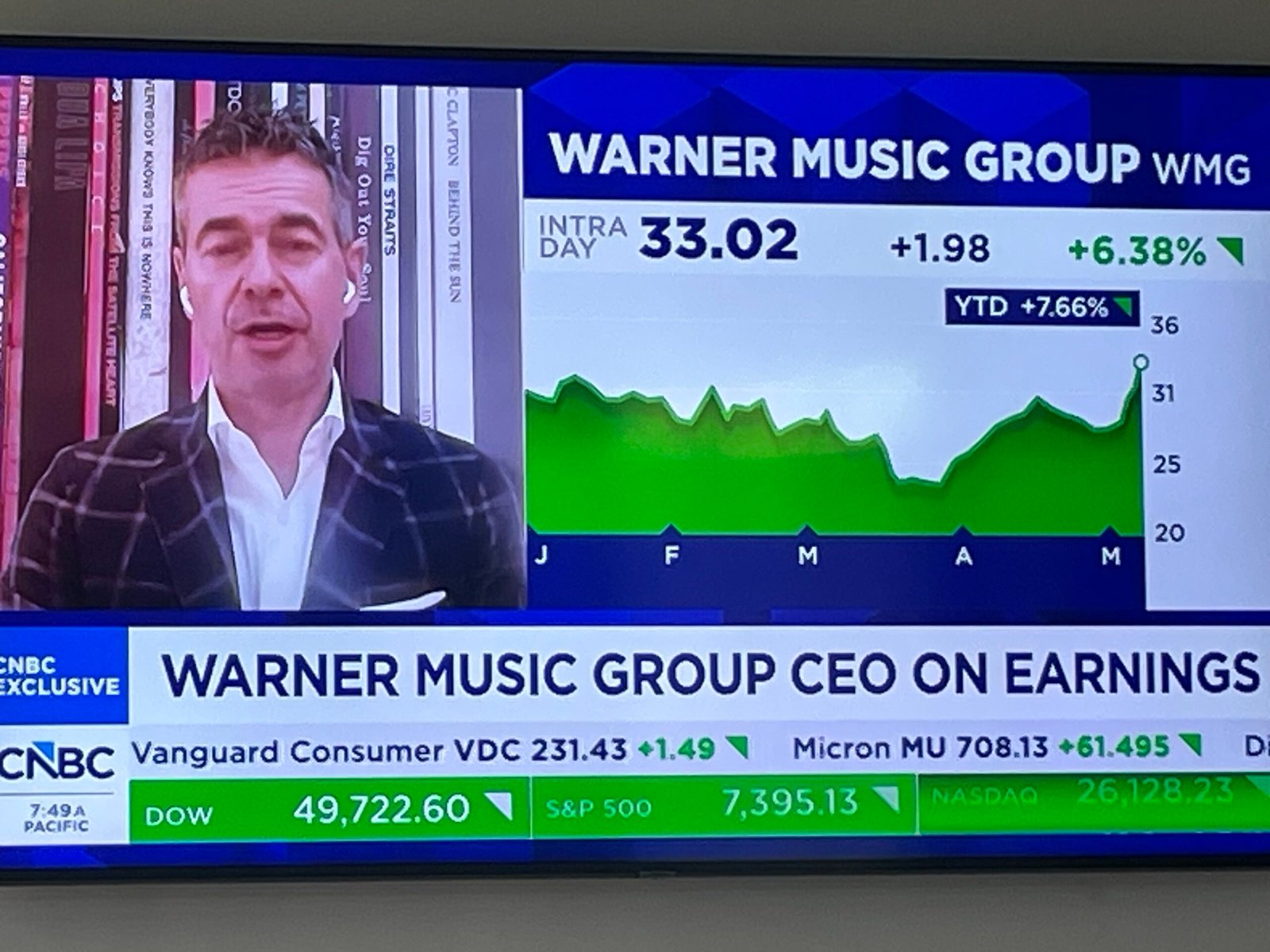
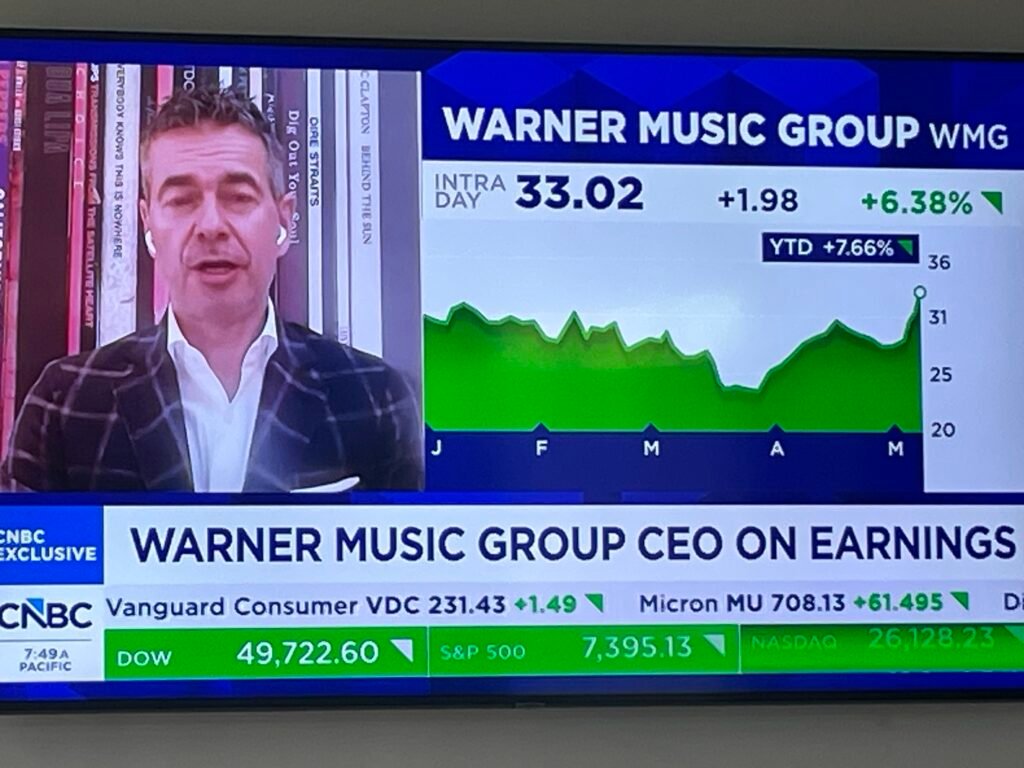
    Artificial intelligence was one of the dominant themes during Warner Music Group’s latest earnings call, and CEO Robert Kyncl made it clear the company sees AI as a major growth opportunity — not just a threat.

    Rather than framing AI as something the music industry must simply defend against, Kyncl repeatedly described AI as a tool that can expand engagement, improve efficiency, create new revenue streams, and increase the value of music catalogs.

    Here are the biggest takeaways from his comments.
    Robert Kyncl

    Warner Says AI Is Already Improving Catalog Monetization

    One of the most revealing parts of the call was Kyncl explaining how Warner is already using AI operationally.

    He said Warner has developed AI tools that help the company create:

    • motion art
    • visualizers
    • lyric videos
    • marketing assets

    …quickly and cost-effectively across its enormous music catalog.

    That matters because Warner’s catalog includes more than:

    • 1 million tracks
    • 70,000 artists

    Historically, labels could only economically market a small percentage of their catalog at scale. AI changes those economics dramatically.

    Kyncl explained that Warner is also using proprietary AI models to help determine where marketing resources should be focused, allowing the company to deepen monetization of older music.

    In practical terms, AI may allow labels to continuously revive and repackage older songs for new audiences at a much lower cost than before.


    Warner Believes AI Can Increase the Value of Music

    Kyncl repeatedly emphasized that Warner’s strategy is focused on “increasing the value of music.”

    One of the ways the company plans to do that is through:

    • AI partnerships
    • premium streaming tiers
    • interactive fan experiences

    Warner specifically discussed working with streaming platforms and emerging AI companies on:

    • AI-powered subscription tiers
    • enhanced fan engagement
    • higher-priced offerings

    The broader implication is that streaming could evolve beyond passive listening into something more interactive.

    That could eventually include:

    • remix functionality
    • fan participation tools
    • AI-assisted music creation
    • personalized listening experiences

    The company appears to believe consumers will pay more for deeper engagement with music.


    Warner’s Partnership With Suno Was A Major Focus

    Kyncl highlighted Warner’s licensing relationship with Suno as an example of the company’s AI strategy in action.

    Rather than attempting to completely shut down AI music platforms, Warner appears to be pursuing a more pragmatic approach:

    • licensing
    • monetization
    • copyright protection
    • participation in future growth

    Warner said Suno currently has:

    • roughly 2 million subscribers
    • an average monthly spend of approximately $12.50

    The company also noted that Suno is reportedly generating around $300 million in annualized revenue.

    Those figures suggest there is already meaningful consumer demand for AI-powered music experiences.


    Warner Says AI Music Has Had “Minimal Dilutive Impact”

    One of the more interesting comments from Kyncl involved concerns that AI-generated music could flood streaming services and reduce the value of professionally created music.

    According to Warner, major DSPs have reported that most AI-generated uploads are currently seeing:

    • very limited engagement
    • minimal impact on overall streaming economics

    Kyncl also emphasized that Warner is working closely with DSP partners to ensure contractual protections exist to prevent dilution and protect artists and songwriters.

    That signals the major labels are attempting to shape the rules of AI music early rather than reacting later.


    AI Is Becoming Part of Warner’s Financial Model

    Perhaps the most important takeaway from the earnings call is that Warner no longer talks about AI as an experiment.

    Executives explicitly stated they expect AI initiatives to become:

    “a material contributor to top and bottom line growth starting in fiscal 2027.”

    That is a major shift.

    It suggests Warner believes AI will eventually contribute to:

    • revenue growth
    • margin expansion
    • operational efficiency
    • streaming monetization
    • catalog engagement

    In other words, AI is now entering the company’s long-term business model.


    The Bigger Picture

    The earnings call revealed something important about the future direction of the music industry.

    Warner Music Group increasingly views itself not simply as a traditional record label, but as:

    • a global intellectual property platform
    • a data-driven media company
    • an AI-enabled infrastructure business

    Rather than seeing AI solely as a threat, Warner appears determined to:

    • license it
    • monetize it
    • integrate it
    • control the commercial framework around it

    That could fundamentally reshape how music is created, distributed, monetized, and experienced over the next decade.
  • 5 Takeaways From Warner Music’s May 2026 Earnings Call

    1. AI Is Already Changing the Music Business

    Warner openly said AI will become a “material contributor” to revenue and profits starting in fiscal 2027. This is no longer theoretical. The company is already using AI for catalog marketing, lyric videos, visualizers, forecasting, reporting, and automation.

    2. Catalog Music Is the Economic Engine

    Warner said catalog music now represents roughly 65% of recorded music streaming revenue. Older music is becoming more valuable in the streaming era because catalogs can generate recurring revenue for decades.

    3. The Labels Want to Monetize AI, Not Just Fight It

    Rather than simply resisting AI platforms, Warner is pursuing licensing deals and partnerships. Its relationship with Suno shows the company believes AI music and interactive fan experiences could become major future revenue streams.

    4. Modern Record Labels Are Starting to Look Like Tech Companies

    The earnings call sounded more like a technology company presentation than a traditional music business update. Warner repeatedly discussed:

    • automation
    • standardized data systems
    • operating leverage
    • AI-driven forecasting
    • centralized intelligence

    The modern label is evolving into an AI-enabled intellectual property platform.

    5. Streaming Is Becoming a Higher-Margin Subscription Business

    Subscription streaming revenue grew 15%, helped by pricing increases across DSPs. The industry is moving beyond pure user growth and toward higher pricing, premium tiers, and stronger monetization of superfans and interactive experiences.

  • The Michael Jackson Estate’s Biggest Opportunity: Repositioning the 1990s Catalog

    Introduction: A Catalog Imbalance Hiding in Plain Sight

    The catalog of Michael Jackson is one of the most valuable in music history. However, it is also uneven.

    On one hand, his 1980s output—Thriller, Bad, Off the Wall—continues to dominate streaming platforms, SiriusXM rotation, and cultural memory. Meanwhile, his 1990s catalog remains underplayed, under-discussed, and under-monetized.

    Importantly, this is not a quality issue. Rather, it is a positioning problem.


    The 1990s Were Bigger Than We Remember

    Dangerous (1991): A Commercial Powerhouse

    The album Dangerous was a commercial powerhouse. It produced major global hits such as “Black or White,” “Remember the Time,” “In the Closet,” and “Jam.”

    At the time, these songs defined pop music on a global scale. Today, however, they are not programmed with the same consistency as his 80s catalog.

    As a result, a generation of listeners associates Michael Jackson primarily with his earlier work, even though the 90s output was substantial.


    HIStory (1995): The Narrative Shift

    HIStory: Past, Present and Future, Book I marked a tonal and thematic pivot.

    Key tracks include:

    • “They Don’t Care About Us”
    • “Scream” (with Janet Jackson)
    • “Stranger in Moscow”
    • “Earth Song”
    • “You Are Not Alone”

    These songs were:

    • More political
    • More introspective
    • More cinematic

    And that shift changed how they age—and how they’re consumed today.


    Why the 90s Catalog Underperforms Today

    1. It Doesn’t Fit Easy Listening Lanes

    The 80s catalog is frictionless:

    • Instant recognition
    • Works in party settings
    • Fits “classic hits” formats

    The 90s catalog is different:

    • Slower
    • Heavier
    • More thematic

    Songs like:

    • “Earth Song”
    • “Stranger in Moscow”

    Don’t slot easily into algorithm-driven playlists or radio formats.


    2. The Narrative Became Complicated

    By the mid-1990s, the story around Michael Jackson changed.

    Music was no longer the only lens:

    • Tabloid coverage intensified
    • Public perception shifted
    • Personal controversy became part of the narrative

    That context affects how songs are remembered and programmed.

    Even a #1 hit like “You Are Not Alone” doesn’t receive consistent rotation today.


    3. There’s a “Story Gap” in the Catalog

    The arc is clear:

    • 70s: emergence
    • 80s: peak dominance
    • 90s: unclear positioning

    Without a defined narrative, the 90s catalog becomes fragmented—and easier to overlook.


    The Reframe: The Cinematic, Global, and Burden of Fame Era

    The 1990s catalog shouldn’t be treated as “post-peak.”

    It should be positioned as:

    Michael Jackson’s cinematic, global era—where the music reflects the weight and consequences of unprecedented fame.

    This reframing connects the work:

    • “Scream” → backlash
    • “They Don’t Care About Us” → defiance
    • “Stranger in Moscow” → isolation
    • “Earth Song” → global consciousness

    Now it’s not a scattered era.

    It’s a cohesive narrative.


    How the Estate Can Unlock Value

    1. Use Film as a Catalyst

    A sequel to Michael presents the strongest opportunity.

    Film doesn’t just revisit music—it reframes it.

    If the 90s are presented as a turning point:

    • Streaming spikes follow
    • Cultural re-evaluation begins
    • Under

    The 1990s Were Bigger Than We Remember

    Dangerous (1991): A Commercial Powerhouse

    The album Dangerous produced major global hits:

    • “Black or White”
    • “Remember the Time”
    • “In the Closet”
    • “Jam”

    These were not minor successes—they were defining records of the era.

    Yet today, they are not programmed or remembered with the same consistency as his 80s work.

    HIStory (1995): The Narrative Shift

    By contrast, HIStory: Past, Present and Future, Book I marked a tonal shift.

    It introduced songs like:

    • “They Don’t Care About Us”
    • “Scream” (with Janet Jackson)
    • “Stranger in Moscow”
    • “Earth Song”

    Notably, these tracks were more political, more introspective, and more cinematic. Because of this, they do not fit neatly into traditional radio formats or algorithm-driven playlists.

    Why the 90s Catalog Underperforms Today

    The 80s catalog is frictionless. For example, it works in party settings, gyms, and “classic hits” formats.

    In contrast, the 90s catalog is slower and more thematic. Therefore, songs like “Earth Song” and “Stranger in Moscow” struggle to find a consistent home in modern programming.

    2. The Narrative Became Complicated

    At the same time, the broader narrative around Michael Jackson changed in the 1990s.

    Music was no longer the only lens. Instead, media coverage and personal controversy began to shape public perception.

    Consequently, even major hits like “You Are Not Alone” do not receive consistent rotation today.

    3. There’s a “Story Gap” in the Catalog

    The arc is clear:

    • 70s: emergence
    • 80s: peak dominance
    • 90s: unclear positioning

    Without a defined narrative, the 90s catalog becomes fragmented—and easier to overlook.

    A Quick Data Check: The Rotation Gap Is Real

    To validate the narrative, it helps to look at real-world airplay.

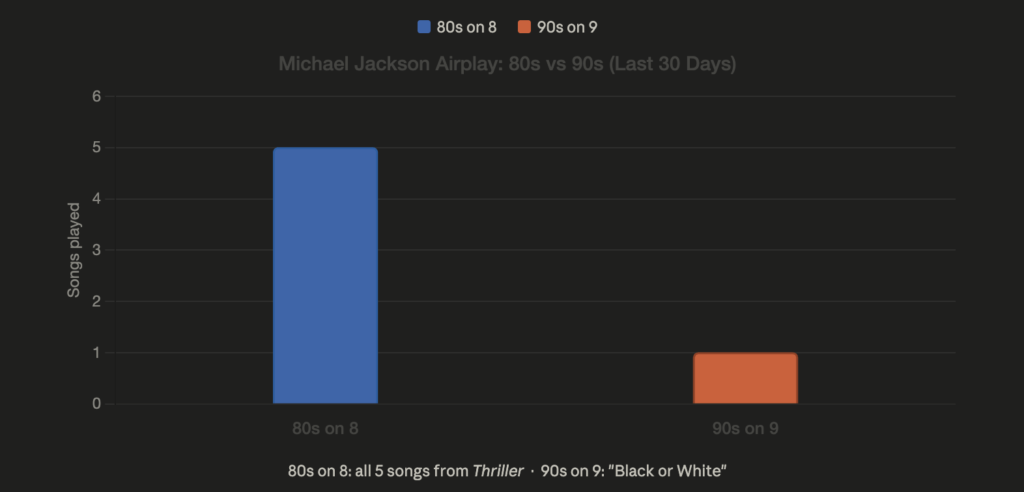
    Over the last 30 days (April 4 – May 4), the gap is clear.

    On 80s on 8, Michael Jackson has five songs among the most-played tracks. Notably, all five come from Thriller.

    In other words, his 1980s presence is not just strong—it is concentrated around a single, dominant tentpole.

    By contrast, the 1990s tell a very different story.

    On 90s on 9, Jackson has just one song in the most-played rotation: “Black or White” from Dangerous.

    Even more interesting, that track ranks #6 overall—and stands as one of the most-played songs from 1991 on the channel.

    However, despite that strong individual performance, the broader 1990s catalog remains largely absent from rotation.

    At the same time, 90s on 9 tends to skew toward the late 1990s, which may further limit exposure for earlier-decade Jackson releases. Still, that alone doesn’t explain the gap.

    Ultimately, the data reinforces the core point:

    The issue isn’t that the 1990s catalog lacks hits—it’s that only one of them consistently breaks through modern programming filters.


    Why This Matters

    Taken together, this creates a clear imbalance:

    • The 1980s catalog is deep, visible, and repeatedly surfaced
    • The 1990s catalog is shallow in rotation, despite proven success

    As a result, listener perception follows exposure—not history.

    And right now, the exposure is telling a very incomplete story.


    The Reframe: The Cinematic, Global, and Burden of Fame Era

    The 1990s catalog shouldn’t be treated as “post-peak.”

    It should be positioned as:

    Michael Jackson’s cinematic, global era—where the music reflects the weight and consequences of unprecedented fame.

    This reframing connects the work:

    • “Scream” → backlash
    • “They Don’t Care About Us” → defiance
    • “Stranger in Moscow” → isolation
    • “Earth Song” → global consciousness

    Now it’s not a scattered era.

    It’s a cohesive narrative.

    How the Estate Can Unlock Value

    1. Use Film as a Catalyst

    A sequel to Michael presents the strongest opportunity.

    Film doesn’t just revisit music—it reframes it.

    If the 90s are presented as a turning point:

    • Streaming spikes follow
    • Cultural re-evaluation begins
    • Underplayed songs gain context

    2. Create New Programming Lanes

    The solution is not forcing 90s songs into old categories.

    It’s building new ones:

    • Cinematic pop
    • Global anthems
    • Fame and pressure narratives

    Right now, these songs are effectively “homeless” in modern programming.

    3. Lean Into Depth, Not Nostalgia

    The 80s catalog thrives on nostalgia.

    The 90s catalog thrives on meaning.

    That distinction matters.

    Songs like:

    • “Earth Song”
    • “Stranger in Moscow”

    Are not background music.

    They are emotional, thematic pieces that require a different listening context.

    The Business Case: A Mispriced Asset

    Catalog value is driven by:

    • Frequency of play
    • Cultural relevance
    • Licensing demand

    Today:

    • 80s MJ = high-frequency assets
    • 90s MJ = low-frequency assets

    That gap is not about quality.

    It’s about positioning.

    The 1990s catalog is a mispriced asset that requires narrative activation to unlock its full value.

    Conclusion

    The music is already there. The hits already exist.

    What’s missing, however, is the story.

    Until the 1990s era is reframed as a distinct and essential chapter—defined by scale, pressure, and global ambition—it will remain underutilized.

    Ultimately, this represents one of the clearest opportunities in modern catalog management.