Category: Sync Licensing

  • Every Song From Love Story: John F. Kennedy Jr. & Carolyn Bessette

    A complete episode-by-episode soundtrack guide to FX’s Love Story — featuring the songs, artists, moods, and unforgettable music moments that turned the series into one of the most talked-about soundtracks of 2026.


    Episode 1 — “Pilot”

    Kate Bush. P.M. Dawn. Cocteau Twins. Primal Scream.

    Sixteen songs launch the series with dream pop, alternative rock, and emotionally loaded ‘90s atmosphere. The pilot immediately establishes that music isn’t background here — it’s part of the storytelling.
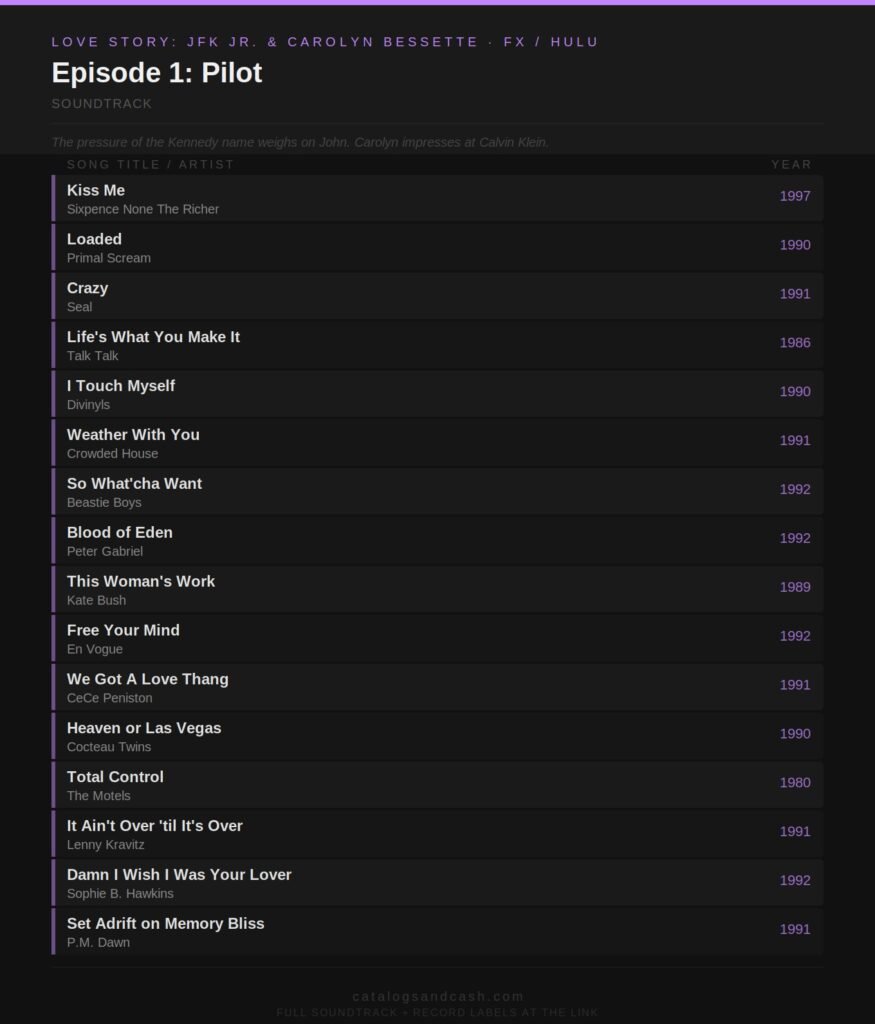
    Love Story Songs Pilot

    🎵 Featured vibe:

    • Dream pop
    • Alternative
    • Ethereal ‘90s nostalgia

    Episode 2 — “The Pool Party”

    Björk. Mazzy Star. The Breeders. The Stone Roses.

    Episode 2 leans fully into early-’90s alternative and dream pop as John and Carolyn’s relationship deepens. This is the episode that likely caused thousands of viewers to open Spotify mid-watch.
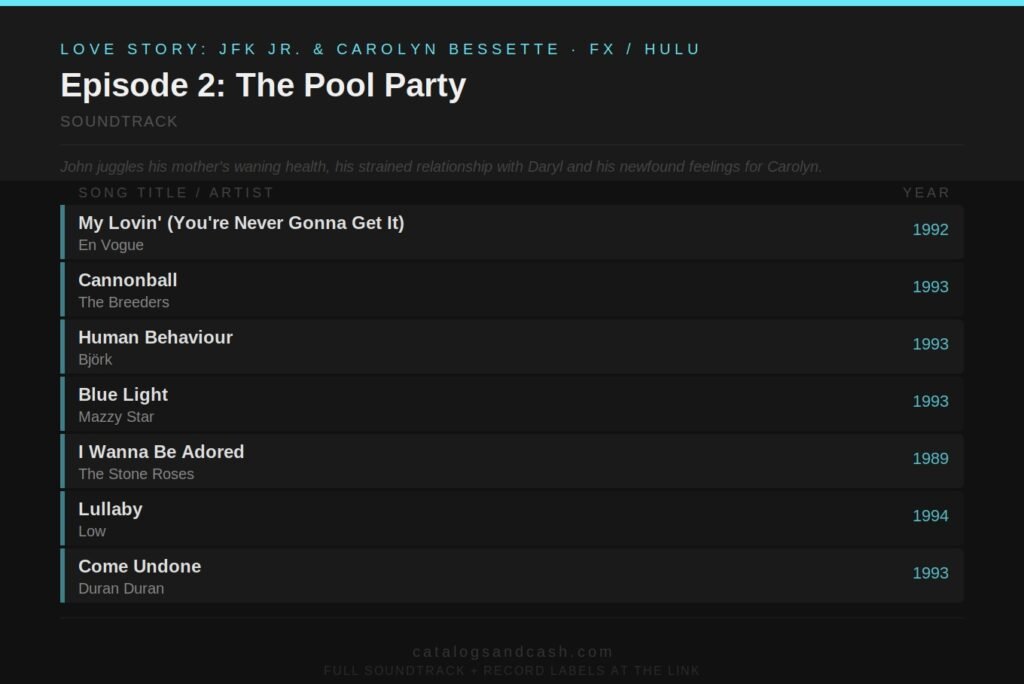
    Love Story - The Pool Party

    🎵 Featured vibe:

    • Dream pop
    • Shoegaze
    • Alternative romance

    Episode 3 — “America’s Widow”

    Mazzy Star’s “Fade Into You.”
    Portishead’s “Roads.”
    Ella Fitzgerald’s “Solitude.”

    Only four songs appear in this episode, but every placement lands emotionally. The soundtrack becomes quieter, heavier, and more devastating.
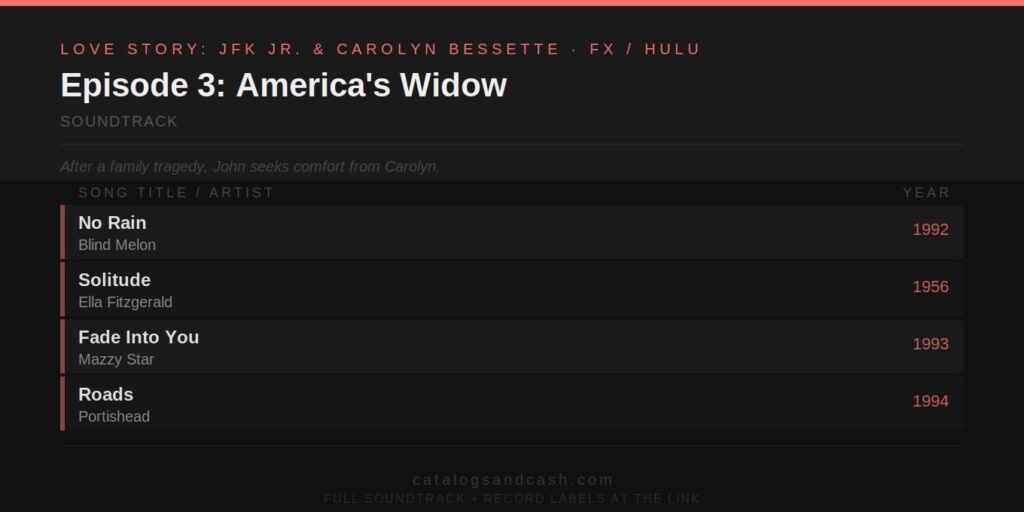
    America's Widow Songs Love Story

    🎵 Featured vibe:

    • Trip-hop
    • Jazz melancholy
    • Emotional minimalism

    Episode 4 — “I Love You”

    The relationship becomes more intimate and emotionally exposed. The soundtrack shifts toward longing, uncertainty, and vulnerability.
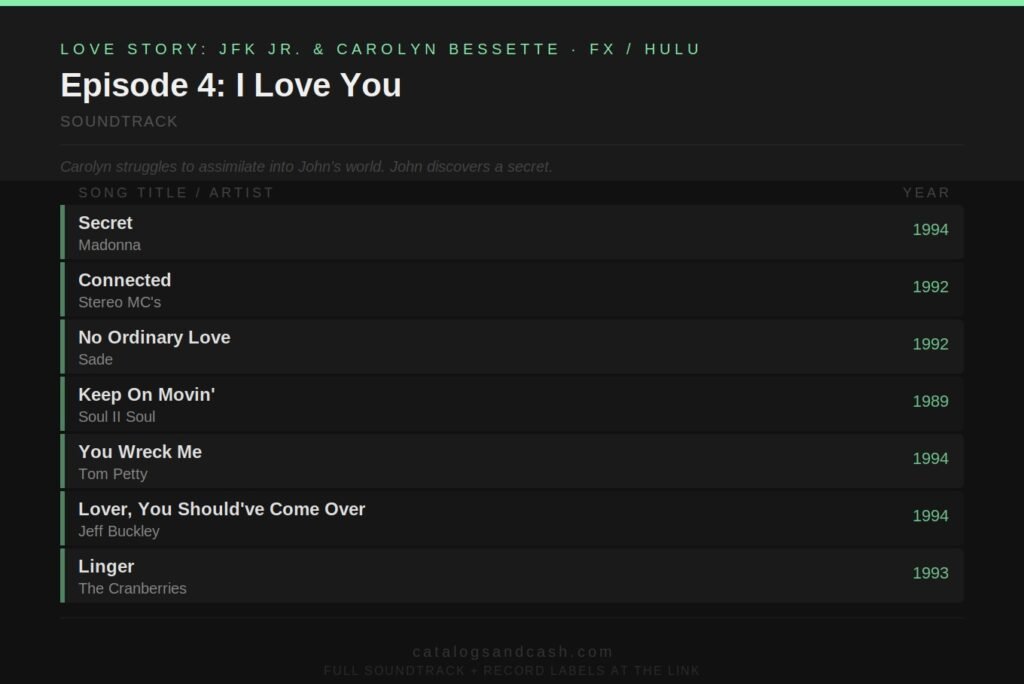
    Love story Songs I Love You

    🎵 Featured vibe:

    • Romantic tension
    • Intimate alternative
    • Emotional slow burn

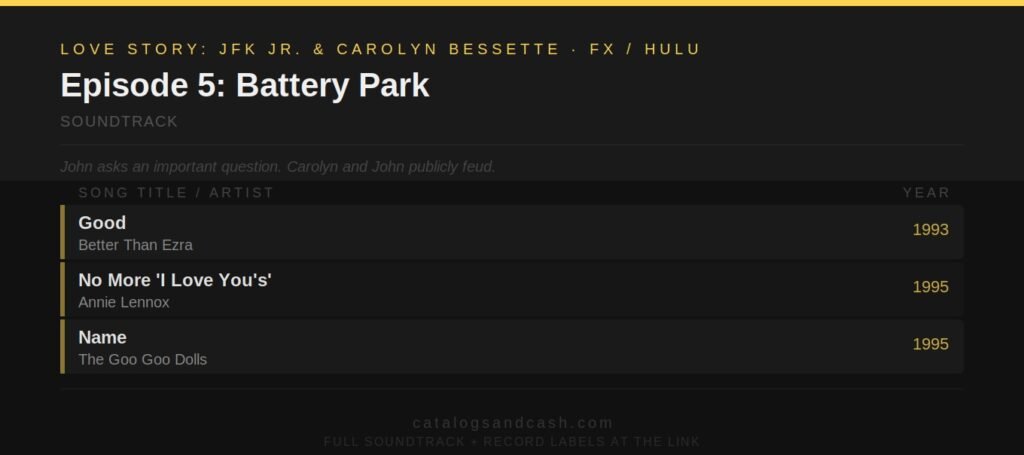
    Episode 5 — “Battery Park”

    The Goo Goo Dolls’ “Name” during the proposal sequence becomes one of the defining music moments of the series.

    Annie Lennox’s “No More ‘I Love You’s’” adds emotional tension underneath the romance.
    Battery Park Songs

    🎵 Featured vibe:

    • ‘90s emotional rock
    • Romantic catharsis
    • Nostalgic heartbreak

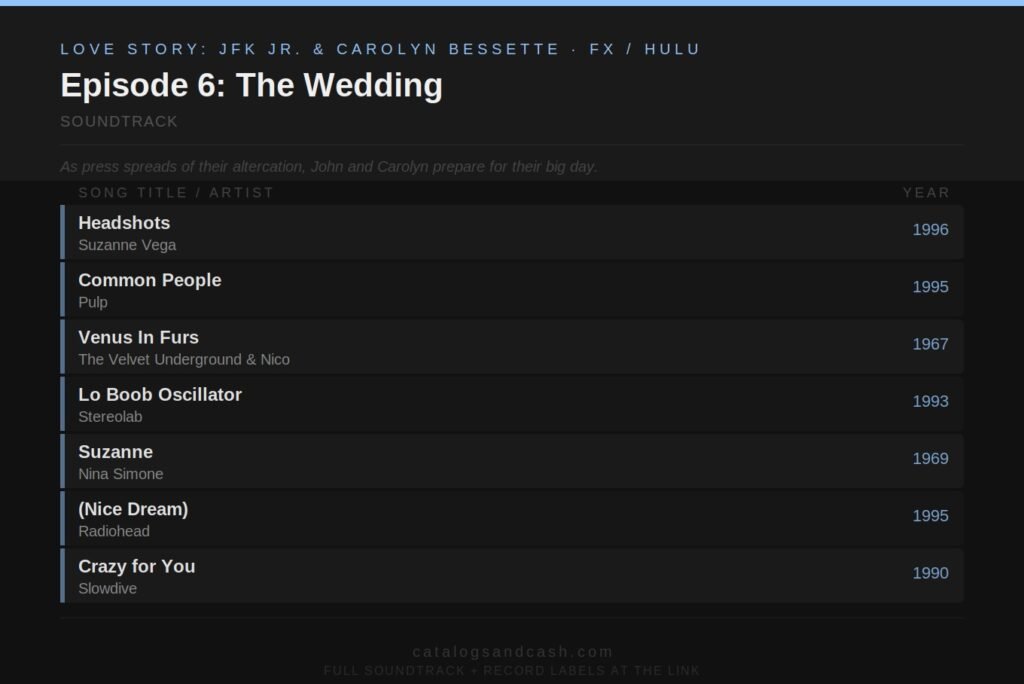
    Episode 6 — “The Wedding”

    The soundtrack turns cinematic and elegant as the mythology surrounding the couple grows larger.
    Love Story The Wedding Songs

    🎵 Featured vibe:

    • Elegant romance
    • Cinematic pop
    • Timeless classics

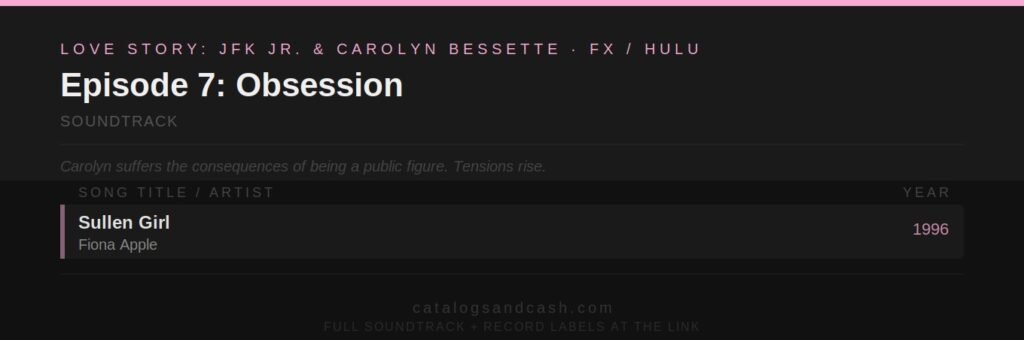
    Episode 7 — “Obsession”

    The glamour starts collapsing into pressure, media scrutiny, and emotional instability. The soundtrack becomes darker and moodier.
    Love Story Obsession

    🎵 Featured vibe:

    • Dark dream pop
    • Emotional tension
    • Fame anxiety

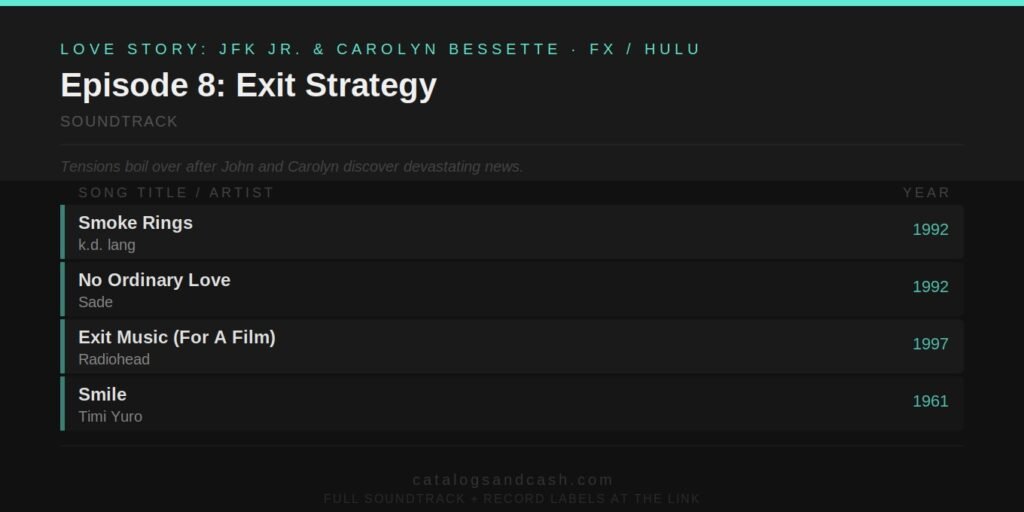
    Episode 8 — “Exit Strategy”

    The music begins preparing the audience emotionally for the inevitable tragedy ahead.
    Love Story Exit Strategy

    🎵 Featured vibe:

    • Reflection
    • Unease
    • Emotional withdrawal

    Episode 9 — “Search and Recovery”

    The soundtrack becomes elegiac and haunting as the series closes with grief, memory, and mythology fully intertwined.
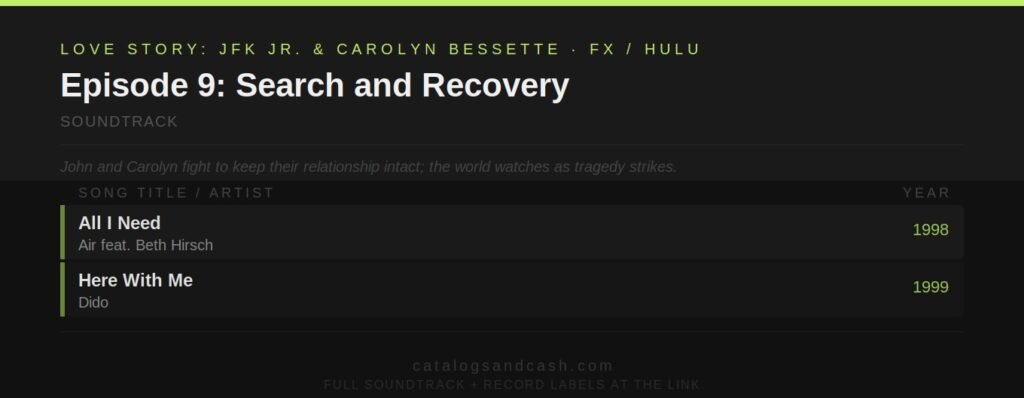
    Love story Songs Search and Recovery

    🎵 Featured vibe:

    • Grief
    • Reflection
    • Cultural memory

    Why the Soundtrack Works

    What makes Love Story stand out is that it doesn’t chase trendy viral songs. Instead, it uses emotionally durable catalog music — songs that already carried history before they appeared in the show.

    That gives the soundtrack:

    • replay value
    • emotional weight
    • catalog longevity
    • streaming upside
    • sync licensing power

    It’s one of the clearest examples in recent TV of how music supervision can elevate an entire series.

  • Why Some Songs Are Easier to License Than Others

    From the outside, music licensing can look like a taste game. A supervisor hears a song, imagines it in a scene, and tries to clear it. But in practice, the songs that get licensed most often are not just the most emotionally effective. They are also the most administratively usable. That is why some songs are easier to license than others. Ease of licensing sits at the intersection of creative fit, legal simplicity, and operational speed.

    The first factor is lyrical and emotional fit. Some songs naturally work in film, television, and advertising because they communicate a mood clearly without becoming distracting. If the lyrics are too specific, too explicit, too controversial, or too narratively dominant, the song may be harder to place. Supervisors often want music that enhances the scene instead of hijacking it. A broadly resonant song with a flexible emotional tone usually has more licensing potential than a track whose meaning is rigid or difficult to adapt.

    Genre also matters. That does not mean some genres are inherently bad for sync, but some are easier to match with mainstream visual storytelling. A clean, emotionally legible rock, soul, pop, jazz, or orchestral track may offer more versatile use cases than a song whose production, vocal style, or lyrical content narrows the field. Commercial advertising in particular tends to reward clarity, immediacy, and broad audience accessibility.

    The second major factor is rights structure. This is where many licensing opportunities become complicated. If a song has one or two writers, straightforward ownership, and a responsive rights team, it can move quickly. If it has a long chain of approvals, multiple publishers, samples, partial disputes, or legacy paperwork issues, the process slows down. Music supervision is often deadline-driven. A perfectly suitable song can lose out simply because it cannot be cleared with enough speed and certainty.

    Sampling creates a special kind of friction. A song built on multiple samples may involve additional permissions beyond the visible writers and publishers. Even when the revenue history looks attractive, the licensing pathway may be much less smooth. The more parties involved, the more chances something stalls. That matters because supervisors, producers, and brands are trying to solve a problem. They may love your song, but they also have schedules, budgets, and legal teams. Convenience has value.

    Artist approval rights can make a difference too. Some artists want tight control over where their music appears, and that can limit licensing opportunities. A company or buyer might own rights on paper, but if approvals are subjective or inconsistent, monetization becomes less predictable. On the other hand, when the rights holders share a pragmatic and brand-aware licensing philosophy, the asset becomes more commercially useful.

    Production quality is another overlooked variable. Songs that are well-recorded, sonically clean, and easy to edit tend to be more usable. Supervisors and editors may need instrumental stems, alternate mixes, shorter versions, or adaptable structures. A track that can be manipulated cleanly for a scene or campaign has an advantage over one that is less flexible. The same is true for metadata. Good metadata may sound boring, but it speeds discovery and reduces friction across the licensing pipeline.

    There is also the issue of cultural risk. Some songs carry baggage because of their lyrics, the artist’s public persona, or the associations attached to the work. A brand might love the sound of a track but decide it is too risky for a national campaign. A film studio may avoid a song if the clearance issues are manageable but the reputational issues are not. That does not eliminate value, but it narrows the buyer pool for placements.

    All of this affects catalog value because licensing potential is part of how investors assess upside. A catalog filled with songs that are artistically strong and operationally easy to clear is more attractive than one where every opportunity becomes a negotiation marathon. Ease of licensing is not just an administrative bonus. It is a monetization advantage.

    The simplest way to say it is this: the market rewards songs that are both good and usable. A great song that is hard to clear can underperform in licensing. A very good song that is fast, flexible, and cleanly owned can outperform. That gap matters a lot in modern music rights. In the sync world, friction is expensive. Clarity gets paid.

  • Why Sync Licensing Matters So Much in Catalog Value

    Sync licensing can change the trajectory of a music catalog faster than almost any other commercial lever. A song that has been quietly earning for years can suddenly surge because it lands in a hit television show, a movie trailer, a global ad campaign, or a viral scene that brings it to a new audience. That is why sync matters so much in catalog valuation. It is not just another revenue line. It can act as both direct income and an engine for broader catalog reactivation.

    At the most basic level, sync licensing generates money because the rights holder is paid to pair music with visual media. That payment can be meaningful on its own, especially for high-profile placements. But the bigger reason investors care is that sync often creates a second wave of consumer attention. A placement can lead to a spike in streams, Shazam activity, playlist adds, social conversation, and cultural relevance. In some cases, the sync fee is only the beginning. The real value comes from renewed discovery.

    This is especially important for older catalogs. A legacy song may already have proven durability, but a sync placement can introduce it to a generation that did not grow up with it. Suddenly the song is not just “old”; it is current again. That kind of renewal is incredibly valuable because it extends the commercial life of the asset. Catalog buyers love signals that suggest a song can travel through time and still connect.

    Sync also matters because it can diversify income. Streaming is central to modern royalty economics, but it is not the only source of value. When a catalog has credible sync potential, it becomes less dependent on passive consumption patterns alone. The rights holder has a more active way to create moments. That is attractive from an investment standpoint because it means the asset can be managed, not merely observed.

    But not all songs are equally syncable. Some music fits visual storytelling more naturally than others. Lyrics matter. Tone matters. Mood matters. Genre matters. So does simplicity of clearance. If a song has many writers, samples, approval hurdles, or ambiguous ownership, it may be harder to place, even if it is artistically perfect. Supervisors and brands often want the clearest path to execution. A great song with a messy rights chain can lose out to a slightly less perfect song that is easy to license.

    This is where catalog valuation gets more nuanced. Buyers do not simply ask, “Has this catalog earned sync revenue before?” They also ask, “Could it earn more under stronger management?” A catalog that has been underexploited may look more attractive to a buyer with a dedicated sync team, better relationships, or a more aggressive licensing strategy. The same songs can be worth more in the hands of an operator who knows how to package and pitch them.

    There is also a halo effect to consider. A successful placement can elevate not just one song, but the wider artist brand or catalog identity. A film scene, a prestige drama, a documentary, or an ad campaign can trigger press, conversation, and rediscovery. People start listening beyond the placed track. They revisit albums, interviews, images, and adjacent songs. In that sense, sync can function as a cultural marketing event as much as a licensing transaction.

    Still, buyers have to be careful. Sync is important, but it is not guaranteed. Some songs are obvious sync candidates and still never land the big placement everyone imagines. Trends change. Supervisors have taste. Brands get cautious. Competitive dynamics shift. The right scene may never materialize. That is why sync upside should enhance a catalog thesis, not replace it. A strong catalog should work even without a dream placement.

    The best way to think about sync is as optionality. It gives the rights holder more ways to create value from the same underlying songs. It can produce direct fees, increase downstream consumption, refresh relevance, and deepen cross-generational awareness. Those are powerful outcomes, especially in a market where cultural attention is fragmented.

    So why does sync licensing matter so much in catalog value? Because it connects the financial logic of ownership with the emotional logic of discovery. A song placed in the right context becomes newly alive. And when a catalog can reliably generate those moments, the market will usually pay more for the possibility.