Category: Streaming

  • How Space Exploration Gave “Run To The Water” a Second Life in the Streaming Era

    How Space Exploration Gave “Run To The Water” a Second Life in the Streaming Era

    The streaming jump for “Run To The Water” by Live may not have been random.

    On April 10, 2026, the song was reportedly played in connection with NASA’s Artemis II mission coverage — and the timing lines up almost perfectly with a noticeable surge in Spotify growth afterward.

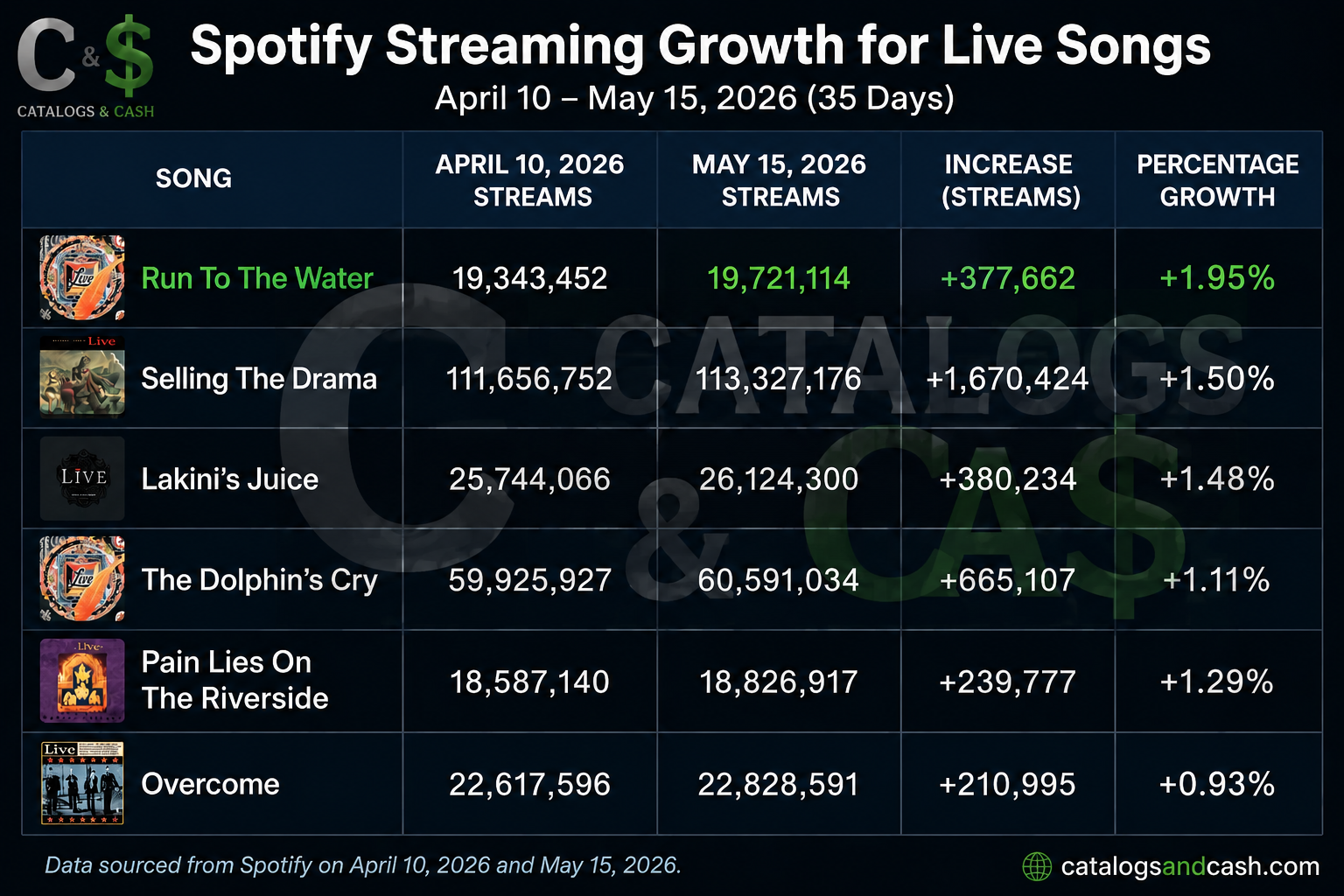
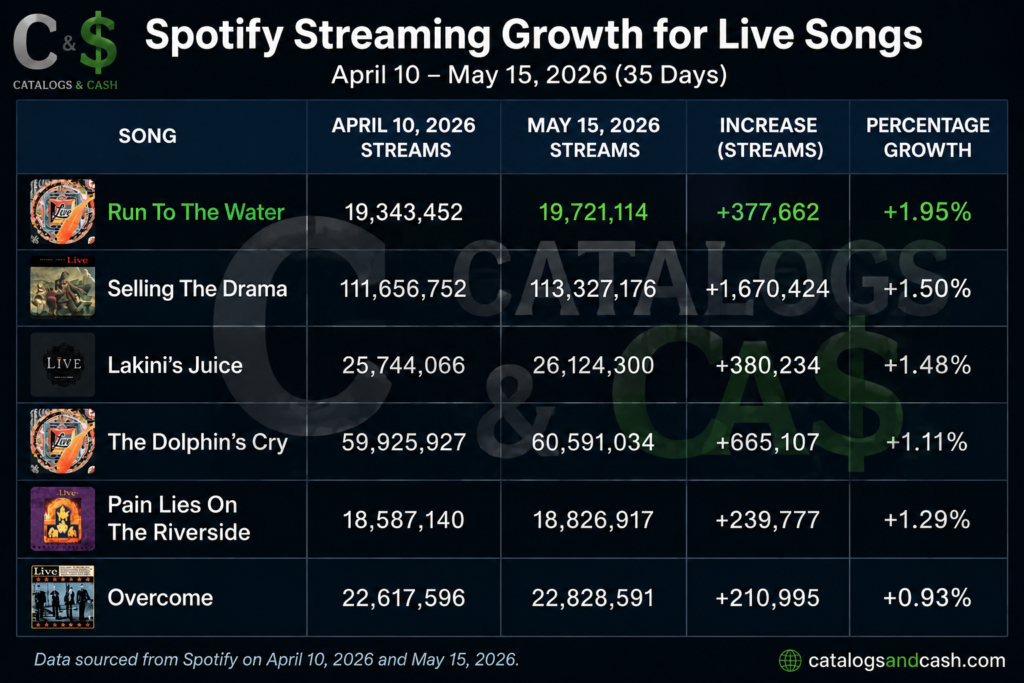
    Between April 10 and May 15, “Run To The Water” increased from 19.34 million streams to 19.72 million streams on Spotify, a gain of 377,662 plays in just 35 days. That represented roughly 1.95% growth, the fastest percentage increase among several major Live catalog tracks during that same period.
    Live "Run to the Water" Spotify growth

    The song also climbed from #9 to #7 in Live’s Spotify rankings during that span. Additionally, Live has seen their monthly listeners grow from 3.7 million to 3.9 million.

    Why Artemis II Matters

    Moments tied to major cultural or emotional events often create renewed interest in older songs. Sometimes it’s a movie placement, a viral TikTok clip, or a sporting event.

    Space missions occupy a unique place in American culture because they combine:

    • optimism,
    • exploration,
    • nostalgia,
    • emotion,
    • and collective attention.

    A song like “Run To The Water” is unusually well-suited for that environment. It has a cinematic, reflective, almost spiritual quality that fits aerospace imagery remarkably well.

    The song already carried themes of movement, searching, transcendence, and emotional release. Pairing that with Artemis-era visuals and mission coverage creates the kind of emotional association that can reignite catalog music in the streaming age.

    Streaming Is Rewriting Music History in Real Time

    One of the most interesting parts of the modern streaming ecosystem is that catalog songs no longer remain frozen in their original commercial status.

    Radio once dictated permanence. Streaming allows rediscovery.

    That means:

    • mood matters more,
    • replayability matters more,
    • emotional atmosphere matters more,
    • and cultural placement can suddenly revive songs decades later.

    “Run To The Water” was never the biggest hit in Live’s catalog. But the streaming era may actually favor songs like this — atmospheric, emotional, and endlessly replayable.

    And if the Artemis II association introduced even a small wave of new listeners, the Spotify numbers suggest those listeners stayed.

  • “Run to the Water” Quietly Outperforms Live’s Spotify Catalog After Artemis II NASA Moment

    Sometimes the story isn’t in the headline numbers. It’s in the small movements that don’t look like much—until you compare them.

    That’s what’s happening right now with “Run to the Water” by Live.

    Live currently sits at around 3.7 million monthly listeners on Spotify. That’s a stable, active catalog. Not surging, not declining—just sitting in that middle ground where most legacy bands live.

    Which is exactly why this matters.

    See our follow up story on “Run to the Water”


    A Small Moment… With Real Movement

    Recently, NASA used “Run to the Water” as part of the wake-up sequence for Artemis II.

    On its own, that’s just an interesting cultural note.

    But when you look at what happened next, the data tells a more interesting story.

    “Run to the Water” didn’t just rise—it outperformed comparable songs in Live’s Spotify Top 10 by roughly 3–4x on a percentage basis over the same period.

    Ed Kowalcyzyk Instagram

    Not the biggest hit. Not the most played.

    But the fastest moving.


    From #9 to #7 — And Why That’s Not Nothing

    The song, written by Ed Kowalczyk and Patrick Dahlheimer, also moved from #9 to #7 in Live’s top tracks.

    That kind of shift doesn’t usually happen randomly in a mature catalog. These rankings tend to be sticky.

    So when something moves, even a couple spots, it’s worth paying attention.

    Because what it suggests is simple:

    Listeners are choosing this song more often relative to the rest of the catalog.

    Not just hearing it—selecting it.


    What We’re Watching

    Right now, this is a signal—not a breakout.

    But it’s the kind of signal that can turn into something if it continues.

    We’ll be watching whether:

    • “Run to the Water” continues to outperform other Top 10 tracks
    • it climbs further up the rankings
    • and whether Live’s 3.7 million monthly listeners begins to tick upward

    If that listener number moves, even modestly, it suggests this isn’t just internal rotation—it’s new attention entering the system.


    The Bigger Idea

    Catalog growth rarely shows up all at once.

    It starts like this:
    a moment, a placement, a small shift in behavior.

    Then you get relative outperformance.

    Then, sometimes, it compounds.

    Most of the time it fades.

    But every now and then, it doesn’t.


    Final Thought

    “Run to the Water” isn’t a hit again. Not yet.

    But it’s doing something more important:

    It’s outperforming its peers.

    And in catalog analysis, that’s usually where the story starts.

    Live currently is in the Top 15 artists played on SiriusXM Lithium from Feb 5-April 5 2026.

  • Does the Popular Music Canon Still Matter in the Streaming Era?

    The popular music canon used to feel easier to describe. There was a clearer sense of which artists, albums, and songs “everybody knew,” and mass media reinforced that hierarchy. Radio, MTV, major magazines, retail displays, and a smaller field of choices all helped create concentration. In the streaming era, that concentration has weakened. Audiences have more music, more access, more algorithms, and more ways to build highly individualized listening habits. So the question is worth asking: does the popular music canon still matter?

    It does, but not in exactly the same way. The canon may be less centralized than it once was, yet it still shapes behavior, value, and cultural memory. In fact, the catalog market depends on it. When investors pay serious money for older songs, they are making a bet that some works have durable recognition beyond temporary trend cycles. That is another way of saying they believe a canon still exists, even if its borders are blurrier than before.

    One change is that the canon is now more modular. Instead of one universally agreed upon ladder, we have overlapping canons. There is the rock canon, the hip-hop canon, the country canon, the R&B canon, the classic pop canon, and increasingly micro-canons formed by online communities, fan cultures, and generational nostalgia. This fragmentation can make the culture feel less unified, but it does not eliminate the economic importance of recognized works. It simply means recognition may live in clusters rather than in one national monoculture.

    Streaming has changed the mechanics of familiarity. People may hear more total hours of music than earlier generations, but their attention is spread across a vastly larger field. That can weaken the concentration once enjoyed by the most dominant catalog artists. At the same time, streaming also makes rediscovery easier. A song from decades ago can reappear through playlists, social media clips, movie placements, or algorithmic recommendations. That means the canon may be less imposed from above, but it can still regenerate from below.

    Another important shift is that image, context, and narrative now play a larger role in how listeners approach older music. A younger fan may not arrive at a classic artist through linear radio exposure. They may arrive through a fashion story, a documentary, a TikTok trend, a podcast, or a biopic. Canon formation is no longer purely musical. It often depends on adjacent cultural channels that reactivate interest.

    This has consequences for catalog value. The old idea of canon implied permanence. The newer version implies resilience. A canonical work today is not simply a song everyone was once told was great. It is a song that can survive format change, playlist culture, algorithmic competition, and shifting audience attention. That kind of resilience is precisely what makes older catalogs investable.

    Still, there is a real challenge. If attention continues fragmenting, it becomes harder for any one body of work to dominate the way previous generations’ giants did. Future canon formation may be weaker, slower, or more contested. That matters because today’s catalog valuations often rely on assumptions about long-term cultural durability. If the culture becomes too diffuse, the economic premium attached to canonical status may become harder to sustain.

    Yet there is a counterpoint. In times of abundance, trusted reference points can become more valuable, not less. When listeners face overwhelming choice, they often return to the familiar, the validated, and the emotionally legible. Canonical songs retain an advantage because people already know what they are. They carry memory, social proof, and repeat utility. Weddings, parties, movies, playlists, sports events, and background listening all reward songs that are already embedded in shared life.

    So does the popular music canon still matter in the streaming era? Yes, but it behaves differently. It is less singular, less top-down, and more dependent on ongoing cultural reinforcement. It is not obsolete. It is evolving. For artists, estates, and investors, the lesson is that catalog value now depends not just on historical greatness, but on the ongoing ability of that greatness to stay visible in a crowded world. The canon still matters because familiarity still matters. And in music, familiarity remains one of the strongest economic assets there is.