Category: Michael Jackson

  • The Michael Jackson Estate’s Biggest Opportunity: Repositioning the 1990s Catalog

    Introduction: A Catalog Imbalance Hiding in Plain Sight

    The catalog of Michael Jackson is one of the most valuable in music history. However, it is also uneven.

    On one hand, his 1980s output—Thriller, Bad, Off the Wall—continues to dominate streaming platforms, SiriusXM rotation, and cultural memory. Meanwhile, his 1990s catalog remains underplayed, under-discussed, and under-monetized.

    Importantly, this is not a quality issue. Rather, it is a positioning problem.


    The 1990s Were Bigger Than We Remember

    Dangerous (1991): A Commercial Powerhouse

    The album Dangerous was a commercial powerhouse. It produced major global hits such as “Black or White,” “Remember the Time,” “In the Closet,” and “Jam.”

    At the time, these songs defined pop music on a global scale. Today, however, they are not programmed with the same consistency as his 80s catalog.

    As a result, a generation of listeners associates Michael Jackson primarily with his earlier work, even though the 90s output was substantial.


    HIStory (1995): The Narrative Shift

    HIStory: Past, Present and Future, Book I marked a tonal and thematic pivot.

    Key tracks include:

    • “They Don’t Care About Us”
    • “Scream” (with Janet Jackson)
    • “Stranger in Moscow”
    • “Earth Song”
    • “You Are Not Alone”

    These songs were:

    • More political
    • More introspective
    • More cinematic

    And that shift changed how they age—and how they’re consumed today.


    Why the 90s Catalog Underperforms Today

    1. It Doesn’t Fit Easy Listening Lanes

    The 80s catalog is frictionless:

    • Instant recognition
    • Works in party settings
    • Fits “classic hits” formats

    The 90s catalog is different:

    • Slower
    • Heavier
    • More thematic

    Songs like:

    • “Earth Song”
    • “Stranger in Moscow”

    Don’t slot easily into algorithm-driven playlists or radio formats.


    2. The Narrative Became Complicated

    By the mid-1990s, the story around Michael Jackson changed.

    Music was no longer the only lens:

    • Tabloid coverage intensified
    • Public perception shifted
    • Personal controversy became part of the narrative

    That context affects how songs are remembered and programmed.

    Even a #1 hit like “You Are Not Alone” doesn’t receive consistent rotation today.


    3. There’s a “Story Gap” in the Catalog

    The arc is clear:

    • 70s: emergence
    • 80s: peak dominance
    • 90s: unclear positioning

    Without a defined narrative, the 90s catalog becomes fragmented—and easier to overlook.


    The Reframe: The Cinematic, Global, and Burden of Fame Era

    The 1990s catalog shouldn’t be treated as “post-peak.”

    It should be positioned as:

    Michael Jackson’s cinematic, global era—where the music reflects the weight and consequences of unprecedented fame.

    This reframing connects the work:

    • “Scream” → backlash
    • “They Don’t Care About Us” → defiance
    • “Stranger in Moscow” → isolation
    • “Earth Song” → global consciousness

    Now it’s not a scattered era.

    It’s a cohesive narrative.


    How the Estate Can Unlock Value

    1. Use Film as a Catalyst

    A sequel to Michael presents the strongest opportunity.

    Film doesn’t just revisit music—it reframes it.

    If the 90s are presented as a turning point:

    • Streaming spikes follow
    • Cultural re-evaluation begins
    • Under

    The 1990s Were Bigger Than We Remember

    Dangerous (1991): A Commercial Powerhouse

    The album Dangerous produced major global hits:

    • “Black or White”
    • “Remember the Time”
    • “In the Closet”
    • “Jam”

    These were not minor successes—they were defining records of the era.

    Yet today, they are not programmed or remembered with the same consistency as his 80s work.

    HIStory (1995): The Narrative Shift

    By contrast, HIStory: Past, Present and Future, Book I marked a tonal shift.

    It introduced songs like:

    • “They Don’t Care About Us”
    • “Scream” (with Janet Jackson)
    • “Stranger in Moscow”
    • “Earth Song”

    Notably, these tracks were more political, more introspective, and more cinematic. Because of this, they do not fit neatly into traditional radio formats or algorithm-driven playlists.

    Why the 90s Catalog Underperforms Today

    The 80s catalog is frictionless. For example, it works in party settings, gyms, and “classic hits” formats.

    In contrast, the 90s catalog is slower and more thematic. Therefore, songs like “Earth Song” and “Stranger in Moscow” struggle to find a consistent home in modern programming.

    2. The Narrative Became Complicated

    At the same time, the broader narrative around Michael Jackson changed in the 1990s.

    Music was no longer the only lens. Instead, media coverage and personal controversy began to shape public perception.

    Consequently, even major hits like “You Are Not Alone” do not receive consistent rotation today.

    3. There’s a “Story Gap” in the Catalog

    The arc is clear:

    • 70s: emergence
    • 80s: peak dominance
    • 90s: unclear positioning

    Without a defined narrative, the 90s catalog becomes fragmented—and easier to overlook.

    A Quick Data Check: The Rotation Gap Is Real

    To validate the narrative, it helps to look at real-world airplay.

    Over the last 30 days (April 4 – May 4), the gap is clear.

    On 80s on 8, Michael Jackson has five songs among the most-played tracks. Notably, all five come from Thriller.

    In other words, his 1980s presence is not just strong—it is concentrated around a single, dominant tentpole.

    By contrast, the 1990s tell a very different story.
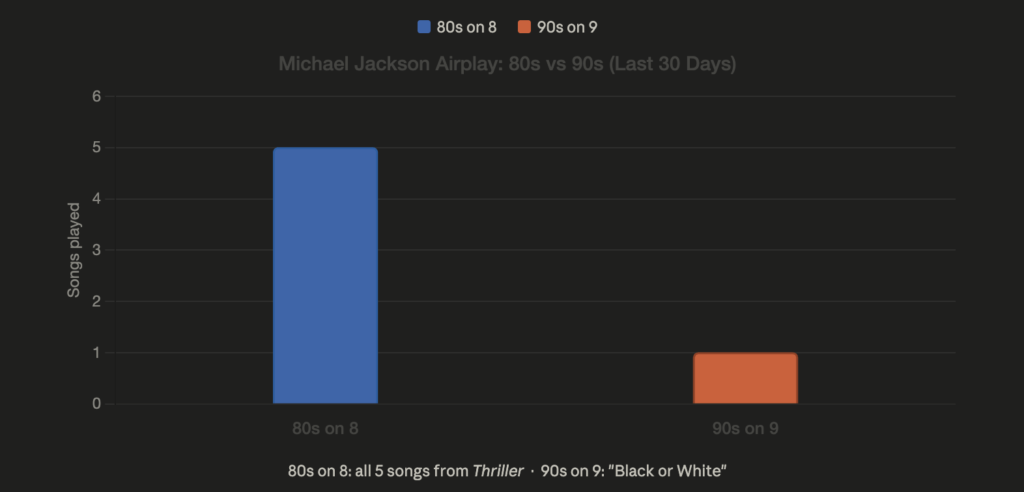
    On 90s on 9, Jackson has just one song in the most-played rotation: “Black or White” from Dangerous.

    Even more interesting, that track ranks #6 overall—and stands as one of the most-played songs from 1991 on the channel.

    However, despite that strong individual performance, the broader 1990s catalog remains largely absent from rotation.

    At the same time, 90s on 9 tends to skew toward the late 1990s, which may further limit exposure for earlier-decade Jackson releases. Still, that alone doesn’t explain the gap.

    Ultimately, the data reinforces the core point:

    The issue isn’t that the 1990s catalog lacks hits—it’s that only one of them consistently breaks through modern programming filters.


    Why This Matters

    Taken together, this creates a clear imbalance:

    • The 1980s catalog is deep, visible, and repeatedly surfaced
    • The 1990s catalog is shallow in rotation, despite proven success

    As a result, listener perception follows exposure—not history.

    And right now, the exposure is telling a very incomplete story.


    The Reframe: The Cinematic, Global, and Burden of Fame Era

    The 1990s catalog shouldn’t be treated as “post-peak.”

    It should be positioned as:

    Michael Jackson’s cinematic, global era—where the music reflects the weight and consequences of unprecedented fame.

    This reframing connects the work:

    • “Scream” → backlash
    • “They Don’t Care About Us” → defiance
    • “Stranger in Moscow” → isolation
    • “Earth Song” → global consciousness

    Now it’s not a scattered era.

    It’s a cohesive narrative.

    How the Estate Can Unlock Value

    1. Use Film as a Catalyst

    A sequel to Michael presents the strongest opportunity.

    Film doesn’t just revisit music—it reframes it.

    If the 90s are presented as a turning point:

    • Streaming spikes follow
    • Cultural re-evaluation begins
    • Underplayed songs gain context

    2. Create New Programming Lanes

    The solution is not forcing 90s songs into old categories.

    It’s building new ones:

    • Cinematic pop
    • Global anthems
    • Fame and pressure narratives

    Right now, these songs are effectively “homeless” in modern programming.

    3. Lean Into Depth, Not Nostalgia

    The 80s catalog thrives on nostalgia.

    The 90s catalog thrives on meaning.

    That distinction matters.

    Songs like:

    • “Earth Song”
    • “Stranger in Moscow”

    Are not background music.

    They are emotional, thematic pieces that require a different listening context.

    The Business Case: A Mispriced Asset

    Catalog value is driven by:

    • Frequency of play
    • Cultural relevance
    • Licensing demand

    Today:

    • 80s MJ = high-frequency assets
    • 90s MJ = low-frequency assets

    That gap is not about quality.

    It’s about positioning.

    The 1990s catalog is a mispriced asset that requires narrative activation to unlock its full value.

    Conclusion

    The music is already there. The hits already exist.

    What’s missing, however, is the story.

    Until the 1990s era is reframed as a distinct and essential chapter—defined by scale, pressure, and global ambition—it will remain underutilized.

    Ultimately, this represents one of the clearest opportunities in modern catalog management.
  • The “Michael” Movie Isn’t a Film—It’s a Catalog Activation Engine

    There are moments in the music business where the signal is so obvious, you either see it—or you miss the entire game.

    This is one of those moments.

    As first reported by Roger Friedman, the “Michael” film is tracking toward $12.5 million in preview revenue—despite functioning less like a traditional biopic and more like a concert experience.

    That detail matters.

    Because this isn’t a movie story.

    It’s a catalog story.


    This Isn’t a Film. It’s a Demand Shock.

    Audiences aren’t passively watching.

    They’re:

    • Dressing like Michael Jackson
    • Dancing in theaters
    • Treating screenings like The Rocky Horror Picture Show-style events

    That’s not entertainment.

    That’s participation.

    And participation is the highest form of catalog engagement.


    The Data Just Confirmed It

    You don’t have to guess what’s happening.

    Amazon’s real-time Top 50 CDs & Vinyl tells the story.

    Key Observations from the Current Chart

    From your dataset:

    • Thriller#2 overall
    • Off the Wall → Top 15
    • Bad → Top 20
    • Number Ones → also charting

    At the same time:

    • Legacy giants dominate:
      • Abbey Road
      • The Dark Side of the Moon
      • Rumours
      • Legend
    • And critically:
      • Greatest hits packages everywhere

    The Hidden Pattern: Catalogs Cluster

    This is the part most people miss.

    When one Michael Jackson album moves…

    → The entire catalog moves.

    That’s exactly what we’re seeing:

    • Thriller pulls attention
    • Off the Wall captures spillover
    • Bad benefits downstream
    • Compilations monetize casual demand

    This is not random.

    This is catalog clustering behavior.


    The Most Important Insight: New Music Is Losing the Battle

    Look at the same chart again.

    Yes, there are new releases:

    • Noah Kahan
    • Olivia Dean
    • Ringo Starr

    But what dominates?

    Proven catalogs.

    Even more telling:

    The “Michael” soundtrack is not leading the charge.

    That’s the punchline.

    The activation event drives listeners backward, not forward.


    Why This Matters for Catalog Investors

    If you’re valuing music assets today, this is your model:

    1. Activation > Creation

    You don’t need new hits.

    You need:

    • Cultural moments
    • Narrative triggers
    • Distribution events

    2. Emotional Memory Compounds Value

    The reason this works:

    People don’t consume Michael Jackson as music.

    They consume him as:

    • Memory
    • Identity
    • Experience

    That’s why accuracy doesn’t matter.


    3. Physical Formats Are a Signal, Not a Relic

    This Amazon chart is CDs and vinyl.

    That matters.

    Physical purchases represent:

    • Intentional demand
    • Higher-margin fandom
    • Collector behavior

    This is your high-conviction audience.


    The Bigger Take: Catalogs Are Experience Engines

    The biggest mistake in music investing is thinking you’re buying songs.

    You’re not.

    You’re buying:

    • A fan behavior loop
    • A repeatable activation system
    • A cultural asset that can be re-triggered

    The “Michael” film is just the latest trigger.


    Final Take: This Is What $12.5M Really Means

    That preview number isn’t about box office.

    It’s about elastic demand for elite catalogs.

    It proves:

    • Fans will re-engage regardless of format quality
    • Legacy hits outperform new releases under pressure
    • Catalog value is driven by activation—not perfection

    And most importantly:

    The best catalogs don’t need to evolve.
    They just need to be turned back on.

  • Ahead of ‘Michael’ Biopic, SiriusXM Data Shows Jackson Never Left the Airwaves

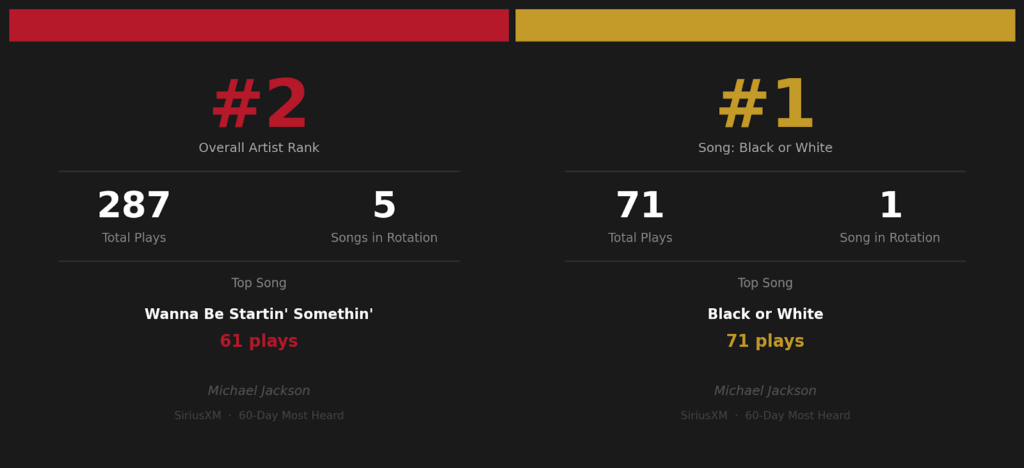
    Over the past 60 days on SiriusXM’s ‘80s on 8, Michael Jackson logged 287 total plays—good enough for #2 overall on the channel, trailing only Journey. Every one of those spins came from a single album era: Thriller (1982). Five songs. One album. The numbers speak for themselves.

    SongYearPlays
    Wanna Be Startin’ Somethin’198361
    Beat It198357
    Billie Jean198357
    P.Y.T. (Pretty Young Thing)198356
    Thriller198456

    Take 1: One Album. Five Titans.

    It’s almost absurd: Jackson’s entire 80s on 8 footprint comes from a single record. No Bad cuts, no Off the Wall holdovers—just five Thriller-era tracks pulling 287 plays between them. That kind of catalog concentration would bury most artists. For Jackson, it barely scratches the surface of what he recorded. It’s a reminder that Thriller wasn’t just a hit album; it was a cultural weather system that 40 years of rotation still hasn’t exhausted. The question for the Jackson estate is why hasn’t “Bad”, which had five number 1 singles, aged as well. Part of it is nostalgia for the “Thriller” era, but you would think some of “Bad” would crack his top 5 songs of the 80’s.

    Take 2: Wanna Be Startin’ Somethin’ Leads the Charge—And That’s Telling

    Most casual listeners would bet on Billie Jean or Beat It as the most-played MJ track. Both are iconic. Both clock in at 57 plays. But it’s Wanna Be Startin’ Somethin’ that sits at the top with 61 spins. The album opener—chaotic, percussive, almost confrontational—turns out to be the 80s on 8 DJ’s first call. It suggests the channel’s audience skews toward energy and nostalgia, not just the singles they know from MTV. Another song, P.Y.T., did not have a video as well.

    Take 3: 287 Plays Is a Pre-Movie Warm-Up, Not a Peak

    Context matters: these 60-day numbers were measured before the film’s release date arrived on the cultural radar. When Lionsgate’s Michael drops, programmers and listeners alike will rediscover the catalog with fresh eyes. Expect these play counts to climb sharply. The 80s on 8 numbers are a baseline—a floor, not a ceiling—for what’s coming.

    ‘90s on 9: One Song, Undeniable

    Michael Jackson’s presence on ‘90s on 9 is intentionally lean—just one track. But “Black or White” (1991) doesn’t feel like an afterthought. With 71 plays over 60 days, it outperforms most artists who placed multiple songs on the same channel—including acts that charted multiple top-15 entries.

    SongYearPlays
    Black or White199171

    Take 1: 71 Plays on One Track Beats Most Multi-Song Artists

    NSYNC placed on the 90s on 9 chart with 78 cumulative plays across multiple tracks. Donna Lewis totaled 80. Black or White, solo, sits at 71—within striking distance of acts who spread plays across entire albums. That kind of per-song efficiency is remarkable. It suggests the 90s on 9 audience isn’t just tolerating MJ’s 90s output; they are actively requesting it.

    Take 2: Black or White Was the Bridge Record—and Listeners Remember

    The Dangerous era (1991) is often framed as a transition: post-Thriller ambition, pre-HIStory turbulence. Black or White was the first single, the statement of intent, and it debuted at #1 in 13 countries. Its 71 plays on 90s on 9 suggest listeners associate the song not just with MJ’s commercial peak but with a specific cultural moment—the fall of the Berlin Wall era, a world that felt optimistic enough to believe in a song about racial unity. That nostalgia is durable.

    Take 3: The 90s Gap Is the Movie’s Biggest Opportunity

    Jackson recorded extensively in the 90s—HIStory, Blood on the Dance Floor, You Are Not Alone, Earth Song, Scream with Janet. None of those appear in the current 60-day window. That’s not a failure; it’s an opening. Could the biopic reintroduces casual fans to the full arc of his career? If it does, the 90s on 9 playlist will need to grow to meet demand. The channel currently has one song to anchor that surge. Programmers should be getting ready.

    The Bigger Picture

    Across both channels, the data tells a coherent story: Michael Jackson’s catalog has maintained a gravitational pull on satellite radio that most artists of any era can’t match. His 80s numbers are elite—287 plays from five songs puts him second only to Journey on a channel full of legitimate icons. His 90s number is a single data point that outperforms artists with fuller playlists. And none of this accounts for the amplification effect that a major studio biopic is almost certain to trigger.

    The movie Michael isn’t creating renewed interest in Jackson’s music. The interest is already there, baked into 60 days of listener data collected quietly on two SiriusXM channels. The film is simply about to give that interest a reason to get louder.

    Data source: SiriusXM ‘80s on 8 and ’90s on 9 — 60-day most-heard tracking.