Category: Legacy Marketing

  • Primary Wave Just Bought Hipgnosis: Why This Deal Matters Far Beyond Album Covers

    Primary Wave announced it has acquired the legendary Hipgnosis artwork catalog — the visual archive behind some of the most iconic album covers in rock history.

    The deal includes Aubrey “Po” Powell’s interests in the Hipgnosis collection, covering artwork tied to artists including Pink Floyd, Led Zeppelin, Black Sabbath, Def Leppard, Queen, Genesis, AC/DC, and more.

    But this is bigger than nostalgia.

    This is a signal that the music business increasingly sees visual identity as part of the monetizable catalog ecosystem.


    What Happened?

    Hipgnosis — the groundbreaking British design studio founded in 1967 by Aubrey “Po” Powell and Storm Thorgerson — revolutionized album artwork by replacing standard band portraits with surreal, conceptual imagery.

    Their work helped define the mythology of rock music itself.

    Primary Wave’s acquisition includes:

    • Rights and interests tied to the Hipgnosis visual catalog
    • Physical objects used in creating the artwork
    • Exhibition opportunities
    • Long-term collaborations with Po Powell
    • Previously unseen archival material

    This wasn’t just buying images.

    It was buying music history as intellectual property.


    3 Takes: What This Means

    1. The Music Industry Is Expanding What Counts as a “Catalog”

    For years, catalog investing meant:

    • Publishing rights
    • Masters
    • Royalty streams
    • Sync revenue

    Now?

    Visual assets are entering the same universe.

    Album covers are no longer just packaging. They’re:

    • Brand assets
    • Licensing assets
    • Merchandise assets
    • Exhibition assets
    • Streaming-era discovery tools
    • Social media visual shorthand

    Think about it:

    • The prism from Dark Side of the Moon
    • The burning man on Wish You Were Here
    • The surreal industrial imagery of classic hard rock albums

    Those visuals are instantly recognizable globally.

    Primary Wave appears to be betting that iconic imagery has enduring commercial value independent of the music itself.


    2. Catalog Companies Want Cultural Ecosystems — Not Just Songs

    This deal shows how modern catalog companies increasingly think like entertainment IP firms.

    Primary Wave isn’t just buying songs anymore. It’s buying:

    • Identity
    • Storytelling
    • Nostalgia
    • Brand mythology
    • Fan emotional connection

    The company specifically mentioned exhibitions and preserving the connection between “sound and image.”

    That’s important.

    The future catalog economy may increasingly look like:

    • Museum experiences
    • Immersive exhibits
    • Documentary licensing
    • Apparel collaborations
    • Coffee-table books
    • Collectibles
    • Digital experiences
    • Premium fan subscriptions

    The catalog business keeps moving closer to Disney-style franchise management.


    3. Rock’s Visual Era Is Becoming Premium Cultural Real Estate

    Hipgnosis helped create the visual language of classic rock during the peak physical-media era.

    In the vinyl era, album covers mattered enormously because fans physically lived with them:

    • Posters on walls
    • Gatefold sleeves
    • Lyric inserts
    • Artwork as ritual

    Streaming reduced some of that physical interaction.

    Ironically, that may make truly iconic artwork more valuable, not less.

    Why?

    Because only a tiny percentage of modern music visuals achieve lasting cultural permanence.

    Classic rock artwork still cuts through instantly in:

    • Documentaries
    • TikTok clips
    • Vinyl reissues
    • Retail displays
    • Streaming thumbnails
    • Nostalgia marketing

    Scarcity matters.

    And Hipgnosis created some of the rarest visual cultural assets in music history.


    Final Thought

    For years, people asked whether music catalogs were overvalued.

    But deals like this suggest the industry is still widening the definition of what a catalog actually is.

    Songs.
    Images.
    Stories.
    Artifacts.
    Mythology.

    The modern catalog business increasingly looks less like royalty collection — and more like long-term cultural asset management.

    And Primary Wave just made a major bet that the visual side of music history still has enormous untapped value.
  • SiriusXM Lithium April 2026 Charts: Nirvana, Green Day, and R.E.M. Dominate the 90s Airwaves

    If you had Lithium on in the car last month, you probably heard a lot of Green Day, R.E.M., and Nirvana — because the data says everyone else did too.

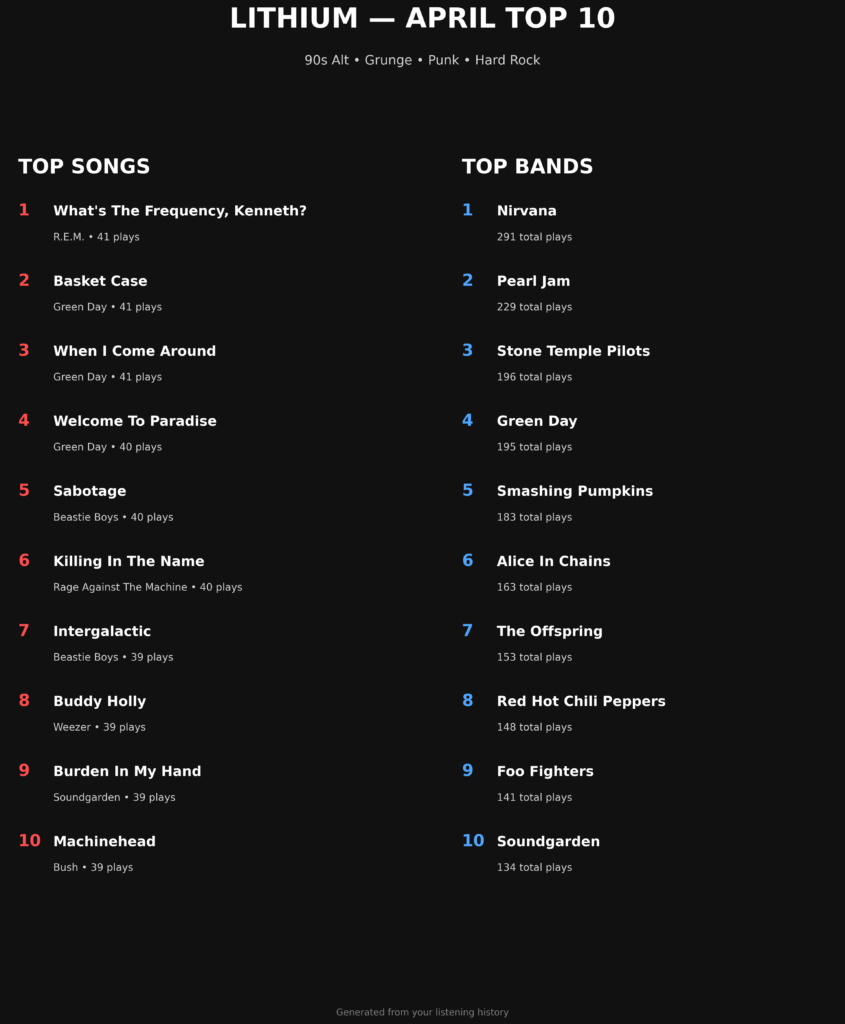
    I pulled the most played songs and bands from Lithium for April 2026. Here’s how it broke down:

    April 2026 Lithium Songs

    The Top 3 were a dead heat:

    1. “What’s The Frequency, Kenneth?” – R.E.M. – 41 plays
    2. “When I Come Around” – Green Day – 41 plays
    3. “Basket Case” – Green Day – 41 plays

    Green Day actually claimed 3 of the top 4 spots, with “Welcome To Paradise” coming in at #4. Rounding out the top 10: Rage Against The Machine, Beastie Boys, Weezer, Stone Temple Pilots, Live, and The Offspring. Peak 90s energy.

    Top 15 Most Played Bands – April 2026

    lithium_top15_bands_april.png

    The Seattle + Cali takeover continues:

    1. Nirvana
    2. Pearl Jam
    3. Stone Temple Pilots
    4. Green Day
    5. Smashing Pumpkins
    6. Alice In Chains
    7. The Offspring
    8. Red Hot Chili Peppers
    9. Foo Fighters
    10. Soundgarden
    11. Weezer
    12. Beastie Boys
    13. R.E.M.
    14. Rage Against The Machine
    15. Live

    Nirvana and Pearl Jam still lead the pack, but STP and Green Day weren’t far behind. Basically, if your band peaked between 1991-1997, you had a good April on Lithium.

  • When NASA Picks Your Song: How “Run to the Water” Saw a 70x Comment Spike After Artemis II

    NASA doesn’t just launch rockets—it can also revive music catalogs.

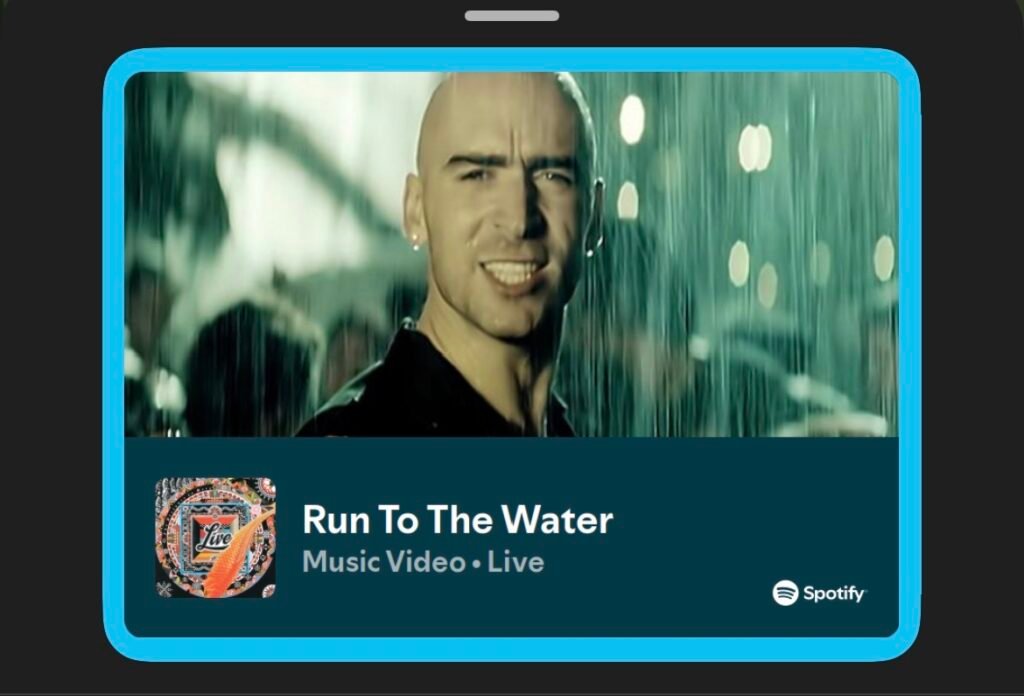
    That’s exactly what happened when the Artemis II crew used “Run to the Water” by Live as a wake-up song during their mission.

    Within days, a YouTube video from 2009 with 19 million views turned into a real-time gathering point for thousands of viewers—many hearing the song for the first time.


    The Data: A Sudden Surge in Engagement

    • Total comments (since 2009): 1,829
    • Historical pace: ~0.31 comments per day
    • Last 3 days: ~70 comments
    • New pace: ~23 comments per day

    Bottom line:

    👉 ~70x increase in daily comment activity

    This isn’t organic growth—it’s a triggered spike tied to a global event.

    Nearly every recent comment references Artemis II, confirming that the surge is driven by discovery, not nostalgia alone.

    Screenshot

    The Comments Tell the Story

    A sample of recent activity shows the pattern clearly:

    • “Here because of Artemis II mission!”
    • “Good morning Artemis II 🚀”
    • “This was the wake-up song on their last day in space”
    • “Millions of people will discover it now”

    This is what catalog owners dream of:
    a cultural moment that redirects attention at scale.


    A Reminder: This Was Always a Global Record

    Originally released in 2000 on Live’s platinum fourth album The Distance to Here, “Run to the Water” had solid but somewhat under-the-radar chart performance.

    The song was not released as a single in the United States, yet still reached:

    • No. 14 – Billboard Modern Rock Tracks
    • No. 17 – Mainstream Rock Tracks

    Internationally, it performed even better:

    • No. 10 – Canada
    • No. 15 – Finland
    • No. 25 – Netherlands
    • No. 34 – Australia
    • No. 44 – New Zealand

    Notably, it reached:

    • No. 1 in Iceland for three consecutive weeks, marking the band’s second straight chart-topper there

    👉 Translation:
    This wasn’t a forgotten song—it was a strong catalog asset waiting for a moment.


    Why This Happens (and Why It Matters)

    Catalog value isn’t just about streams—it’s about moments of rediscovery.

    When a song gets:

    • Placed in a cultural event
    • Associated with a mission or narrative
    • Introduced to a new generation

    …it can behave like a new release again.

    NASA unintentionally created:

    • A global listening event
    • A shared emotional context (space, return, humanity)
    • A discovery funnel into a 25-year-old catalog

    The Bigger Insight for Catalog Owners

    This is the playbook:

    1. Moments > Marketing
      You don’t need a campaign—you need a trigger.
    2. Context Creates Meaning
      A space mission reframes a song instantly.
    3. Dormant Doesn’t Mean Dead
      Catalogs are latent assets waiting for activation.
    4. Attention Can Be Re-Routed
      One decision (a wake-up song) → thousands of interactions

    Final Thought

    Most songs fade into passive streaming ecosystems.

    But every once in a while, something external—
    a film, a meme, a viral clip, or in this case, a NASA mission—
    pulls a track back into the center of attention.

    “Run to the Water” didn’t just get played.

    It got reintroduced to the world.

  • Miles Davis and the New Blueprint for Legacy Catalog Marketing

    Legacy catalog marketing used to be treated as a relatively straightforward exercise. Reissue the music, celebrate the anniversary, maybe place a few ads, and hope a familiar audience returns. That model still exists, but it is no longer enough. In a fragmented media environment, the most effective legacy campaigns do more than remind people that the music exists. They create new entry points into the artist’s world. That is why Miles Davis offers such a useful modern blueprint.

    What makes Miles especially instructive is that the music is only one gateway into the catalog. The artist also carries visual identity, cultural mystique, fashion credibility, historical importance, and an aura of cool that can travel far beyond jazz audiences. When that broader identity is activated well, it can lead people back to the recordings even if the first point of contact was not a song. That is a crucial lesson for anyone thinking about long-term catalog value.

    In the modern attention economy, artists are often rediscovered through image, story, and adjacent culture before they are rediscovered through audio. A younger audience might first encounter Miles Davis through street style content, photography, documentaries, social media clips, or editorial features about his influence and presence. Only then does the listener go back to the music. That path still counts. In fact, it may become increasingly important for older catalogs whose commercial future depends on crossing generational boundaries.

    This changes how rights holders should think about activation. A legacy campaign is not only about pushing streams directly. It is about strengthening the total cultural footprint of the artist. Fashion partnerships, museum-like storytelling, visual retrospectives, curated content, archival releases, interviews, and centennial programming can all build momentum that eventually supports streaming and licensing. Some tactics have an immediate earnings effect. Others work more indirectly by deepening relevance.

    Anniversary years are especially powerful because they create a natural media hook. They give estates, labels, publishers, and partners a reason to coordinate activity around a moment that feels newsworthy. But the strongest campaigns do not rely on the anniversary alone. They use it as a frame for a broader narrative about why the artist still matters now. In other words, the timing helps, but the story has to travel on its own merits.

    Miles Davis also shows the value of professional estate collaboration. Legacy rights are often most effective when the estate and the operating company are aligned on goals, quality, and strategy. That alignment allows activations to feel coherent rather than opportunistic. It helps ensure that commercial moves support, rather than dilute, the artist’s image. In the catalog world, stewardship and monetization are not always in conflict. When done well, they reinforce each other.

    There is also a broader business insight here. Streaming growth for legacy artists does not always come from obvious music-first marketing. Sometimes the path is global, cross-disciplinary, and cumulative. A fashion article, a cultural essay, a documentary mention, a social clip, and a well-timed reissue may each contribute only a little. Together, they create rediscovery. Catalog value often grows through this kind of ecosystem effect rather than one giant switch being flipped.

    For investors and operators, that means legacy value should not be thought of as static. The catalog is not merely sitting there collecting passive nostalgia income. It can be activated through identity, context, and culture. The better the team understands the artist’s broader mythology, the more ways it has to create demand.

    Miles Davis is a strong example because his appeal reaches beyond jazz purists. He represents taste, edge, reinvention, and visual sophistication in addition to musical greatness. That makes him unusually adaptable to modern forms of cultural storytelling. But the underlying lesson extends more broadly. Legacy artists remain economically relevant when rights holders stop treating the catalog as just audio and start treating it as a living brand archive.

    That is the new blueprint for legacy catalog marketing: do not just remind the audience of the songs. Rebuild the world around the artist, create multiple points of entry, and let cultural curiosity pull listeners back into the music. When that happens, streams rise, licensing gets easier, and the catalog becomes active again.

  • 5 Takeaways From Golnar Khosrowshahi’s Billboard’s“On the Record” Interview

    Golnar Khosrowshahi, founder and CEO of Reservoir Media, joined Billboard’s On the Record to discuss where the music catalog market stands in 2026 — and where it’s headed. Here are the five sharpest insights from the conversation.

    Golnar Khosrowshahi
    Golnar Khosrowshahi, CEO of Reservoir Media


    1. Multiples tell the whole story of the boom

    When Reservoir started buying catalogs in 2007, assets traded at just two to four times annual cash flow. Today, the same assets command 15 to 20 times — sometimes more. That shift reflects streaming’s rise from an uncertain experiment to the industry’s dominant revenue engine, turning music IP into a proven, perpetual cash flow asset that institutional investors now eagerly compete for.

    “We certainly saw it as an opportunity — but not through some sort of crystal ball.”


    2. The key valuation question: how long will people care?

    Genre matters in catalog valuation — but not in the way most people assume. The real question buyers ask is how widely a song is listened to, and how long that will last. Classic rock and timeless pop commands premium prices because the music has already proven its staying power across decades. Hip-hop, dance, and even country can fetch strong prices too — but buyers need to believe the music will still resonate in 10, 15, or 20 years.

    “Is it ‘Take Me Home, Country Roads’ — that you will keep listening to forever? Or is it a hit in the moment that won’t sustain that cultural impact two decades from now?”


    3. Relationships — not auctions — drive the best deals

    While the catalog boom brought competitive bidding wars and sky-high auction prices, Reservoir has largely avoided that game. Khosrowshahi says the company executes most of its significant deals off-market, built on long-term relationships with artists, songwriters, lawyers, and managers. That approach — combined with offering ongoing creative services and administration, not just a financial transaction — attracts sellers who care about how their legacy is managed, not just who writes the biggest check.

    “We weren’t really transacting through auction processes. Our business is based on relationships.”


    4. Sync, biopics, and “flipping” songs all move the needle

    A well-placed song in a hit TV show — think Euphoria or Grey’s Anatomy — can reintroduce a catalog to an entirely new generation of listeners. So can a biopic, a fashion collaboration, or a hot new artist sampling an older track. Reservoir knows this firsthand: their ownership of “Ready or Not” (via the Delfonics catalog) has benefited from multiple high-profile interpolations. The challenge, Khosrowshahi notes, is that none of these uplifts can be reliably predicted or baked into a valuation model — they’re upside, not guarantees.

    “There is a group of cornerstone songs that are suitable for this and will continue to have this revival.”


    5. AI is today’s version of the streaming uncertainty — and the principle is the same

    Khosrowshahi draws a direct parallel between the fear around streaming’s rise in the late 2000s and today’s uncertainty around AI-generated music. Her view: the delivery mechanism matters far less than protecting the underlying rights. Whether music is consumed via CD, ringtone, streaming, or some platform that doesn’t yet exist, the business model is fundamentally the same — IP gets licensed and revenue flows from that license. The priority now is ensuring AI-generated music properly compensates the catalogs it trains on.

    “The conduit matters less than the rights protection and the importance of maintaining copyright.”


    Based on Golnar Khosrowshahi’s appearance on On the Record, Billboard’s music industry podcast.