Category: Catalog Market

  • The “Michael” Movie Isn’t a Film—It’s a Catalog Activation Engine

    There are moments in the music business where the signal is so obvious, you either see it—or you miss the entire game.

    This is one of those moments.

    As first reported by Roger Friedman, the “Michael” film is tracking toward $12.5 million in preview revenue—despite functioning less like a traditional biopic and more like a concert experience.

    That detail matters.

    Because this isn’t a movie story.

    It’s a catalog story.


    This Isn’t a Film. It’s a Demand Shock.

    Audiences aren’t passively watching.

    They’re:

    • Dressing like Michael Jackson
    • Dancing in theaters
    • Treating screenings like The Rocky Horror Picture Show-style events

    That’s not entertainment.

    That’s participation.

    And participation is the highest form of catalog engagement.


    The Data Just Confirmed It

    You don’t have to guess what’s happening.

    Amazon’s real-time Top 50 CDs & Vinyl tells the story.

    Key Observations from the Current Chart

    From your dataset:

    • Thriller#2 overall
    • Off the Wall → Top 15
    • Bad → Top 20
    • Number Ones → also charting

    At the same time:

    • Legacy giants dominate:
      • Abbey Road
      • The Dark Side of the Moon
      • Rumours
      • Legend
    • And critically:
      • Greatest hits packages everywhere

    The Hidden Pattern: Catalogs Cluster

    This is the part most people miss.

    When one Michael Jackson album moves…

    → The entire catalog moves.

    That’s exactly what we’re seeing:

    • Thriller pulls attention
    • Off the Wall captures spillover
    • Bad benefits downstream
    • Compilations monetize casual demand

    This is not random.

    This is catalog clustering behavior.


    The Most Important Insight: New Music Is Losing the Battle

    Look at the same chart again.

    Yes, there are new releases:

    • Noah Kahan
    • Olivia Dean
    • Ringo Starr

    But what dominates?

    Proven catalogs.

    Even more telling:

    The “Michael” soundtrack is not leading the charge.

    That’s the punchline.

    The activation event drives listeners backward, not forward.


    Why This Matters for Catalog Investors

    If you’re valuing music assets today, this is your model:

    1. Activation > Creation

    You don’t need new hits.

    You need:

    • Cultural moments
    • Narrative triggers
    • Distribution events

    2. Emotional Memory Compounds Value

    The reason this works:

    People don’t consume Michael Jackson as music.

    They consume him as:

    • Memory
    • Identity
    • Experience

    That’s why accuracy doesn’t matter.


    3. Physical Formats Are a Signal, Not a Relic

    This Amazon chart is CDs and vinyl.

    That matters.

    Physical purchases represent:

    • Intentional demand
    • Higher-margin fandom
    • Collector behavior

    This is your high-conviction audience.


    The Bigger Take: Catalogs Are Experience Engines

    The biggest mistake in music investing is thinking you’re buying songs.

    You’re not.

    You’re buying:

    • A fan behavior loop
    • A repeatable activation system
    • A cultural asset that can be re-triggered

    The “Michael” film is just the latest trigger.


    Final Take: This Is What $12.5M Really Means

    That preview number isn’t about box office.

    It’s about elastic demand for elite catalogs.

    It proves:

    • Fans will re-engage regardless of format quality
    • Legacy hits outperform new releases under pressure
    • Catalog value is driven by activation—not perfection

    And most importantly:

    The best catalogs don’t need to evolve.
    They just need to be turned back on.
  • “Run to the Water” Quietly Outperforms Live’s Spotify Catalog After Artemis II NASA Moment

    Sometimes the story isn’t in the headline numbers. It’s in the small movements that don’t look like much—until you compare them.

    That’s what’s happening right now with “Run to the Water” by Live.

    Live currently sits at around 3.7 million monthly listeners on Spotify. That’s a stable, active catalog. Not surging, not declining—just sitting in that middle ground where most legacy bands live.

    Which is exactly why this matters.

    See our follow up story on “Run to the Water”


    A Small Moment… With Real Movement

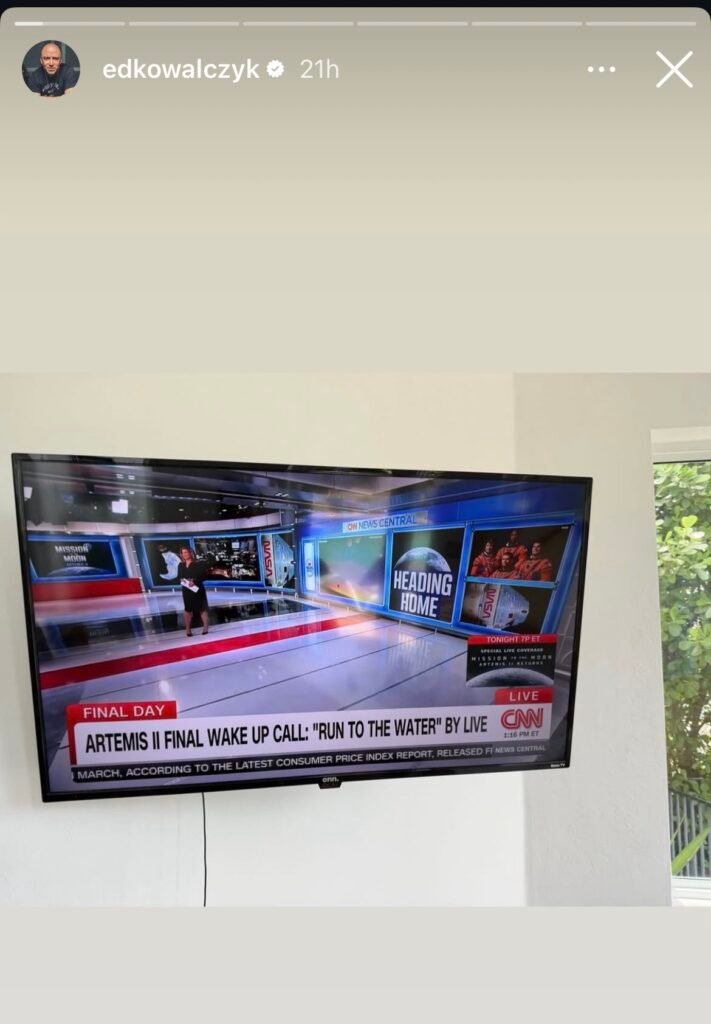
    Recently, NASA used “Run to the Water” as part of the wake-up sequence for Artemis II.

    On its own, that’s just an interesting cultural note.

    But when you look at what happened next, the data tells a more interesting story.

    “Run to the Water” didn’t just rise—it outperformed comparable songs in Live’s Spotify Top 10 by roughly 3–4x on a percentage basis over the same period.

    Ed Kowalcyzyk Instagram

    Not the biggest hit. Not the most played.

    But the fastest moving.


    From #9 to #7 — And Why That’s Not Nothing

    The song, written by Ed Kowalczyk and Patrick Dahlheimer, also moved from #9 to #7 in Live’s top tracks.

    That kind of shift doesn’t usually happen randomly in a mature catalog. These rankings tend to be sticky.

    So when something moves, even a couple spots, it’s worth paying attention.

    Because what it suggests is simple:

    Listeners are choosing this song more often relative to the rest of the catalog.

    Not just hearing it—selecting it.


    What We’re Watching

    Right now, this is a signal—not a breakout.

    But it’s the kind of signal that can turn into something if it continues.

    We’ll be watching whether:

    • “Run to the Water” continues to outperform other Top 10 tracks
    • it climbs further up the rankings
    • and whether Live’s 3.7 million monthly listeners begins to tick upward

    If that listener number moves, even modestly, it suggests this isn’t just internal rotation—it’s new attention entering the system.


    The Bigger Idea

    Catalog growth rarely shows up all at once.

    It starts like this:
    a moment, a placement, a small shift in behavior.

    Then you get relative outperformance.

    Then, sometimes, it compounds.

    Most of the time it fades.

    But every now and then, it doesn’t.


    Final Thought

    “Run to the Water” isn’t a hit again. Not yet.

    But it’s doing something more important:

    It’s outperforming its peers.

    And in catalog analysis, that’s usually where the story starts.

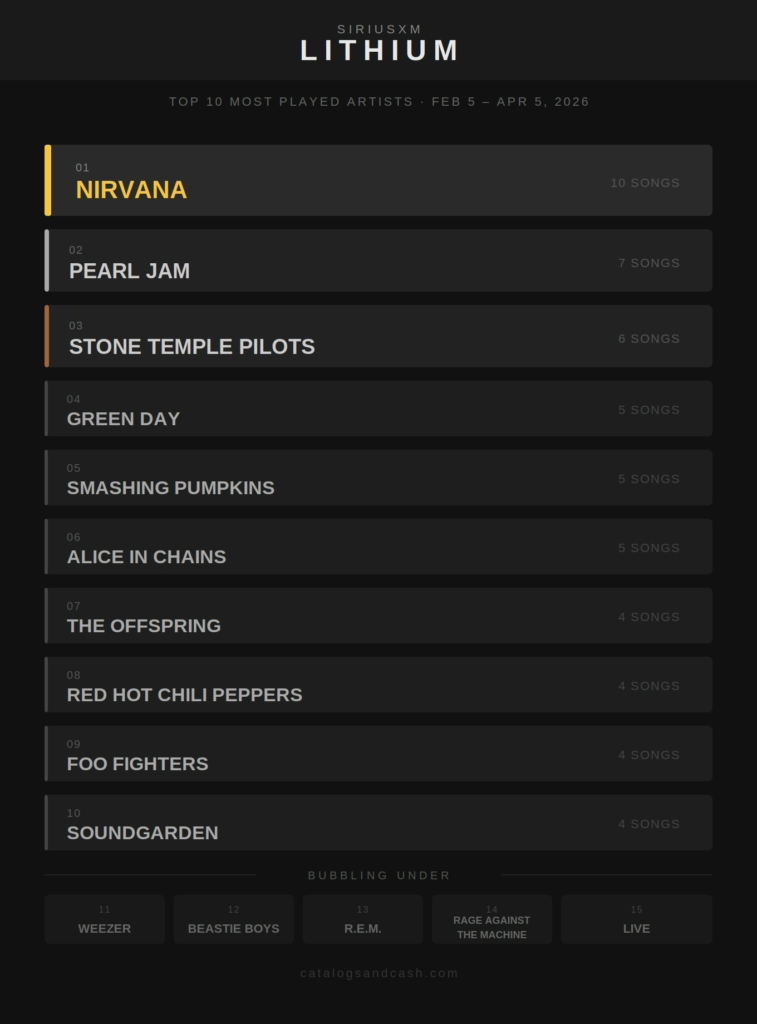
    Live currently is in the Top 15 artists played on SiriusXM Lithium from Feb 5-April 5 2026.

  • What the De La Soul catalog story teaches us about uncleared samples and digital distribution

    For years, De La Soul’s pioneering catalog was effectively invisible to an entire generation of listeners — absent from every streaming platform because of uncleared samples buried in the music. Golnar Khosrowshahi, founder and CEO of Reservoir Media, shares what it took to finally bring it online in her appearance on Billboard’s On the Record.


    1. Uncleared samples can lock an entire catalog off streaming platforms

    When Reservoir acquired the Tommy Boy Records catalog in June 2021, one of the most urgent priorities was De La Soul’s music, which had never been available on digital streaming platforms due to uncleared samples embedded throughout their recordings. The group were pioneers of hip-hop’s golden era and among the most critically lauded artists in the genre’s history — yet an entire generation of listeners had no easy way to access their music. Every uncleared sample was a legal liability that had to be resolved before a single track could go live.

    “We purchased Tommy Boy in June of 2021. The first call was to them — and then we spent 18 months clearing the samples.”


    2. Sample clearance is one of the most labor-intensive processes in the business

    The 18-month clearance process for the De La Soul catalog was run on Excel spreadsheets, weekly phone calls, and extensive human coordination — tracking down rights holders, negotiating terms, and documenting every cleared sample one by one. For a catalog as sample-dense as De La Soul’s, this was an enormous undertaking. It required Reservoir to trace the ownership of dozens of interpolated recordings, often across multiple rights holders, label mergers, and estate arrangements. The complexity is a window into why so many catalogs with uncleared samples simply sit in limbo rather than getting resolved.

    “It was run on an Excel spreadsheet with weekly phone calls and a lot of human interaction and recall — an 18-month exercise to get the music ready for the first time on digital platforms.”


    3. Clearing samples can unlock enormous additional value

    Getting De La Soul’s music onto streaming platforms was not just a logistical achievement — it was a commercial one. Once the catalog was live, it was eligible for sync licensing opportunities that had previously been off the table. One of the first to materialize: “3 Is the Magic Number” appearing in the credits of Spider-Man in November, just weeks before Reservoir released the first De La Soul single in January 2023 and the full catalog on March 3rd. A song that had been stuck in legal limbo suddenly had one of the biggest possible promotional platforms in the world.

    “That opened up licensing for ‘3 Is the Magic Number’ in the credits of Spider-Man — which happened the November before we released the music.”


    4. The human cost was devastating — and the timing made it worse

    The clearance work and the eventual streaming release were meant to be a triumphant moment for De La Soul — a long overdue recognition of their legacy and a chance for the three members to finally see their music reach the audience it deserved. Instead, founding member Dave Jolicoeur passed away just weeks before the catalog went live, leaving the group and the Reservoir team to navigate the release in the shadow of grief. For Khosrowshahi, the loss was not primarily a business setback — it was a deeply personal one.

    “What made me the most sad was that they wouldn’t enjoy this moment together, the three of them — with their families. It was going to be such an important moment for them.”


    5. AI could transform sample clearance — and the implications are significant

    Khosrowshahi reflects that the same 18-month clearance process, if undertaken today with AI-assisted tools, could potentially be compressed to a fraction of the time. Sample identification, rights chain research, and clearance tracking are exactly the kinds of repetitive, data-intensive tasks that AI tools are rapidly improving at. For catalog owners sitting on music with uncleared samples, this is potentially transformative: value that has been locked away for legal reasons may become accessible far more quickly and cheaply than it would have been just a few years ago.

    “I wonder if 18 months would be one month — because we would be able to use AI tools to help us clear the samples.”


    Based on Golnar Khosrowshahi’s appearance on On the Record, Billboard’s music industry podcast.

  • How sync licensing really works — and why a TV placement can change a song’s value overnight

    A single TV placement can send a decades-old song to the top of streaming charts overnight. Golnar Khosrowshahi, founder and CEO of Reservoir Media, explains how sync licensing actually works — and why it’s one of the most powerful and unpredictable forces in the catalog market — in her appearance on Billboard’s On the Record.


    1. Sync is the most powerful discovery engine in the industry

    When a song lands in the right scene of the right show at the right moment, it can introduce that music to an entirely new generation of listeners who had never heard it before. Grey’s Anatomy pioneered this in the mid-2000s, becoming not just a hit drama but a genuine music discovery platform — to the point where landing a placement on the show became an explicit goal for songwriters. Euphoria carried that torch into the streaming era, pairing emotionally charged scenes with carefully curated music that sparked streaming spikes and cultural conversations.

    “Grey’s Anatomy really started this trend of not only being a show everyone was glued to, but being a place where people were discovering music.”


    2. The streaming uplift is real but varies enormously

    Not every placement creates the same effect. A song featured in a pivotal season finale of a culturally dominant show will generate a very different response than background music in a mid-season episode. Khosrowshahi points to Sinead O’Connor’s “Drink Before the War” — a Reservoir catalog asset — which was featured in a key scene of Euphoria Season 2 and drove meaningful renewed interest in O’Connor’s catalog. Shows that have built a reputation for sophisticated musical taste, where audiences actively seek out the soundtrack, consistently deliver stronger and more durable uplifts.

    “Euphoria has captured this persona of having sophisticated musical taste and being very deliberate about the music — and people are still seeking gatekeepers like that.”


    3. Biopics are the ultimate sync play for catalog owners

    A well-made biopic does what no single TV placement can: it immerses an audience in an artist’s entire story and catalog for two hours, then sends them to streaming platforms to explore further. The Johnny Cash biopic was a landmark moment for catalog revival. More recently, the Bob Dylan biopic — with Timothée Chalamet in the lead — represents the same opportunity at enormous scale. Khosrowshahi sees the surge in music biopics as partly driven by catalog owners who now have both the financial resources and the incentive to fund or facilitate these projects.

    “More liquidity and bigger budgets enable either rights holders or filmmakers adjacent to music companies to underwrite these projects — that’s why you’re seeing more of them.”


    4. Some music simply cannot be synced — and that has a cost

    Sync licensing requires clean rights and content that advertisers and studios are willing to associate their brand or project with. Music with heavy use of expletives, uncleared samples with multiple credited writers, or complicated rights chains is effectively locked out of much of the sync market. For catalog buyers evaluating a potential acquisition, the sync ceiling is a material part of the valuation. A catalog that has historically said no to licensing — or that simply can’t be cleared — is worth materially less than one that is open and accessible.

    “You could have music that has historically just said no to licensing — that creates a whole bunch of opportunity. Or music with uncleared samples that can’t easily be licensed at all.”


    5. You can’t engineer a sync moment — but you can position for one

    The most valuable sync placements are the ones that emerge organically from a music supervisor genuinely falling in love with a song for a specific scene. They cannot be bought or manufactured. What catalog owners can control is making sure their music is in front of as many supervisors as possible, that the rights are clean and quick to clear, and that the catalog is actively maintained and promoted. The placement itself is unpredictable; the preparation for it is not.

    “Our sync team is very aware of what the trends are and what the licensing future looks like — is this something we think we can do better marketing to the music supervisors in our database?”


    Based on Golnar Khosrowshahi’s appearance on On the Record, Billboard’s music industry podcast.

  • Why genre matters (and doesn’t) when selling your music catalog

    Ask most people which genre commands the highest prices in the catalog market and they’ll say classic rock. They’re not wrong — but they’re not exactly right either. Golnar Khosrowshahi, founder and CEO of Reservoir Media, offers a more nuanced take on her appearance on Billboard’s On the Record.


    1. Genre is a proxy for the question buyers actually care about

    Catalog buyers don’t value genre for its own sake. What they’re really evaluating is how widely a song is listened to and how long that appeal is likely to last. Classic rock tends to score well on both dimensions — hence the premium prices — but the underlying logic applies across every genre. A country artist with four decades of proven radio presence is a fundamentally different investment proposition than a dance artist whose biggest hits came out three years ago, regardless of genre.

    “I would break it down as: how widespread is the listenership and how long is that going to last? At what rate is the revenue on this music going to decay?”


    2. Longevity is the real premium, not genre

    There is a finite group of artists and songwriters across every genre who will command truly elite catalog prices. What they share is not a sound or a style — it’s the proven ability to remain culturally relevant long after their peak commercial moment. “Take Me Home, Country Roads” is licensed constantly, covered endlessly, and embedded in American culture in a way that generates consistent revenue decade after decade. That kind of staying power is what justifies a premium multiple, whether the music is country, jazz, pop, or soul.

    “There is a finite group of artists and songwriters across genre who will command that premium — and everything else comes down to what this will be worth in 10, 15, 20 years.”


    3. Hip-hop and dance face real headwinds in sync licensing

    One area where genre genuinely creates friction is sync licensing — the placement of music in films, TV shows, and advertisements. Music with heavy use of expletives or that relies on uncleared samples from other recordings is simply harder to license for these purposes. Advertisers need clean clearances; film and TV supervisors need straightforward rights chains. That doesn’t make hip-hop or dance catalogs worthless — but it does reduce the ceiling on one of the most lucrative revenue streams available to catalog owners.

    “We are going to be more or less optimistic on film and TV sync if we’re looking at music filled with expletives. That’s not going to be easy.”


    4. Geography creates unexpected opportunities

    The catalog market is global, and listener behavior doesn’t always follow obvious patterns. Miles Davis is enormously popular in Japan and France. Country music has a passionate following in France. These cross-cultural affinities can meaningfully expand the revenue base for catalogs that might otherwise seem niche — and they’re easy to overlook if you’re only thinking about domestic streaming numbers when running your valuation.

    “There are pockets of genre-geography marriages that are very, very surprising. Country music is very popular in France.”


    5. The real risk is music that was big in the moment but won’t last

    Every era produces songs that feel culturally definitive at the time but fade quickly from the cultural conversation. Catalog buyers are acutely aware of this risk. A song can be a genuine #1 hit, a genuine cultural moment, and still not be worth much as a catalog asset if there’s no reason to believe people will still be listening to it in 2040. The question isn’t whether a song was important — it’s whether it’s durable.

    “Some hits don’t really stick around. They could be a culturally defining moment — but that doesn’t mean they will sustain that cultural impact two decades from now.”


    Based on Golnar Khosrowshahi’s appearance on On the Record, Billboard’s music industry podcast.

  • Taylor Swift, Big Machine, and Shamrock: what the catalog sale taught the industry

    No catalog sale in history generated more public attention than when Big Machine Records sold Taylor Swift’s master recordings to Shamrock Holdings. Golnar Khosrowshahi, founder and CEO of Reservoir Media, reflects on what the saga actually taught the music business in her conversation on Billboard’s On the Record.


    1. It exposed the gap between financial investors and music companies

    The sale drew a sharp public line between two very different kinds of buyers operating in the catalog market. On one side: financial investors like Shamrock whose primary interest is cash flow acquisition and return on investment. On the other: music companies and labels with active platforms, artist relationships, and a long-term stake in how a catalog is managed. Most catalog deals happen quietly between industry insiders. This one played out in public, and it forced a mainstream audience to reckon with the fact that music rights can change hands without an artist’s involvement or consent.

    “It started to shed light on this bifurcation — those with platforms who are in the business of preserving legacies, and those in the business of cash flow acquisition.”


    2. The deal structure Swift signed was standard at the time — and that’s the point

    Swift was a teenager when she signed with Big Machine. Under the terms of her deal, as was typical for record contracts of that era, the label retained ownership of her master recordings. There was nothing unusual or predatory about the arrangement by the standards of the time — which is precisely what made it such a powerful moment for public education. Millions of people who had never thought about music rights suddenly understood that an artist could pour years of creative work into recordings they don’t own.

    “It was within Big Machine’s right to do with the catalog what they wanted to. That situation put a spotlight on the fact that Taylor Swift did not own her own masters.”


    3. Re-recording only worked because of who she is

    Swift’s decision to re-record her entire back catalog as “Taylor’s Version” was audacious — and it worked. Fans switched en masse to the new recordings, effectively diminishing the commercial value of the originals. But Khosrowshahi is clear-eyed about why: Swift had spent years building one of the most devoted fan bases in music history, and she had the direct relationship with those fans to make her case and be believed. Almost no other artist could pull off the same move. The lesson isn’t that re-recording is now a viable weapon for any artist — it’s that it was viable for her specifically.

    “That artist has completely changed the structure of how you connect with your fan base. She’s already talking to an existing group of people who are just out there supporting her.”


    4. It accelerated the shift to more artist-friendly deal structures

    In the wake of the Swift situation, major labels began adding re-recording restriction clauses to new contracts — but they also began offering more favorable ownership terms to attract and retain artists. Today it is increasingly common for artists to receive deals where ownership reverts to them after a set period, or where they retain a meaningful equity stake from the outset. The next generation of catalog sellers will be artists who actually own or co-own their masters — a very different market dynamic from the one that existed when Reservoir started.

    “Nowadays we’re seeing much more artist-friendly deals — artists getting record deals where ownership reverts to them, or they get to own 50% of it.”


    5. The broader catalog market barely felt a ripple

    For all the public drama, Khosrowshahi says Reservoir felt no direct impact from the Swift situation on its own deal flow or valuations. The catalog market was already heating up for structural reasons — streaming growth, institutional capital, and a finite supply of premium assets. The Swift saga added mainstream visibility and public education, but the underlying market dynamics were already well in motion. If anything, the attention it brought helped normalize catalog investing as a concept for a wider pool of potential buyers and sellers.

    “We didn’t feel any impact. It was a perfect storm of who was involved and the impact on someone with such a huge fan base.”


    Based on Golnar Khosrowshahi’s appearance on On the Record, Billboard’s music industry podcast.

  • Why Artists Should Treat Their Music Catalog Like a Family Business

    There’s a quiet shift happening in the music industry — and most artists are missing it.

    For decades, the dream was simple: write great songs, get famous, and eventually cash out. Sell the catalog, take the money, and move on.

    But that model is starting to look short-sighted.

    Because a music catalog isn’t just a collection of songs.

    It’s a cash-flowing asset. A brand. A long-term business.

    And the artists who understand that are starting to think very differently.


    🎸 The Old Model: Build, Peak, Sell

    Historically, artists treated their catalog like a final paycheck.

    You build value over time:

    • Release albums
    • Generate hits
    • Accumulate royalties

    Then one day, you sell:

    • Private equity firm
    • Music publisher
    • Label-backed fund

    We’ve seen this play out again and again:

    • Bob Dylan sells publishing
    • Bruce Springsteen sells masters
    • Stevie Nicks sells catalog stake

    From a financial perspective, it makes sense:

    • Immediate liquidity
    • Risk transfer
    • Estate simplicity

    But here’s the problem:

    You’re selling the one asset that can pay you — and your family — forever.


    💰 The New Reality: Catalogs Are Perpetual Cash Machines

    Streaming changed everything.

    In the past, revenue was front-loaded:

    • Album sales
    • Radio play
    • Touring cycles

    Now, catalogs generate ongoing, compounding income:

    • Spotify / Apple Music streams
    • YouTube monetization
    • Sync licensing (film, TV, ads)
    • Algorithmic discovery

    A song released 30 years ago can still produce meaningful revenue today — sometimes more than when it was released.

    That’s why albums like:

    • Legend
    • Greatest Hits

    continue to generate millions annually.

    These aren’t just albums anymore.

    They’re income-producing portfolios.


    🧠 The Mental Shift: From Artist to Asset Owner

    This is where things get interesting.

    The artists who win long-term don’t just think like creators — they think like owners.

    Instead of asking:

    “How much can I sell this for?”

    They ask:

    “How much can this generate over 30–50 years?”

    That’s a completely different mindset.

    It’s closer to:

    • Real estate investing
    • Dividend stocks
    • Private equity hold strategies

    And it leads to a different conclusion:

    Selling your catalog might be the least optimal move.


    🏛️ The Family Business Model

    Think about a music catalog like a family-owned company.

    You wouldn’t sell a profitable business that:

    • Requires minimal overhead
    • Generates recurring revenue
    • Appreciates over time

    You’d:

    • Protect it
    • Grow it
    • Pass it down

    Music catalogs work the same way.

    A well-managed catalog can:

    • Fund education for future generations
    • Provide consistent income
    • Increase in value as platforms expand

    A hit song isn’t just a moment. It’s an annuity.


    ⚖️ Why Some Artists Still Sell

    To be fair, selling isn’t always wrong.

    There are legitimate reasons:

    • Estate planning complexity
    • Tax optimization
    • Lack of management infrastructure
    • Desire for immediate liquidity

    But increasingly, those decisions are being made under pressure from:

    • Private equity firms
    • Catalog aggregators
    • Institutional buyers

    And those buyers are betting on one thing:

    That the catalog is worth more in the future than what they’re paying today.


    🎯 The Strategic Alternative: Partner, Don’t Sell

    Instead of selling outright, artists have more options than ever:

    • Partial sales (retain control)
    • Joint ventures (share upside)
    • Administration deals (outsource management)
    • Licensing optimization (increase revenue without selling)

    This is where the smartest artists are going.

    They’re treating their catalog like:

    A business to operate — not an asset to exit.


    🔥 The Hidden Opportunity

    Here’s the bigger picture — and it’s where things get really interesting.

    Most artists are:

    • Undermanaging their catalog
    • Undermonetizing their rights
    • Ignoring long-tail value

    Which means there’s a massive opportunity for:

    • Consultants
    • Analysts
    • Operators

    To step in and treat catalogs like:

    • Data assets
    • Financial instruments
    • Strategic businesses

    🟡 Final Thought

    For years, the industry taught artists to chase hits.

    But the real game isn’t hits.

    It’s ownership.

    A catalog isn’t a payday. It’s a dynasty.

    And the artists who understand that will build something far more valuable than a moment of success.

    They’ll build something that lasts.

  • What is a music catalog multiple? How catalog valuations actually work

    Every music catalog deal comes with a number attached — sometimes eye-watering ones. But what does that number actually represent? Golnar Khosrowshahi, founder and CEO of Reservoir Media, pulls back the curtain on how catalog valuations really work in her conversation on Billboard’s On the Record.


    1. The multiple is just a way of pricing future cash flow

    A catalog’s value starts with one number: how much cash it generates each year. Buyers then apply a multiple to that figure to determine what they’re willing to pay today in exchange for those future earnings. A catalog generating $1 million annually at a 15x multiple would sell for $15 million. The multiple reflects how confident the buyer is that the cash flow will hold — or grow — over time. Higher confidence in longevity means a higher multiple.

    “The multiple is essentially valuing what the future cash flow is — you are paying two times that gross profit line, or today anywhere from 15 to 20 times.”


    2. Multiples have exploded since the early days

    When Reservoir started acquiring catalogs in 2007, assets were trading at just two to four times annual cash flow. The market was depressed by piracy fears and deep uncertainty about whether streaming would ever work. As streaming matured and proved it could grow music industry revenues sustainably, buyer confidence surged. By the peak of the boom, top-tier catalogs were trading at 15 to 20 times — and marquee assets like Bruce Springsteen’s or Bob Dylan’s catalog commanded even more. That’s a tenfold increase in how much buyers were willing to pay for the same underlying asset.

    “In 15 years, that 2, 3, 4 times multiple you’re paying today is going to translate into a 20 times multiple for that same asset.”


    3. Due diligence goes far beyond the headline number

    Arriving at the right multiple requires deep investigation into a catalog’s history. Buyers examine what percentage of revenue comes from licensing versus streaming, whether sync opportunities have been actively pursued or left on the table, whether any samples are uncleared, and whether the music has simply been neglected. A catalog that has never been properly administered may look undervalued on paper but actually represent a major opportunity — or a major headache, depending on what’s lurking beneath the surface.

    “Has the music been neglected? Maybe it was just collecting dust. Or maybe you’re buying a catalog that has been maximized. We’re certainly not going to say ‘we’ll do 20% better’ — because that’s just not always true.”


    4. Genre, longevity, and sync potential all feed into the number

    Not all cash flows are created equal. Buyers discount future revenue more heavily if they believe a catalog’s appeal will fade. A classic rock catalog from the 1970s carries a very different risk profile than a hip-hop catalog from 2015 — not because one genre is inherently better, but because the older catalog has already proven it can sustain listener interest across decades. Sync potential also factors in: music filled with expletives or uncleared samples simply cannot be licensed to advertisers or film and TV, which reduces the ceiling on future revenue.

    “What is this going to be worth in 10 years, in 15 years, in 20 years? Are we still going to be able to license ‘Take Me Home, Country Roads’ to Google? Yes.”


    5. The unpredictable uplifts are upside, not assumptions

    A well-placed sync in a hit TV show, a biopic, or a viral TikTok moment can dramatically increase a catalog’s streaming numbers overnight. Buyers know this happens — but they cannot reliably model it. Responsible valuation treats these events as potential upside rather than baking them into the base case. The core multiple is built on what a catalog demonstrably earns today; everything else is a bonus that makes the investment more attractive in hindsight.

    “You just wing it — there’s so much that goes into valuing a catalog, but you cannot account for those random blips on the radar that are really positive.”


    Based on Golnar Khosrowshahi’s appearance on On the Record, Billboard’s music industry podcast.

  • Most Played Artists on SiriusXM Lithium Feb 5-April 5 2026

    Based on the Top 100 songs played.

    3 Takeaways

    Nirvana’s catalog is still untouchable. Even more than 30 years after Kurt Cobain’s death, Nirvana placed 10 songs in the Top 100 — more than any other artist — making them the undisputed kings of SiriusXM Lithium’s Feb–April 2026 chart period.

    Seattle ruled the 90s, and it still rules the airwaves. Four of the Top 10 artists — Nirvana, Pearl Jam, Alice In Chains, and Soundgarden — are products of the Pacific Northwest grunge explosion. That’s half the chart, 30 years later.

    Depth beats hits. The artists at the top didn’t just have one or two massive singles — they had catalogs. Pearl Jam, Stone Temple Pilots, and Green Day each placed 5–7 songs, proving that on a channel like Lithium, album cuts and deep tracks matter just as much as the radio staples.

  • Masters vs. publishing rights: what’s the difference and which is more valuable?

    If you’ve ever read a headline about a music catalog sale and wondered exactly what was bought and sold, you’re not alone. Golnar Khosrowshahi, founder and CEO of Reservoir Media, broke down the distinction clearly in her appearance on Billboard’s On the Record — and the difference matters more than most people realize.


    1. Masters and publishing are two completely separate assets

    When an artist records a song, two distinct sets of rights are created. The master recording — the actual audio file you hear on Spotify — is typically owned by the record label that funded the recording. The publishing rights cover the underlying composition: the melody and lyrics written by the songwriter. These can be owned by a publisher, the artist themselves, or split between multiple parties. Every catalog deal involves one, the other, or both — and the price reflects which rights are actually on the table.

    “You can sell your publishing, which is the songwriting rights. Those are two different things — masters versus publishing. A lot of people want one or the other or both.”


    2. Publishing has historically been the safer bet

    In the early days of the catalog market, publishing rights were considered far less risky than masters. Masters required active marketing investment — vinyl releases, promotion, physical product — while publishing generated royalties more passively every time a song was performed, streamed, or licensed. For investors who wanted steady income without operational complexity, publishing was the cleaner bet. Today, Khosrowshahi says the two asset classes trade at roughly equivalent multiples — but the underlying operational demands remain very different.

    “In the early days, the publishing was far less risky. Today I would tell you that these assets are trading at par.”


    3. Owning masters means running an active business

    Buying master recordings isn’t a passive investment. It comes with real operational responsibilities: releasing vinyl, running marketing campaigns, pitching music supervisors, and managing a recorded music roster. Reservoir maintains entirely separate teams for its publishing and recorded music businesses precisely because the work is so different. Anyone looking to acquire masters needs to honestly assess whether they have the infrastructure and expertise to actively manage that catalog — or whether they’re better suited to the publishing side.

    “Publishing is more like ‘I want checks to come in the mail.’ Masters are ‘I’m out there, I want to market, I want to make it more valuable.’”


    4. Who owns the other side of the rights matters too

    If you buy publishing rights to a song, you’re now in a long-term relationship with whoever owns the masters — and vice versa. Khosrowshahi says Reservoir always investigates this before closing a deal. Are the masters owned by a major label with resources to keep marketing the music? Or are they sitting with a smaller label that may not be around in five years? The quality and commitment of the party controlling the other set of rights has a real impact on how much value a catalog can generate over time.

    “We definitely look at who owns the masters — are they going to keep doing any job? Because that’s what you really want to know.”


    5. Taylor Swift’s situation clarified everything for a mainstream audience

    When Big Machine Records sold Taylor Swift’s master recordings to Shamrock Holdings without her consent, millions of people suddenly understood — viscerally — why the masters vs. publishing distinction matters. Swift had signed her deal as a teenager, which was standard practice at the time: the label funded the recordings and retained ownership. Her decision to re-record her entire back catalog as “Taylor’s Version” was an unprecedented response, and it accelerated a broader industry shift toward more artist-friendly deal structures where ownership eventually reverts to the artist or is shared from the outset.

    “That situation really put a spotlight on the fact that Taylor Swift did not own her own masters — and nowadays we’re seeing much more artist-friendly deals at these record labels.”


    Based on Golnar Khosrowshahi’s appearance on On the Record, Billboard’s music industry podcast.